Mechanical Basics Explained
Introduction to Forces
The Push and Pull of the World
In physics, a force is simply a push or a pull on an object. It’s what makes things move, stop moving, or change direction. When you kick a ball, you apply a force. When you pick up a bag of groceries, you apply a force. Even when you’re just standing still, forces are at work all around you and inside you.
Force
noun
A push or a pull on an object resulting from the object's interaction with another object.
Forces have both a size (or magnitude) and a direction. It matters not just how hard you push something, but also which way you push it. The standard unit for measuring the magnitude of a force is the Newton, abbreviated as N. It's named after Sir Isaac Newton, whose work laid the foundation for our understanding of forces and motion.
Forces in Everyday Life
We experience different kinds of forces all the time, even if we don't notice them. Let's break down a few of the most common ones.
Gravitational Force: This is the force of attraction between any two objects with mass. The more massive the objects and the closer they are, the stronger the gravitational pull. The force that keeps your feet on the ground is the gravitational pull between you and the Earth. We often call this force 'weight'.
Normal Force: When an object rests on a surface, the surface pushes back on the object. This support force is called the normal force. It acts perpendicular (or 'normal') to the surface. For a book resting on a table, the table exerts an upward normal force that balances the downward force of gravity, keeping the book from falling through.
Frictional Force: Friction is the force that opposes motion when two surfaces slide against each other. It's why you have to keep pushing a heavy box to slide it across the floor. Without friction, the world would be a very slippery place. It allows us to walk, and it's what makes car brakes work.
Tension Force: This is the pulling force transmitted through a string, rope, cable, or chain. When you pull a wagon by a rope, the force you apply is transferred to the wagon as tension in the rope. A lamp hanging from the ceiling is held up by the tension in its cord.
Newton's Laws of Motion
Isaac Newton formulated three fundamental laws that describe how forces affect motion. These laws are the bedrock of classical mechanics.
First Law: The Law of Inertia An object will stay at rest or continue moving at a constant velocity unless an outside force acts on it.
This law introduces the concept of inertia, which is an object's resistance to a change in its state of motion. The more mass an object has, the more inertia it has. Think about being in a car that stops suddenly. Your body continues to move forward because of its inertia. That's why seatbelts are so important; they provide the outside force needed to slow you down with the car.
Second Law: Force Equals Mass Times Acceleration The acceleration of an object is directly proportional to the net force acting on it and inversely proportional to its mass.
This is often summarized by the famous equation:
Here, is the net force, is the mass of the object, and is its acceleration. This means if you push two objects with the same force, the one with less mass will accelerate more. It's easier to get a bicycle moving quickly than a car because the bicycle has much less mass.
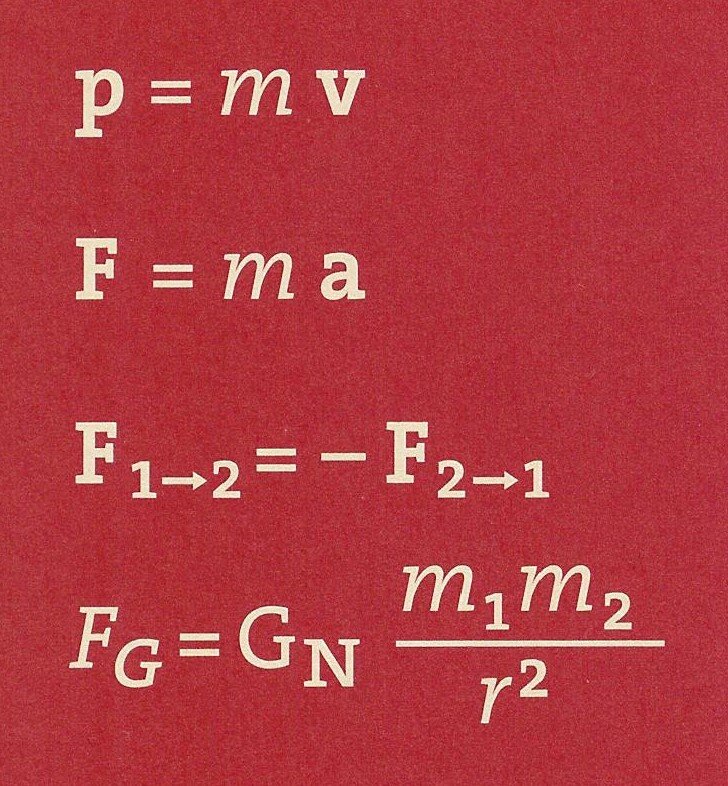
Third Law: Action and Reaction For every action, there is an equal and opposite reaction.
This law means that forces always come in pairs. If you push on a wall, the wall pushes back on you with an equal amount of force. A rocket works by pushing hot gas out of its engine (the action). The gas, in turn, pushes the rocket forward (the reaction). A swimmer pushes the water backward, and the water pushes the swimmer forward.
These three laws provide the framework for understanding almost every motion we see in our daily lives, from a thrown ball to the orbits of the planets.