Mean vs Median Understanding Data
Introduction to Mean and Median
Finding the Center of Data
When we look at a set of numbers, it's often helpful to find a single value that represents the group. This is called a measure of central tendency. It’s like finding the typical or central point of the data. Think of it as a summary in a single number. We'll explore two of the most common ways to do this: the mean and the median.
The Mean or Average
The most common way to find the center of a dataset is by calculating its mean. You probably already know this by its more common name: the average. The mean is simply the sum of all the values in a group, divided by the number of values in that group.
Mean is the sum of all values divided by the number of values in the set.
In statistics, the formula for the mean of a population is often written like this:
Let's break that down. The symbol (the Greek letter mu) stands for the mean. The symbol (sigma) means 'sum up'. So, just means 'add up all the individual values ()'. Finally, is the total number of values in your dataset. Let's try an example.
Let’s say you have five test scores: 85, 90, 75, 95, and 80.
- Sum the values: .
- Count the number of values: There are 5 scores.
- Divide the sum by the count: .
The mean score is 85.
The Median or Middle Value
Another way to find the center is to find the median. The median is the value that's exactly in the middle of a dataset when the numbers are arranged in order from smallest to largest.
Thinking about the center median on a highway can help you remember that the median measure is the number that falls exactly in the middle when you place the set values in numerical order.
Finding the median is a two-step process: first you order the data, then you find the middle number. What you do next depends on whether you have an odd or an even number of data points.
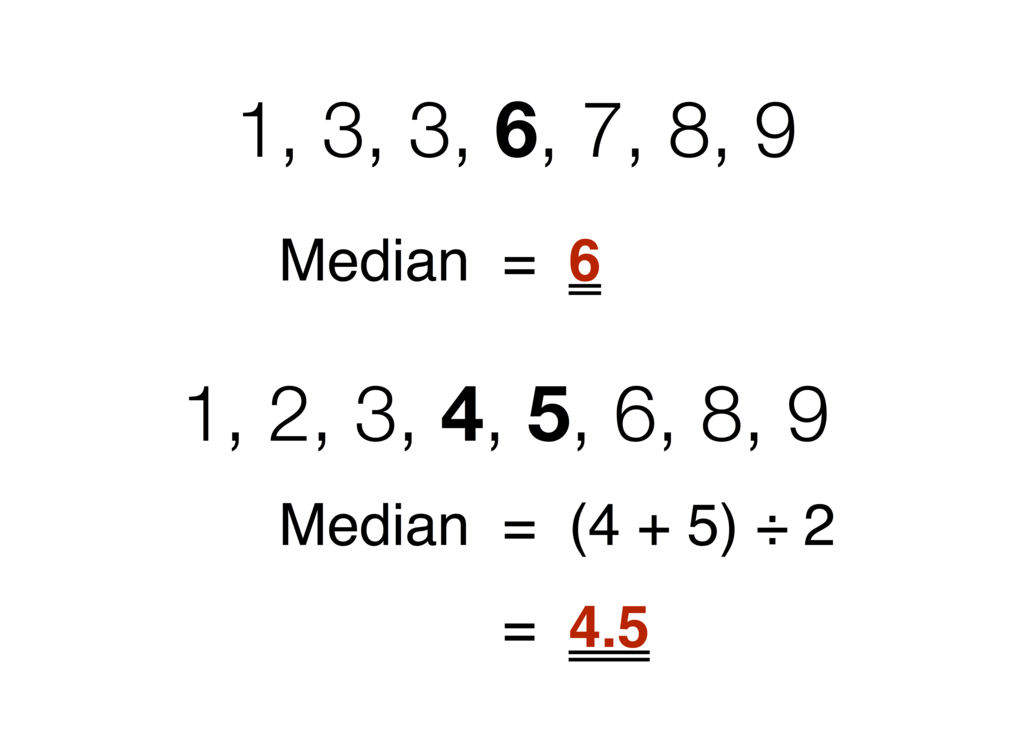
Let’s look at an example with an odd number of values. Imagine a group of 7 friends has the following ages: 12, 15, 11, 18, 13, 16, 12.
First, we put the ages in order: 11, 12, 12, 13, 15, 16, 18
The number in the exact middle is 13. There are three numbers before it and three numbers after it. So, the median age is 13.
Now, what if there's an even number of values? Let's add one more friend who is 19 years old. Our ordered list is now:
11, 12, 12, 13, 15, 16, 18, 19
This time, there are two numbers in the middle: 13 and 15. To find the median, we calculate the mean of these two middle numbers. We add them together and divide by 2.
So, for this new group of friends, the median age is 14. The mean and the median are both powerful tools for getting a quick sense of a dataset. They give us a single, representative number that helps us understand where the center of the data lies.