MCAT IQ vs. Knowledge
MCAT Structure
The MCAT Blueprint
The Medical College Admission Test, or MCAT, is more than just a science exam. It's designed to see if you have the critical thinking and problem-solving skills needed for medical school. Admissions committees use it to gauge your ability to think like a doctor, connecting concepts from different disciplines to analyze complex situations.
Familiarize Yourself with the Exam Structure: Before diving into your study materials, understand the format, duration, and types of questions you will encounter.
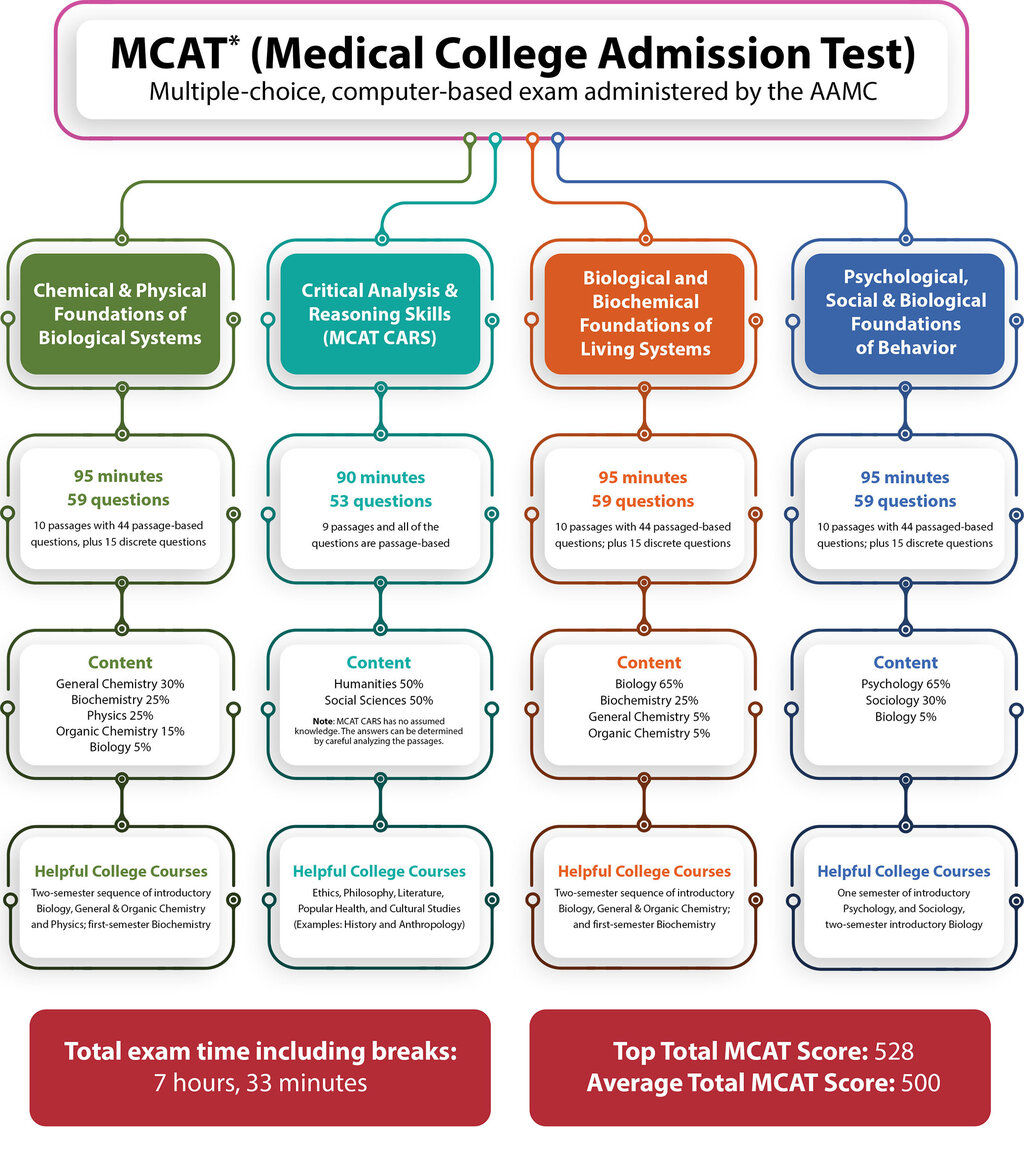
The MCAT is a standardized, computer-based test divided into four multiple-choice sections. The total testing time is about 6 hours and 15 minutes, with optional breaks in between.
| Section | Number of Questions | Time |
|---|---|---|
| Chemical and Physical Foundations | 59 | 95 minutes |
| Critical Analysis and Reasoning Skills | 53 | 90 minutes |
| Biological and Biochemical Foundations | 59 | 95 minutes |
| Psychological, Social, and Biological Foundations | 59 | 95 minutes |
The Four Sections
Each section of the MCAT has a unique focus, testing a different combination of knowledge and skills. Let's break them down.
Chemical and Physical Foundations of Biological Systems
other
This section tests your understanding of the mechanical, physical, and biochemical functions of human tissues, organs, and organ systems. It covers general chemistry, physics, organic chemistry, and introductory biochemistry.
Think of it as the bridge between the foundational sciences and living systems. You won't just be asked to recall a formula; you'll need to understand how it applies to a biological process.
Critical Analysis and Reasoning Skills (CARS)
other
The CARS section is the only non-science part of the exam. It measures your ability to comprehend and analyze what you read. You'll be presented with passages from the humanities and social sciences and asked questions that test your reading comprehension, critical thinking, and reasoning skills.
Success in this section isn't about prior knowledge of the topics. It’s about your ability to deconstruct arguments and understand nuanced texts, a skill essential for reading medical literature and patient histories.
Biological and Biochemical Foundations of Living Systems
other
This section focuses on the processes unique to living organisms, such as growing, reproducing, and acquiring energy. It tests your knowledge of introductory biology, organic chemistry, general chemistry, and biochemistry.
This section dives deep into the machinery of life. It’s where your understanding of the building blocks of biology is put to the test.
Finally, the newest section of the exam explores the human element of medicine.
Psychological, Social, and Biological Foundations of Behavior
other
This section asks you to apply concepts from psychology, sociology, and biology to understand the behavioral and social determinants of health. It tests your knowledge of how psychological, social, and biological factors influence perceptions, behavior, and well-being.
Understanding Your Score
After the test, you'll receive five scores: one for each of the four sections and one total score. Each section is scored on a scale from 118 to 132, with a midpoint of 125.
Your total score is the sum of your four section scores, ranging from a 472 to a 528. The midpoint is 500. This is a scaled score, meaning it's adjusted based on the difficulty of the specific test you took. This ensures that a score of, say, 510 represents the same level of performance regardless of which test version you took or when you took it.
Along with your scaled score, you'll receive a percentile rank. This shows how you performed compared to other test-takers. For example, a percentile rank of 80 means you scored better than 80% of the people who took the exam.
Understanding this structure is the first step in preparing for the exam. It helps you see the big picture and plan your studies around the specific skills and knowledge areas you'll need to succeed.
Let's test your understanding of the MCAT's format.
What is the primary purpose of the MCAT for medical school admissions committees?
What is the total score range for the MCAT exam?
Knowing the layout of the MCAT is a crucial foundation for building your study plan. You now have the blueprint to guide your preparation.