Maxwell Model for Soft Tissues Demystified
Introduction to Viscoelasticity
The In-Between Materials
Some materials are easy to categorize. A steel spring is elastic—it snaps back to its original shape after you stretch it. Water is viscous—it flows and resists motion. But many materials, especially in biology, don't fit neatly into these boxes. They behave like a combination of both.
viscoelasticity
noun
The property of materials that exhibit both viscous and elastic characteristics when undergoing deformation.
Think of silly putty. If you pull it apart quickly, it snaps like a solid. If you pull it slowly, it stretches and flows like a thick liquid. This dual behavior is the essence of viscoelasticity. The material's response depends on how fast you deform it. This time-dependent behavior is crucial for understanding materials from plastics to human skin.
Stress and Strain
To understand how materials deform, we need two key concepts: stress and strain. They are the language we use to describe the mechanics of materials.
Stress (\\[sigma\\]) is the internal force that particles of a material exert on each other, per unit of area. It's a measure of how much force is being applied over a specific area.
Here, is the applied force and is the cross-sectional area over which the force is distributed.
Strain (\\[epsilon\\]) is the measure of the deformation of the material. It's the fractional change in length or shape. A strain of 0.1 means the material has stretched by 10% of its original length.
In this equation, is the original length of the material and is the change in length.
Purely Elastic vs. Purely Viscous
Viscoelasticity is a hybrid, so let's look at the two pure behaviors it combines.
A purely elastic material, like an ideal spring, follows Hooke's Law. The stress is directly proportional to the strain. The amount it deforms depends only on how much force you apply, not how quickly you apply it. When you remove the stress, the material instantly returns to its original shape. All the energy you put into stretching it is returned.
A purely viscous material, like honey or water, is different. Its resistance to deformation depends on the rate of strain. Think of pushing a syringe. The faster you try to move the plunger, the harder you have to push. For a viscous material, stress is proportional to the strain rate. When you remove the stress, the material doesn't return to its original shape. The energy you used to deform it is dissipated as heat.
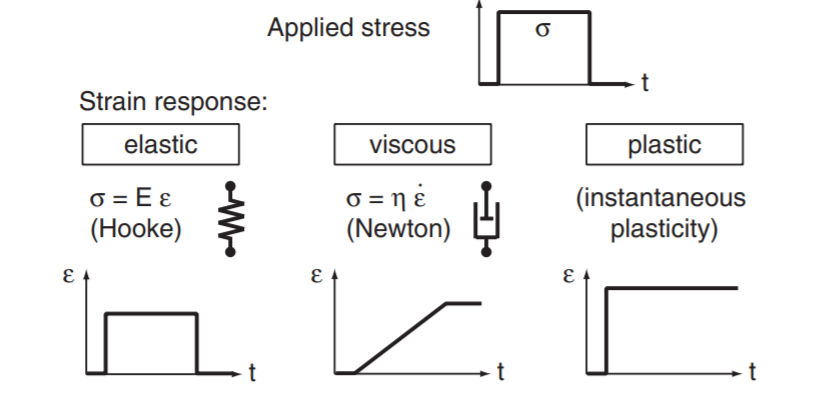
In mathematical terms, we can compare them like this:
| Elastic (Solid) | Viscous (Fluid) |
|---|---|
| Stress depends on strain: | Stress depends on strain rate: |
| Stores energy | Dissipates energy |
| Instantly recovers shape | Does not recover shape |
Viscoelastic materials do a bit of both. When a stress is applied, they deform, but not instantly. They continue to creep, or deform slowly, over time. When the stress is removed, they slowly return toward their original shape, but they may not recover completely. Some energy is stored and returned, while some is dissipated.
This time-dependent deformation is the hallmark of viscoelasticity. The relationship between stress and strain isn't a simple constant; it changes with time and the rate of loading.
Understanding these fundamental differences is the first step toward modeling the more complex, real-world behavior of materials like biological tissues.
What is the defining characteristic of a viscoelastic material?
In a purely elastic material, all the energy used to deform it is stored and then returned when the stress is removed.