Mathematics of Sacred Geometry
Phi and Fibonacci
From Geometry to Algebra
The golden ratio is a special number that appears frequently in geometry, art, and nature. It’s often introduced with pictures of spirals in shells or the proportions of a rectangle. But where does this number actually come from? The answer lies in a simple algebraic relationship derived from a geometric idea.
Imagine a line segment divided into two parts, a longer part (a) and a shorter part (b). The division is in the golden ratio if the ratio of the total length (a + b) to the longer part (a) is the same as the ratio of the longer part (a) to the shorter part (b).
Let's define this common ratio as the Greek letter (phi). So, . If we divide the numerator and denominator of the left side of our equation by , we get:
Substituting into this equation gives us a new relationship that only involves our unknown ratio.
To solve for , we can multiply both sides by to get . Rearranging this gives us a standard quadratic equation: . Using the quadratic formula, we find two possible solutions. Since we're dealing with geometric lengths, we take the positive solution.
The Fibonacci Connection
Now, let's turn to the , a series of numbers where each term is the sum of the two preceding ones. It starts with 0 and 1, and continues: 0, 1, 1, 2, 3, 5, 8, 13, 21, 34, ...
What's remarkable is the connection between this discrete integer sequence and the continuous, irrational value of . If you take any two successive Fibonacci numbers and divide the larger one by the smaller one, the result gets closer and closer to as you move up the sequence.
| Fibonacci Numbers | Ratio (Larger / Smaller) | Approximation of φ |
|---|---|---|
| 2, 3 | 3 / 2 | 1.5 |
| 3, 5 | 5 / 3 | 1.666... |
| 5, 8 | 8 / 5 | 1.6 |
| 8, 13 | 13 / 8 | 1.625 |
| 13, 21 | 21 / 13 | 1.615... |
| 21, 34 | 34 / 21 | 1.619... |
This convergence isn't a coincidence. The deep link is revealed by , an explicit equation for finding the -th Fibonacci number, , without having to calculate all the numbers before it. Notice what famous number is at its core.
This formula shows that the Fibonacci numbers are fundamentally based on powers of the golden ratio. As gets larger, the term becomes extremely small, and the ratio approaches , which simplifies to just .
Spirals and Harmonies
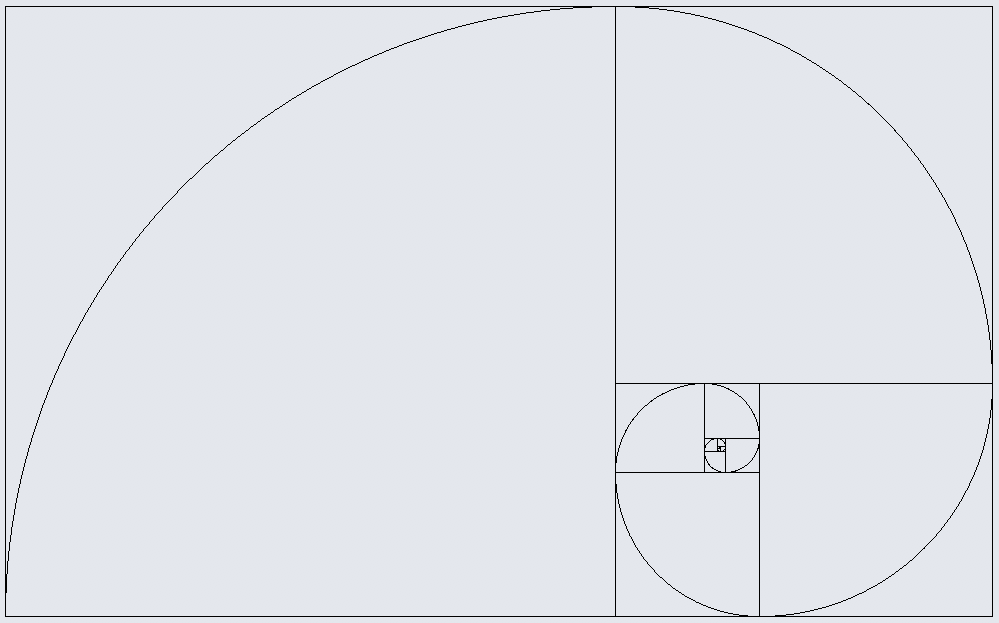
The link between Fibonacci and also gives rise to the Golden Spiral. This is a logarithmic spiral whose growth factor is . For every quarter turn it makes, the spiral gets wider by a factor of . You can approximate this spiral by drawing arcs inside a series of squares whose side lengths are Fibonacci numbers.
The influence of these mathematical patterns extends beyond visual geometry into the realm of sound. In music, harmony is created by the relationship between frequencies of different notes. Some of the most consonant, or pleasant-sounding, musical intervals are based on simple integer ratios. For example, an octave has a 2:1 ratio, and a perfect fifth has a ratio very close to 3:2.
Interestingly, these simple ratios can be generated using the Fibonacci sequence. The ratio 3:2 is a perfect fifth, 5:3 is a major sixth, and 8:5 is a minor sixth. As we move up the Fibonacci sequence, the ratios approach , which is related to intervals that are considered less conventionally consonant but are structurally important in and modern compositions. This suggests a deep connection between the numbers that create visual harmony and those that create auditory harmony.
Before you test your knowledge, let's review the key terms from this section.
Ready to see what you've learned?
How is the golden ratio, , defined geometrically using a line segment divided into a longer part (a) and a shorter part (b)?
What happens to the ratio of two successive Fibonacci numbers (e.g., ) as the numbers get larger?
From a simple line segment to the structure of music, the golden ratio and the Fibonacci sequence reveal a hidden mathematical thread connecting different parts of our world. Their relationship is a perfect example of how discrete numbers and continuous proportions can be two sides of the same beautiful coin.