Mathematics Fundamentals
Arithmetic
The Building Blocks
Arithmetic starts with two simple ideas: putting things together and taking them away. We call these addition and subtraction.
Addition is just combining groups. If you have 3 apples and you get 2 more, you add them together to find the total. You now have 5 apples. The result of an addition problem is called the sum.
Subtraction is the opposite. It's about removing items from a group or finding the gap between two numbers. If you start with 5 apples and eat 2, you subtract to see what's left. You have 3 apples remaining. The result here is called the difference.
These two operations are the foundation for everything else in math. They help us understand how quantities change.
Faster Counting
What if you need to add the same number over and over? If you buy 4 bags of apples and each bag has 6 apples, you could add $6 + 6 + 6 + 6$. But that's slow. Multiplication is the shortcut.
Multiplication is just repeated addition. Instead of adding 6 four times, you can simply multiply.
The answer, 24, is called the product. It's a much quicker way to handle large, equal groups.
Division is the reverse. It's like asking, "How many equal groups can I make?" or "How many items go into each group?" If you have 24 apples and want to divide them into 4 equal bags, division tells you how many go in each bag.
The result of division is the quotient. It's a way to split a quantity into smaller, even parts. Essentially, it's repeated subtraction.
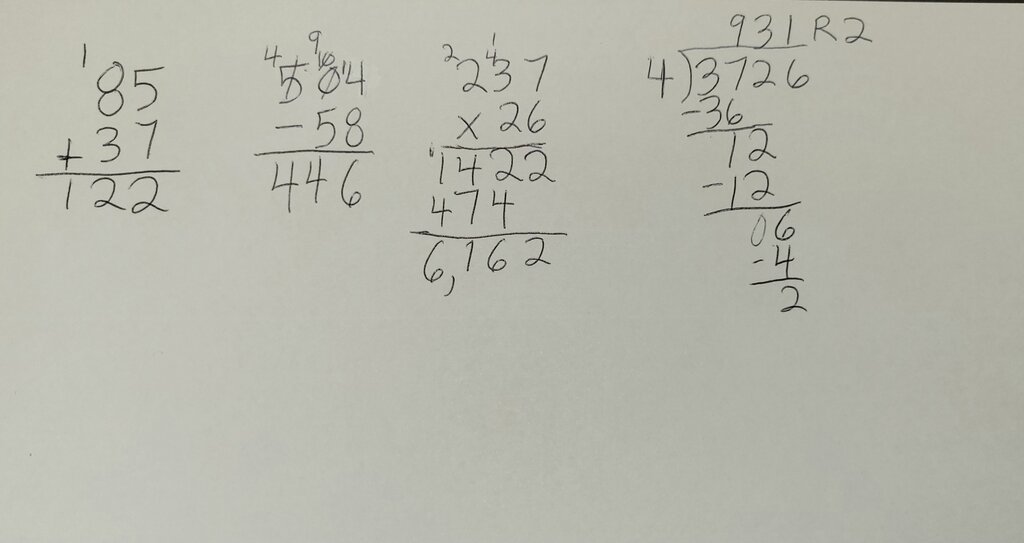
The Rules of the Road
Numbers don't just exist; they follow certain rules. These rules, or properties, make calculations consistent and predictable. One of the simplest is the Commutative Property. It means that for addition and multiplication, the order doesn't matter. Buying milk then bread is the same total cost as buying bread then milk.
Then there's the Associative Property, which says you can group numbers differently when adding or multiplying without changing the outcome. It's helpful for simplifying problems in your head.
With so many operations, we need a specific sequence to make sure everyone gets the same answer from the same problem. This is called the order of operations. A common way to remember it is with the acronym PEMDAS.
- Parentheses: Solve anything inside parentheses first.
- Exponents: Next, handle any exponents (powers).
- Multiplication and Division: Work from left to right.
- Addition and Subtraction: Finish by working from left to right.
Consider this problem:
First, you solve the part in the parentheses: . Then you do the addition: . Without this order, you might get a different answer.
Parts of a Whole
Not everything can be counted with whole numbers. Sometimes we need to deal with parts of something, like half a pizza or a quarter of a dollar. That's where fractions and decimals come in.
A fraction shows a part of a whole. It has two numbers. The bottom number, the denominator, tells you how many equal pieces the whole is split into. The top number, the numerator, tells you how many of those pieces you have.
If you have 1/2 of a pizza, the whole pizza was cut into 2 (denominator) equal slices, and you have 1 (numerator) of them.
A decimal is another way to write a part of a whole. Decimals are based on the number 10 and its multiples. A decimal point separates the whole number part from the fractional part.
The number 1.5 means one whole unit and five-tenths of another. You see this all the time with money. 💲2.50 is two whole dollars and 50 cents, which is half of another dollar.
Fractions and decimals are just different ways of expressing the same idea. For example, the fraction 1/2 is the same as the decimal 0.5. Both represent one half. Understanding them is key to working with measurements, money, and data in the real world.
Ready to test your knowledge?
When you subtract one number from another, what is the result called?
Which operation is described as a shortcut for repeated addition?
These fundamental concepts are the bedrock of mathematics. Mastering them opens the door to understanding more complex ideas down the road.