Mathematical Statistics Essentials
Probability Theory
What Are the Chances?
We deal with uncertainty every day. Will it rain? Will my favorite team win? Will I catch the bus? Probability is the branch of mathematics that gives us a way to measure this uncertainty. It puts a number on how likely an event is to happen.
This number is always between 0 and 1. An event with a probability of 0 is impossible. An event with a probability of 1 is certain. Everything else falls somewhere in between. A 0.5 probability means an event has a 50/50 chance of occurring, just like a coin flip.
For simple events where all outcomes are equally likely, we can calculate probability with a straightforward formula.
Let's roll a standard six-sided die. What's the probability of rolling a 4? There is only one favorable outcome (rolling a 4) and six total possible outcomes (1, 2, 3, 4, 5, 6). So, the probability is $1/6$, or about 0.167.
What about the probability of rolling an even number? There are three favorable outcomes (2, 4, 6) out of six total outcomes. The probability is $3/6$, which simplifies to $1/2$ or 0.5.
Random Variables
In probability, we often work with something called a random variable. It isn't as strange as it sounds. It's simply a variable whose value is a numerical outcome of a random event. We usually represent it with a capital letter, like or .
Random Variable
noun
A variable whose value is a numerical outcome of a random phenomenon.
Random variables come in two main flavors: discrete and continuous.
A discrete random variable can only take on a countable number of distinct values. Think about the number of heads you get when you flip a coin three times. You could get 0, 1, 2, or 3 heads, but you can't get 2.5 heads. The number of cars passing a point on a highway in an hour is another example. You can count them.
A continuous random variable can take on any value within a given range. A person's height is a continuous variable. It could be 1.75 meters, 1.751 meters, or any value in between. Other examples include temperature, time, and weight. These are measured, not counted.
Mapping Probabilities
So we have a random variable, but we also want to know the probability of each of its possible values. That’s where a probability distribution comes in. A probability distribution is a function or a table that describes the likelihood of all possible outcomes for a random variable.
For a discrete variable like our six-sided die, the distribution is simple. It assigns a probability of $1/6$ to each of the six outcomes.
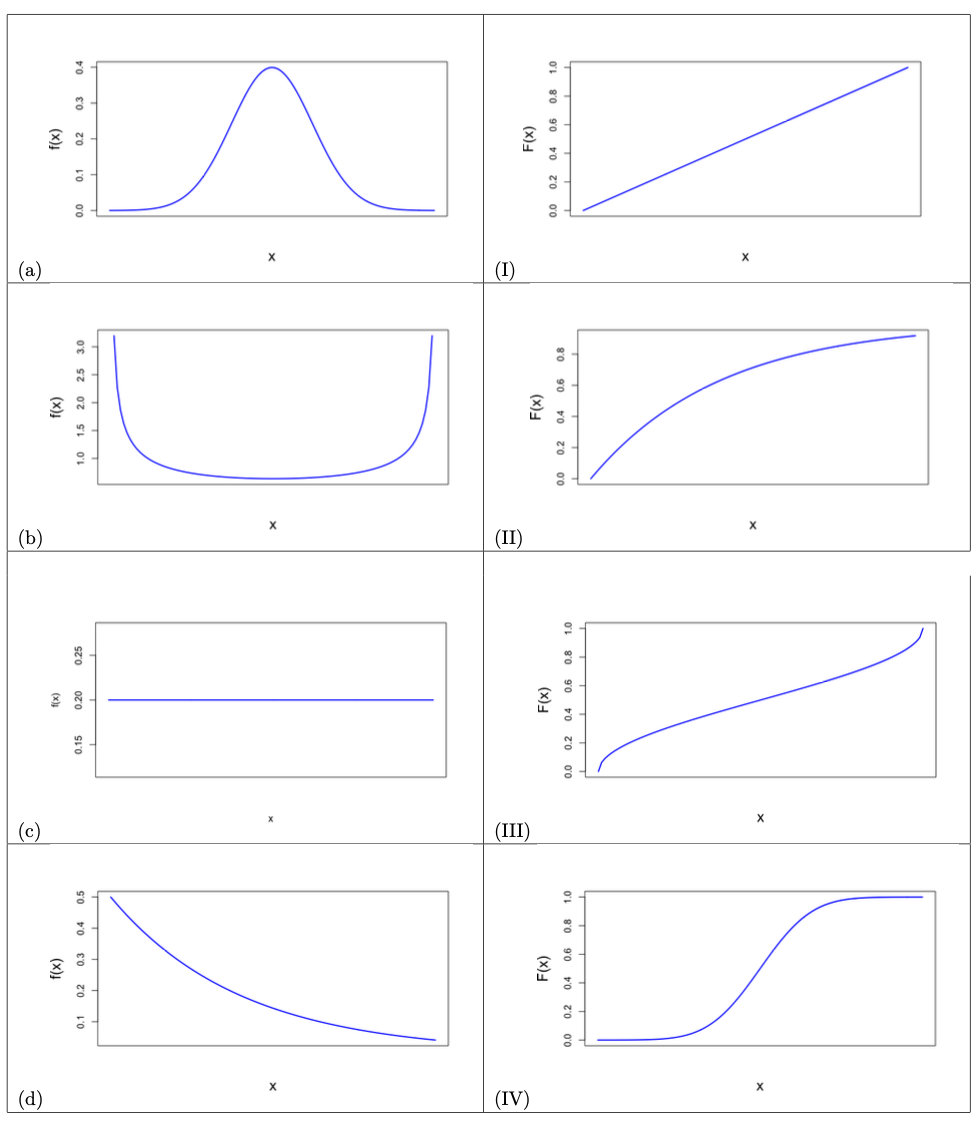
For continuous variables, the distribution is often represented by a curve called a probability density function. The area under the curve between two points gives the probability that the variable will fall within that range. A famous example is the bell-shaped curve of the normal distribution.
The Rules of the Game
Probabilities follow a few fundamental rules that help us combine them. The two most basic are the addition rule and the multiplication rule.
The Addition Rule is used for finding the probability of one event or another event happening. For this to work simply, the events must be mutually exclusive, meaning they cannot happen at the same time. For example, you can't roll a 2 and a 3 on a single die at the same time.
For mutually exclusive events A and B:
What's the probability of rolling a 2 or a 3? Since and , the probability of rolling either a 2 or a 3 is:
The Multiplication Rule is for finding the probability that two events both happen. For the simple version of this rule, the events must be independent, meaning the outcome of one doesn't affect the outcome of the other.
For independent events A and B:
Imagine flipping a coin and rolling a die. What's the probability of getting heads and rolling a 4? The probability of heads is , and the probability of rolling a 4 is . Since these events are independent, we multiply their probabilities:
These concepts form the bedrock of how we analyze randomness and make predictions in the face of uncertainty.
Let's review the main ideas we've covered.
Now, let's test your understanding with a few questions.
The probability of an event is always a number between...
Using a standard six-sided die, what is the probability of rolling a number greater than 4?