Mathematical Limits and Continuity
Epsilon-Delta Definition
From Intuition to Proof
We've talked about limits as a value a function approaches. This is a great starting point, but it's not precise enough for mathematics. The word "approaches" is intuitive, but it lacks rigor. To build the rest of calculus, we need a definition that is solid, unambiguous, and provable. This is where the epsilon-delta definition comes in.
The formal definition of a limit turns an intuitive idea into a measurable guarantee.
Imagine a challenge: I claim the limit of a function as approaches is . You are skeptical. To prove me right, you challenge me by picking a small positive number, epsilon (), which defines an "error tolerance" or a narrow horizontal band around the limit . Your challenge is: can I guarantee that the function's value, , will be inside your band ?
My answer is yes, provided I can find another small positive number, delta (), that defines a vertical band around . If I can find a such that for any value within that narrow vertical band , the corresponding value is guaranteed to land inside your band, then my claim about the limit is true.
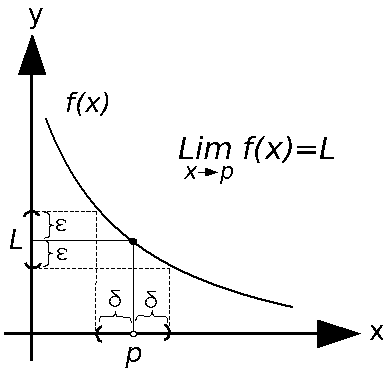
This is the core of the formal definition of a limit, first solidified by mathematicians like Augustin-Louis Cauchy and Karl Weierstrass. It's a game of challenge and response. For any given error tolerance , we must be able to find a corresponding range that satisfies the condition.
...if for every number , there exists a number such that:
Proving a Linear Limit
Let's use this definition to prove something we already know intuitively. We'll prove that the limit of as approaches 4 is 7.
Our goal: .
Here, , , and . Our task is to find a relationship between and . We start with the conclusion of the definition, , and work backward to find a suitable .
- Start with the inequality: We want .
- Simplify the expression: This becomes . We can factor out a 2, giving us .
- Isolate the term: Divide by 2 to get .
This is exactly what we were looking for! We have found a direct relationship. We can see that if we choose our to be equal to , our condition will be met. So, the proof is simple: given any , we choose . Then, if , it follows that , which means , and therefore . The proof is complete.
Handling Quadratic Functions
Proving limits for non-linear functions like quadratics is a bit trickier. The relationship between and isn't a fixed constant. Let's try to prove that .
Here, , , and . We start again with the inequality:
Factoring the difference of squares gives us:
The part looks like our target , but what do we do with the term? It contains , so it's not a constant. We can't simply divide by it. The trick is to find an upper bound for this extra term.
Since we only care about values of that are close to , we can make an initial assumption about . Let's assume will be no larger than 1. This is a common and safe choice. If we need an even smaller later, this assumption still holds.
If we set , then , which means . For this range of , what is the maximum value of the troublesome term? When is 4, is 7. So, within this neighborhood of , we know . Now we have a bound.
We can now substitute this bound back into our inequality:
Now, we can isolate :
We have two conditions for : we assumed , and we just found that we also need . To satisfy both at the same time, we must choose the smaller of the two values. This gives us our final choice for in terms of epsilon.
By finding a concrete way to choose for any given , we have formally proven that the limit is indeed 9. This method transforms the vague notion of 'approaching' into a precise, verifiable procedure.
What is the primary purpose of the epsilon-delta definition of a limit?
In the epsilon-delta 'game' to prove , if a challenger provides a specific , what must be demonstrated to win the challenge?
This rigorous definition is the bedrock upon which the major theorems of calculus are built.