Mathematical Foundations Explored
Introduction to Mathematical Logic
The Language of Reason
At its heart, mathematical logic is a system for clear thinking. It gives us a precise language to talk about whether statements are true or false, and how we can build complex arguments from simple pieces. The most basic piece is called a proposition.
Proposition
noun
A declarative sentence that is definitively either true or false, but not both.
Think of propositions as simple facts. "It is raining" is a proposition. "2 + 2 = 4" is also a proposition. However, "What time is it?" is not a proposition because it's a question. "This statement is false" is also not a proposition, as it creates a paradox.
Once we have these basic statements, we need a way to connect them. In English, we use words like "and," "or," and "if...then." In logic, we use symbols called logical connectives. They are the grammar of our logical language.
Building Blocks of Logic
Let's meet the five most common connectives. We'll use the variables and to stand in for any proposition.
-
Negation (NOT): This simply flips the truth value of a proposition. The symbol is . So, if is "It is sunny," then means "It is not sunny."
-
Conjunction (AND): This connects two propositions and is true only if both are true. The symbol is . If is "The coffee is hot" and is "The mug is red," then means "The coffee is hot and the mug is red."
-
Disjunction (OR): This connects two propositions and is true if at least one of them is true. The symbol is . Using the same examples, means "The coffee is hot or the mug is red." This statement is true if the coffee is hot, if the mug is red, or if both are true.
-
Implication (IF...THEN...): This shows a relationship where the truth of the first proposition guarantees the truth of the second. The symbol is . The statement is read as "If , then ." For example: "If it is raining, then the ground is wet."
-
Biconditional (IF AND ONLY IF): This is a stronger connection, stating that two propositions have the exact same truth value. The symbol is . The statement means " if and only if ." For example: "You can vote if and only if you are registered."
To see how these connectives work in every possible scenario, we use a tool called a truth table.
| p | q | ¬p | p ∧ q | p ∨ q | p → q | p ↔ q |
|---|---|---|---|---|---|---|
| T | T | F | T | T | T | T |
| T | F | F | F | T | F | F |
| F | T | T | F | T | T | F |
| F | F | T | F | F | T | T |
Truth tables are powerful because they remove all ambiguity. For any logical statement, no matter how complex, we can build a truth table to find every case where it is true or false. This is the foundation of how computers make decisions.
Beyond Simple Statements
Propositional logic is great for combining complete statements. But what if we want to talk about the properties of things or make general claims? For that, we need to upgrade to predicate logic.
Predicate logic breaks propositions down further. Consider the statement "Socrates is a man." In predicate logic, "is a man" is the predicate—a property that something can have. "Socrates" is the subject. We could write this as . The predicate is a template; it becomes a proposition once we plug something in for .
This new level of detail allows us to use quantifiers to talk about entire groups of things.
Universal Quantifier (): Means "for all" or "for every." It makes a claim about everything in a certain group. For example, translates to "For every x, if x is a human, then x is mortal." Or more simply, "All humans are mortal."
This asserts that there is not a single human who is not mortal.
Existential Quantifier (): Means "there exists" or "for some." It claims that at least one thing in a group has a certain property. For example, translates to "There exists an x such that x is a cat and x is black." More simply, "Some cats are black."
This only requires us to find one black cat for the statement to be true. Quantifiers give our logical language incredible power, allowing us to express complex mathematical ideas and form structured arguments.
Making a Point
The final step is to use this language to build valid arguments. In logic, an argument consists of a set of propositions called premises, which lead to another proposition called the conclusion. The process of reaching that conclusion is called logical inference.
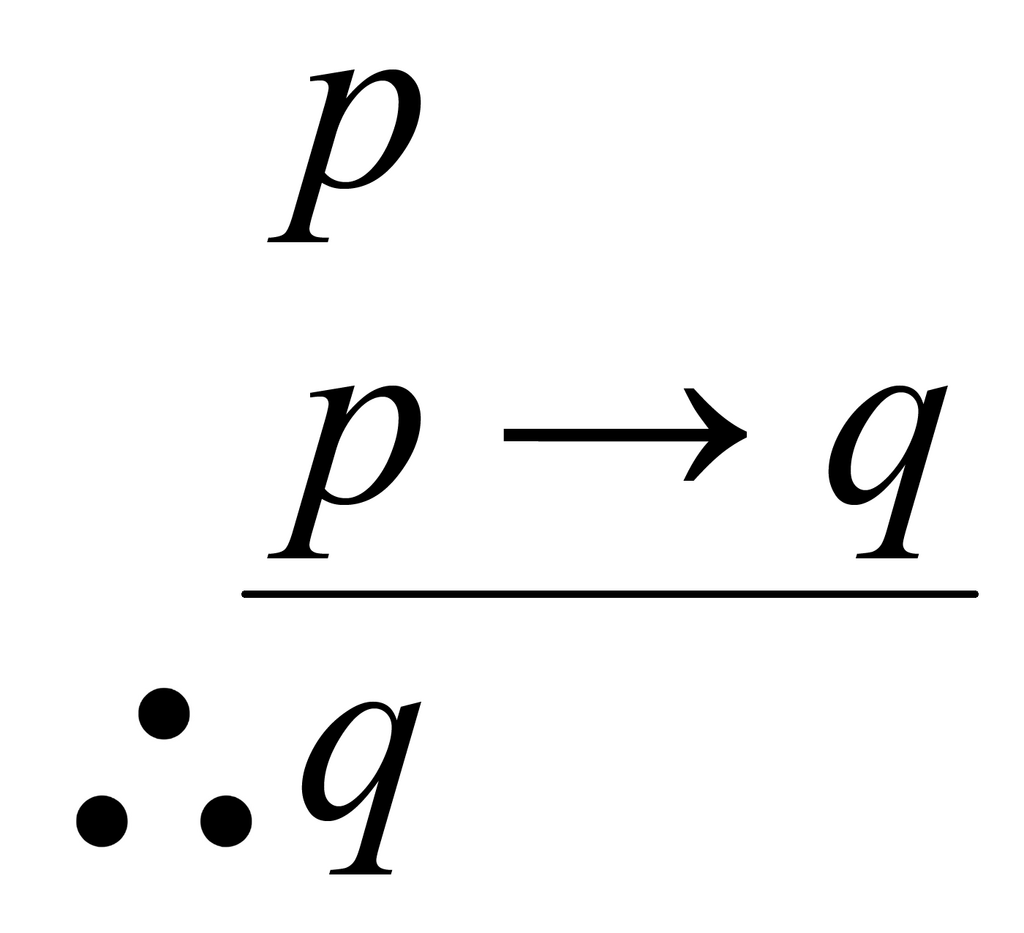
A classic example is called Modus Ponens.
Let's put it into words:
- Premise 1: If it is raining (), then the streets are wet ().
- Premise 2: It is raining ().
- Conclusion: Therefore, the streets are wet ().
This argument is valid because if the premises are true, the conclusion must also be true. Mathematical proofs are essentially long chains of these valid inferences, starting from a set of axioms (assumed truths) and arriving at a new, proven conclusion.
Now, let's test your understanding of these logical concepts.
Which of the following is a proposition?
Let be 'It is raining' and be 'The ground is wet'. Which symbolic expression represents the statement 'If it is raining, then the ground is wet'?
These building blocks—propositions, connectives, quantifiers, and rules of inference—form the backbone of mathematical reasoning. They allow us to construct arguments with precision and certainty, ensuring that our conclusions follow logically from our starting points.