Math From Grade School to High School
Number Sense
What Is Number Sense?
Number sense is a feel for numbers. It’s the ability to understand what numbers mean, how they relate to one another, and how you can use them to solve problems. Think of it like learning the alphabet. Before you can read words and sentences, you need to know what each letter looks like and what sound it makes. Number sense is that same fundamental understanding, but for math.
It isn't just one skill. It's a collection of ideas that work together. It starts with basics like counting and grows into more complex ideas like figuring out if an answer seems reasonable.
Number sense includes three connected areas: understanding numbers, number relations, and number operations.
Having good number sense means you can be flexible with numbers and see them in different ways. This intuition is the foundation for all the math you'll ever learn.
Counting and Seeing Numbers
Everything starts with counting. Most of us learn to recite numbers early on: one, two, three, four, five. But counting is more than just saying the words in order. It’s about connecting a number word, like "three," to a specific quantity, like three apples or three blocks.
This one-to-one connection is the first major step. The next is understanding that the last number you count in a set tells you the total amount. If you count five pencils, the word "five" represents the entire group. This is a key concept called cardinality.
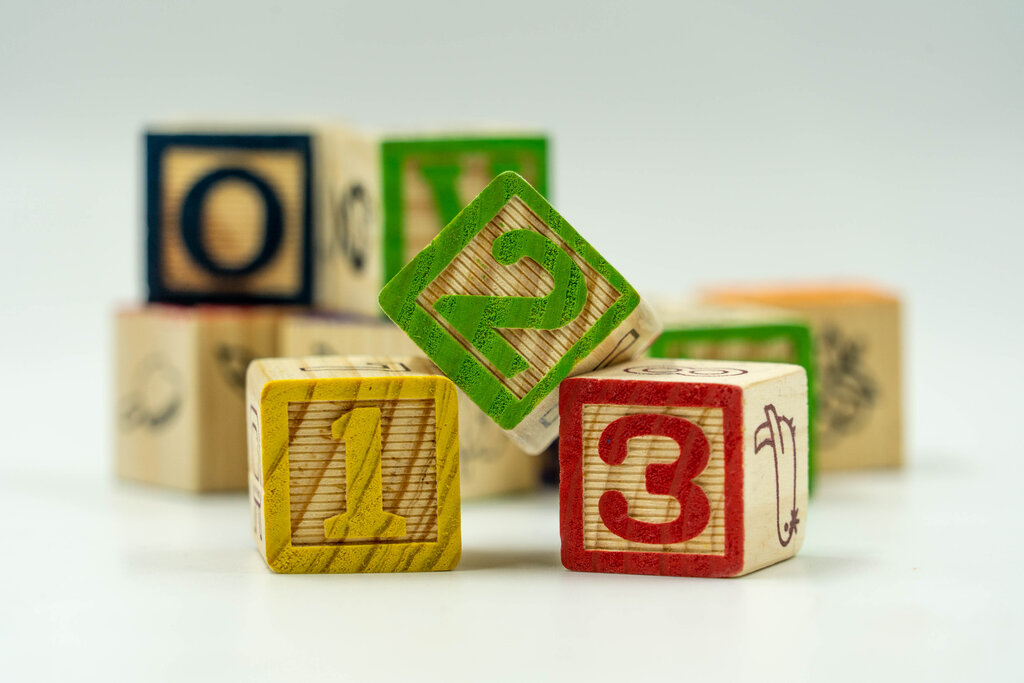
Counting isn't just reciting words in order; it’s about understanding quantity.
The Power of Place Value
Once we can count, we need a way to organize bigger numbers. That’s where place value comes in. Our number system is based on ten digits: 0, 1, 2, 3, 4, 5, 6, 7, 8, and 9. The value of a digit depends on its position, or place, in a number.
Consider the number 25. It’s made of a '2' and a '5'. But the '2' doesn't just mean two. Because it’s in the tens place, it means two tens, or 20. The '5' is in the ones place, so it means five ones, or 5. Together, 20 and 5 make 25.
| Number | Tens Place (Value) | Ones Place (Value) | Total |
|---|---|---|---|
| 25 | 2 (20) | 5 (5) | 25 |
| 63 | 6 (60) | 3 (3) | 63 |
| 80 | 8 (80) | 0 (0) | 80 |
Understanding this concept is critical. It allows us to work with large numbers easily and is the key to performing operations like addition and subtraction.
Basic Operations
With counting and place value under our belts, we can start combining and separating numbers. This brings us to the first two major operations: addition and subtraction.
Addition is about combining quantities. If you have 3 apples and you get 2 more, you add them together to find the total. You now have 5 apples.
Subtraction is the opposite. It's about taking away. If you start with 5 apples and eat 2, you subtract to find out how many are left. You have 3 apples remaining.
These operations are the tools we use to manipulate numbers to solve everyday problems. They build directly on our understanding of quantity and place value. For example, to solve , we add the ones () and then the tens () to get 38.
Time to check your understanding of these core concepts.