Math for Generative AI
Linear Algebra
The Building Blocks of Data
At the heart of AI and machine learning are two fundamental concepts from linear algebra: vectors and matrices. Think of them as the language we use to speak to computers about data. Whether it's an image, a sentence, or a user's preferences, it gets translated into these structures.
If you’re just stepping into AI and machine learning, you’ll quickly notice that understanding vectors, matrices, and transformations is not just useful—it’s essential.
A vector is simply a list of numbers. You can think of it as a point in space or an arrow pointing from the origin (the point (0,0)) to that point. For example, a vector could represent the features of a house: [number of bedrooms, square footage, age in years]. Each number in the vector is a component or dimension.
A vector space is the collection of all possible vectors of a certain type. For instance, the set of all 3D vectors makes up a 3D vector space. The key idea is that within a vector space, you can perform two basic operations: adding vectors together and multiplying them by a single number (a scalar). These operations always result in another vector that's still inside the same space.
This graphic shows two vectors, and , in a 2D vector space. Adding them together creates a new vector, , that's also in the same 2D space.
Organizing Data with Matrices
If a vector is a list of numbers, a matrix is a grid of numbers, arranged in rows and columns. You can think of it as a collection of vectors stacked together. We describe the size of a matrix by its dimensions: rows by columns. For example, a 3x2 matrix has 3 rows and 2 columns.
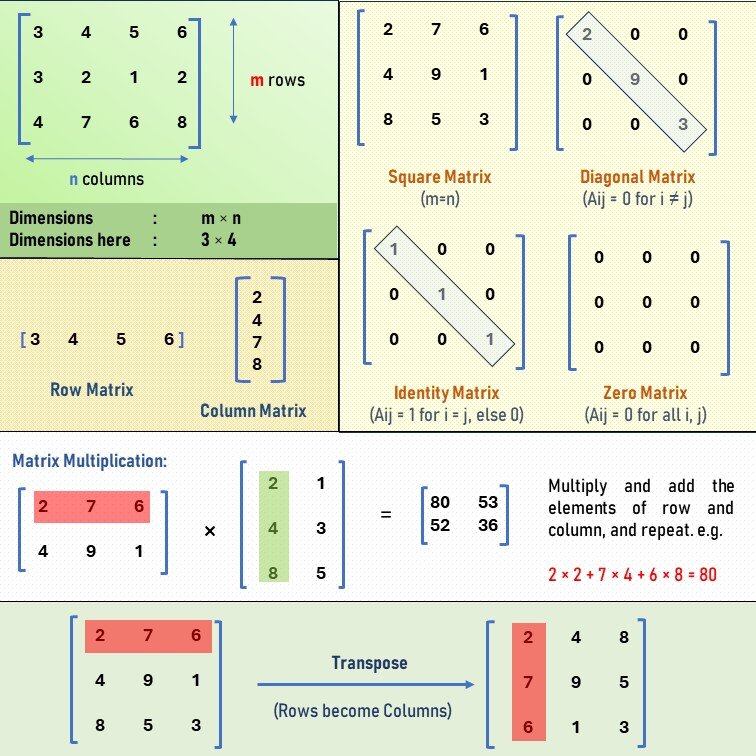
Like vectors, matrices have their own set of operations.
Addition and Subtraction: You can add or subtract two matrices only if they have the exact same dimensions. The operation is done element by element. If you add a number in the first row and first column of one matrix, you add it to the number in the first row and first column of the second matrix.
Scalar Multiplication: This means multiplying every single element in the matrix by one number (a scalar).
Matrix Multiplication: This is the most important operation, and it's a bit different. To multiply two matrices, and , the number of columns in must equal the number of rows in . The result is found by taking the dot product of the rows of with the columns of .
In AI, matrix multiplication is how we apply transformations to data. For instance, a matrix can represent a set of operations (like rotate, scale, or shear) to be applied to a vector representing a point in an image.
Unlocking Matrix Secrets
Some numbers and vectors can tell us deep truths about a matrix and the transformation it represents. These are the determinants, eigenvalues, and eigenvectors.
Determinant
noun
A scalar value that can be computed from the elements of a square matrix. It provides important information about the matrix, such as whether it is invertible.
The determinant is a special number calculated from a square matrix. For a 2x2 matrix, the calculation is simple. Geometrically, the determinant tells you how much the area (in 2D) or volume (in 3D) changes when you apply the matrix transformation. A determinant of 1 means the area doesn't change, while a determinant of 0 means the transformation squishes everything onto a line or a single point.
Eigenvectors and eigenvalues are a matched pair. When a matrix acts on most vectors, it changes their direction. But for any given matrix, there are special vectors called eigenvectors that don't change their direction. They only get stretched, shrunk, or flipped.
The eigenvalue is the number that tells you how much the eigenvector was stretched or shrunk. A positive eigenvalue means it was stretched, an eigenvalue between 0 and 1 means it was shrunk, and a negative eigenvalue means it was flipped and then scaled.
Eigenvectors are the axes of a transformation, and eigenvalues are the scale factors along those axes.
Finally, Singular Value Decomposition (SVD) is a powerful technique for breaking down any matrix into three other, more meaningful matrices. It's like finding the fundamental components of the transformation the matrix represents.
SVD is crucial in machine learning for tasks like dimensionality reduction and data compression because the singular values in the matrix are sorted by importance. This allows us to discard the least important ones to simplify data without losing much information.
What is the primary condition required to add two matrices together?
In the context of a matrix transformation, what is an eigenvector?
These concepts form the mathematical bedrock upon which many complex AI models are built. A solid grasp of how vectors and matrices work is the first step toward understanding the inner workings of generative AI.