Math Adventures for Young Learners
Addition and Subtraction
Putting Numbers Together
Let's start with a simple idea: putting things together. That’s all addition is. If you have 3 toy cars and your friend gives you 2 more, you now have 5 toy cars. We use a special sign, called a plus sign (+), to show we're combining groups.
The numbers you add together are called addends, and the answer you get is called the sum. So in our example, 3 and 2 are the addends, and 5 is the sum. It's like building with blocks. You start with a few, add some more, and end up with a taller tower.
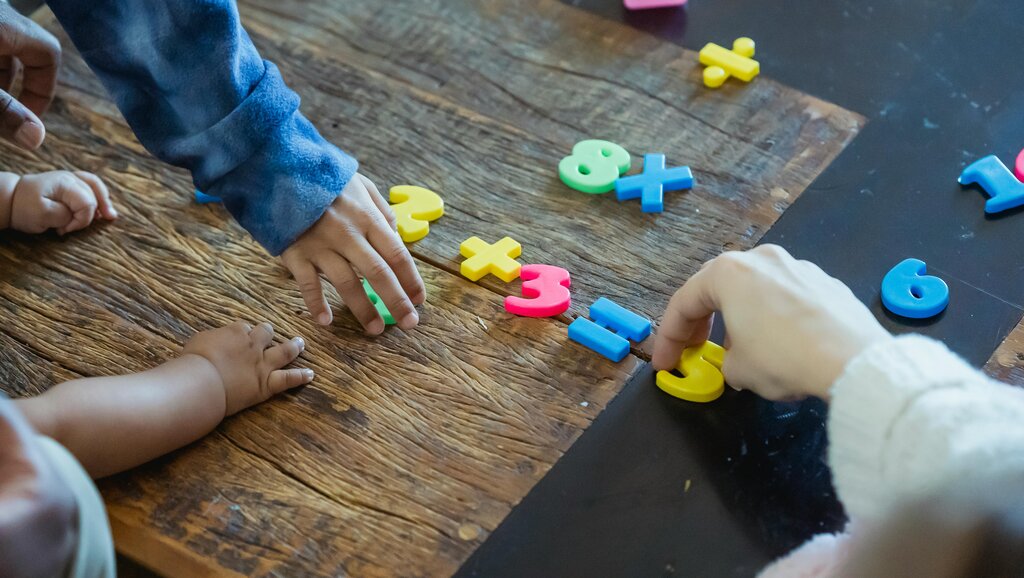
Knowing your basic addition facts helps you solve problems quickly. These are simple sums that are good to have memorized. For example:
- $4 + 5 = 9$
- $7 + 3 = 10$
- $8 + 6 = 14$
Taking Numbers Apart
Now what if you start with a group of things and take some away? That's subtraction. Imagine you have 8 cookies and you eat 2 of them. You have 6 cookies left. The sign for subtraction is the minus sign (-).
The number you get after subtracting is called the difference. Here, the difference between 8 and 2 is 6.
Subtraction is the opposite of addition. They are connected. Because $6 + 2 = 8$, we know that $8 - 2 = 6$. They're like a family! This is called a fact family.
Fact Family Example: The numbers 4, 5, and 9 are a family. $4 + 5 = 9$ $5 + 4 = 9$ $9 - 5 = 4$ $9 - 4 = 5$
Math in Your Head
Sometimes you don't need paper to solve a math problem. You can use tricks to do it in your head. This is called mental math.
One popular strategy is "counting on." To solve $9 + 4$, you don't have to start counting from 1. Just start at the bigger number, 9, and count up four more times: 10, 11, 12, 13. So, $9 + 4 = 13$.
Another trick is "making ten." Tens are easy numbers to work with. To solve $7 + 5$, you can break the 5 into a 3 and a 2. Why? Because you know that $7 + 3 = 10$. Now you just have the 2 left over. Add that to your 10, and you get 12.
For subtraction, you can count back. To solve $11 - 3$, start at 11 and count backward three times: 10, 9, 8. The answer is 8.
Solving Story Problems
The best part about math is using it to figure out real-world puzzles. We call these story problems or word problems.
When you read a story problem, first figure out what it's asking. Are you supposed to combine groups or take something away?
Let's look at an example: "Maria had 6 stickers. Her friend gave her 7 more. How many stickers does Maria have in all?"
The words "in all" tell you to add. You need to combine the two groups of stickers.
Maria has 13 stickers.
Here's a subtraction problem: "There were 15 birds on a wire. 4 of the birds flew away. How many birds are left?"
The words "flew away" and "are left" are clues that you need to subtract.
There are 11 birds left.
Before you solve, always ask yourself: Is the final number going to be bigger or smaller? If it's bigger, you're probably adding. If it's smaller, you're probably subtracting.
Ready to test your new skills? Give these questions a try.
In the math problem , what are the numbers 3 and 4 called?
Which mental math strategy involves starting with the larger number and counting up?
Great job working with addition and subtraction. These are the building blocks for all the amazing math you'll learn in the future.