Math 9 Foundations
Real Numbers
The Number Universe
Think of a number line, stretching infinitely in both directions. Every single point on that line represents a real number. It's the complete set of all the numbers you use every day, from the price of a snack to the measurement of a room.
This vast universe of numbers is split into two major families: the rational numbers and the irrational numbers. Every real number belongs to one, and only one, of these families.
Let's look at each family more closely.
Rational Number
noun
Any number that can be expressed as a fraction , where and are integers and is not zero. This includes all integers, terminating decimals (like 0.5), and repeating decimals (like 0.333...).
Irrational Number
noun
A number that cannot be expressed as a simple fraction. As a decimal, it goes on forever without repeating.
Rules of the Road
The good news is that all the basic rules of arithmetic you know still apply to real numbers. You can add, subtract, multiply, and divide them just as you would with integers or fractions.
However, mixing rational and irrational numbers can produce interesting results. For example, adding a rational number to an irrational number always results in another irrational number. You can't simplify it into a single clean number.
Real numbers also follow a few key properties that make algebra work. These properties are like the fundamental grammar of mathematics.
| Property | For Addition | For Multiplication |
|---|---|---|
| Commutative | ||
| Associative | ||
| Distributive | N/A |
In simple terms:
- Commutative: The order doesn't matter.
- Associative: The grouping doesn't matter.
- Distributive: Multiplying a number by a group of numbers is the same as doing each multiplication separately.
Finding Numbers on the Line
Every real number has a unique spot on the number line. Integers are easy to place. Rational numbers, like or , fit neatly between them.
But what about irrational numbers? They also have precise locations, even if their decimal forms are endless.
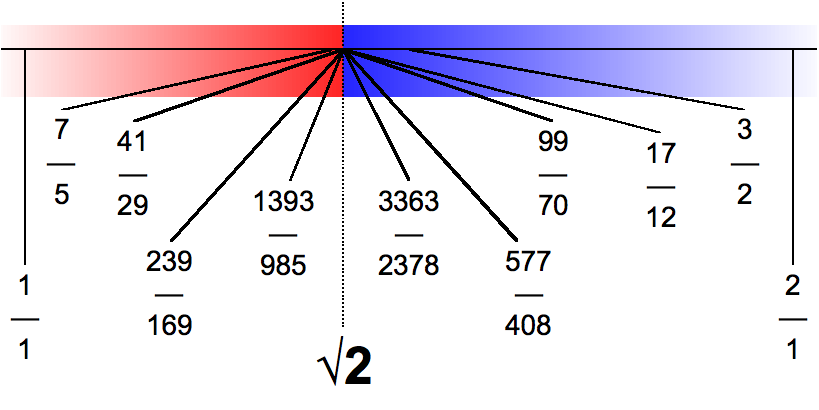
The image above illustrates how we can pinpoint the location of an irrational number like . It's the exact point that separates all the numbers whose squares are less than 2 from all the numbers whose squares are greater than 2.
This confirms a mind-bending fact: between any two different real numbers, you can always find another real number. In fact, you can find infinitely many. This is called the density property of real numbers. The number line is completely packed, with no gaps.
Time to test what you've learned about real numbers.
The set of real numbers is composed of which two major, mutually exclusive families?
What is the result of adding a rational number to an irrational number?
Understanding the real number system is a crucial step in your math journey. It's the foundation for algebra, geometry, and beyond.