Mastery of the Pelagic Albatross
Dynamic Soaring Physics
The Wind-Powered Engine
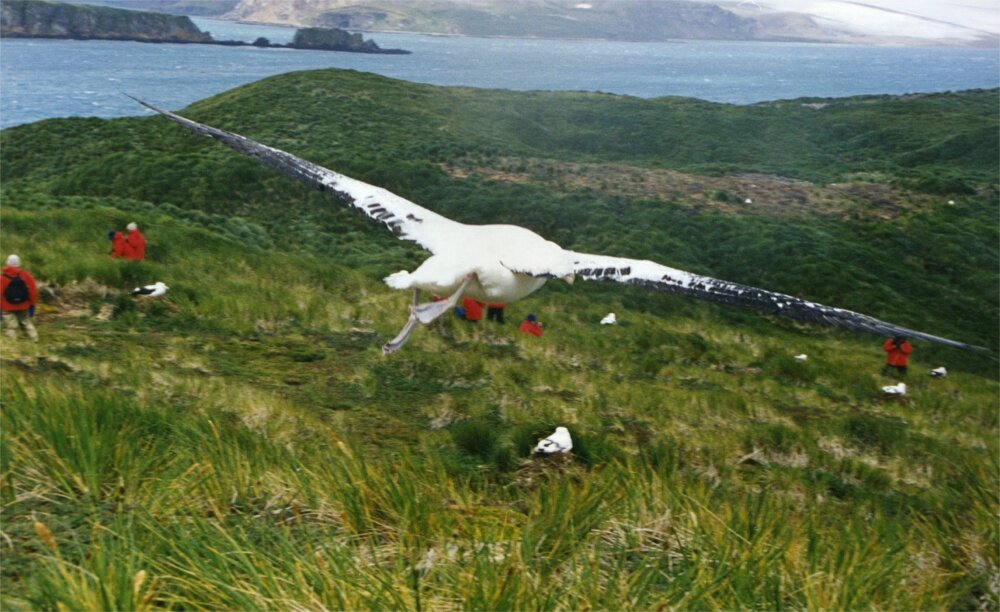
An albatross can fly for thousands of miles without flapping its wings, a feat that seems to defy the laws of physics. It’s not magic; it’s a technique called dynamic soaring. Instead of simply riding the wind like a kite, the albatross exploits differences in wind speed to generate its own energy. The secret lies in a feature of the ocean environment that is invisible to us but fundamental to the bird's flight: the wind gradient.
Over the vast expanse of the ocean, the air doesn't move as a single, uniform block. The layer of air closest to the water is slowed by friction with the waves. As you move higher, this friction has less effect, and the wind speed increases. This change in wind speed with altitude is known as the wind gradient or wind shear.
This zone of varying wind is called the atmospheric boundary layer. For an albatross, this gradient is a source of limitless energy. By repeatedly climbing and descending through this layer, it extracts kinetic energy from the wind shear, effectively turning the sky into an engine.
The Soaring Cycle
The specific set of maneuvers used by the albatross is a loop known as the , named after the physicist Lord Rayleigh who first proposed the theory in 1883. The cycle has four distinct phases.
The bird's goal is to maximize its gain in ground speed during the maneuver, which it then converts into altitude on the next climb, repeating the cycle.
-
Upwind Climb: The bird starts near the sea surface and turns into the wind. It uses its momentum (high ground speed) to climb. As it gains altitude, the headwind increases, which slows its speed relative to the ground but increases its speed relative to the air (airspeed). It's trading kinetic energy for potential energy.
-
High-Altitude Turn: At the top of its climb, now in the fastest-moving air, the bird makes a sharp turn to fly downwind.
-
Downwind Descent: Now moving with the strong tailwind, the bird dives. Gravity and the fast-moving air accelerate it dramatically, massively increasing its kinetic energy and ground speed.
-
Low-Altitude Turn: As it nears the ocean surface, it enters the slow-moving air layer. Crucially, it carries the high momentum from its descent. It makes another sharp turn back into the wind, ready to begin the next climb with a huge surplus of speed. Each completed cycle provides a net gain in energy.
Harvesting Energy
The energy gain doesn't come from gravity or simple tailwinds alone. It comes from the transfer of kinetic energy between wind layers. When the bird flies from a slow layer into a fast one (the climb) and then back into a slow one (the descent), it manipulates its airspeed and ground speed to its advantage.
The thrust generated through this process is directly related to the steepness of the wind gradient, denoted as . A steeper gradient, meaning a larger difference in wind speed over a short change in altitude, allows for a greater energy harvest per cycle.
Data from researchers at the and MIT has confirmed this incredible efficiency. They tracked a wandering albatross and found it could maintain an average speed of 8.4 m/s in a wind that averaged only 3.6 m/s, all without flapping. The bird wasn't just being pushed by the wind; it was actively extracting energy from it.
Every bird’s flight is a masterpiece of balanced forces—lift, thrust, drag, and weight working in perfect harmony.
By executing this elegant, looping dance, the albatross acts as a biological sailplane, perfectly adapted to transform the structure of the wind into the power of flight.
What is the primary source of energy for an albatross using dynamic soaring?
The set of maneuvers an albatross uses for dynamic soaring, involving a climb, a turn, a descent, and another turn, is known as the...