Mastery of Mathematical Foundations and Advanced Analysis
Advanced Algebraic Structures
Deconstructing Polynomials
When we analyze complex systems, we often model them with polynomials. To understand these models, we need to break them down into simpler parts. Just like you can divide 27 by 4 to get a quotient and a remainder, you can divide one polynomial by another.
The most direct method is polynomial long division. It mirrors the long division you learned in arithmetic. Let's divide by .
This tells us that . The general form is , where is the quotient and is the remainder.
For the special case of dividing by a linear factor of the form , we can use a faster method called synthetic division which uses only the coefficients.
| Step | Action | Example: |
|---|---|---|
| 1 | Write down the value of and the coefficients of the polynomial. Use a 0 for any missing terms. | . Coefficients: . `3 |
| 2 | Bring down the first coefficient. | `3 |
| 3 | Multiply by this number and place the result under the next coefficient. Add the column. | `3 |
| 4 | Repeat the multiply-and-add step for all coefficients. | `3 |
| 5 | The last number is the remainder. The other numbers are the coefficients of the quotient. | Remainder: . Quotient: . |
The Root Connection
Polynomial division isn't just a mechanical exercise. It reveals deep truths about a polynomial's roots, which are the values of that make the polynomial equal to zero. Two theorems form the bridge between division and roots.
First is the Remainder Theorem. It states that if you divide a polynomial by , the remainder is simply . In our synthetic division example, the remainder was . Let's check: . It works perfectly and saves us a lot of calculation.
The Factor Theorem follows directly. If the remainder is 0, then must be a factor of . This means finding a root is the same as finding a factor.
But how do you find that first root to test? The gives us a list of candidates. For a polynomial with integer coefficients, , any rational root must be of the form , where is a factor of the constant term () and is a factor of the leading coefficient ().
Let's find the roots of . Factors of the constant term are . Factors of the leading coefficient are . The possible rational roots () are . Let's test with synthetic division.
2 | 2   1   -13   6
  |     4    10  -6
  |________________
    2   5    -3   0
The remainder is 0, so is a root and is a factor. The division gives us the other factor, a quotient of . We can now write the polynomial in factored form: .
Factoring the quadratic gives . The roots are , , and . All three were on our list of possibilities.
Beyond Polynomials
Algebra isn't limited to polynomials. Transcendental functions, like exponential and logarithmic functions, describe phenomena that polynomials can't, such as population growth, radioactive decay, and compound interest.
An exponential function is of the form , where the base is a positive constant. If , the function shows exponential growth. If , it shows exponential decay. The most important base is the irrational number , which arises naturally in many areas of science and finance.
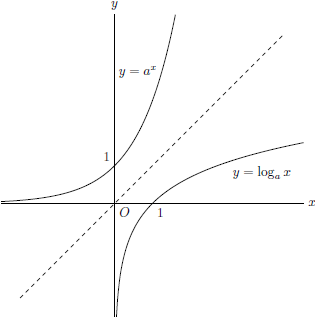
The inverse of an exponential function is a logarithmic function. If , then . It answers the question: "To what power must we raise base to get ?" Manipulating these functions requires knowing their identities.
| Identity | Name | Explanation |
|---|---|---|
| Product Rule | The log of a product is the sum of the logs. | |
| Quotient Rule | The log of a quotient is the difference of the logs. | |
| Power Rule | The log of a power is the exponent times the log. | |
| Change of Base | Convert a log from one base to another. |
These rules are essential for solving equations. To solve , we take the log of both sides: , which simplifies to . Therefore, .
Partial Fractions
Just as we can break integers into prime factors, we can break complex rational functions (one polynomial divided by another) into simpler fractions. This technique, called , is indispensable in calculus for integration.
The goal is to rewrite a fraction like as a sum of simpler fractions whose denominators are the factors of the original denominator.
First, factor the denominator: . We can then set up the decomposition.
To find and , we first clear the denominators by multiplying both sides by : .
This equation must hold true for all values of . We can exploit this by choosing clever values of to make terms disappear.
- If we let , the term becomes zero: .
- If we let , the term becomes zero: .
So, we have successfully decomposed the fraction.
This process allows us to analyze the behavior of the function near its vertical asymptotes ( and ) more easily and, as mentioned, is crucial for integration.
Let's check your understanding of these advanced algebraic tools.
According to the Remainder Theorem, if you divide a polynomial by , what is the remainder?
If a polynomial has integer coefficients, the Rational Root Theorem helps us find possible rational roots. For the polynomial , which of the following is NOT a possible rational root?
Mastering these techniques provides the rigorous foundation needed to analyze the behavior of complex systems and transition into the limit-based reasoning of calculus.