Mastery of Martial Systems and Combat Philosophies
Striking Systems Compared
The Science of Striking
Every striking art seeks the same goal: hitting an opponent without getting hit. But how they achieve this varies dramatically. Western boxing, for instance, has perfected the art of the punch. Boxers generate immense power by rotating their hips and torso, transferring force from the ground, through their core, and into a gloved fist. The gloves allow for a high volume of strikes to the head, creating a specific cadence of offence and defence built around combinations and head movement.
Muay Thai, the 'Art of Eight Limbs,' takes a different approach. A Muay Thai punch is biomechanically distinct. It often involves less torso rotation and is delivered more linearly, designed to set up kicks, knees, or elbows. Power isn't sacrificed, but it's shared across a wider arsenal. The real powerhouses are the roundhouse kick, which uses a full hip turn like swinging a baseball bat, and the devastating elbow and knee strikes at close range.
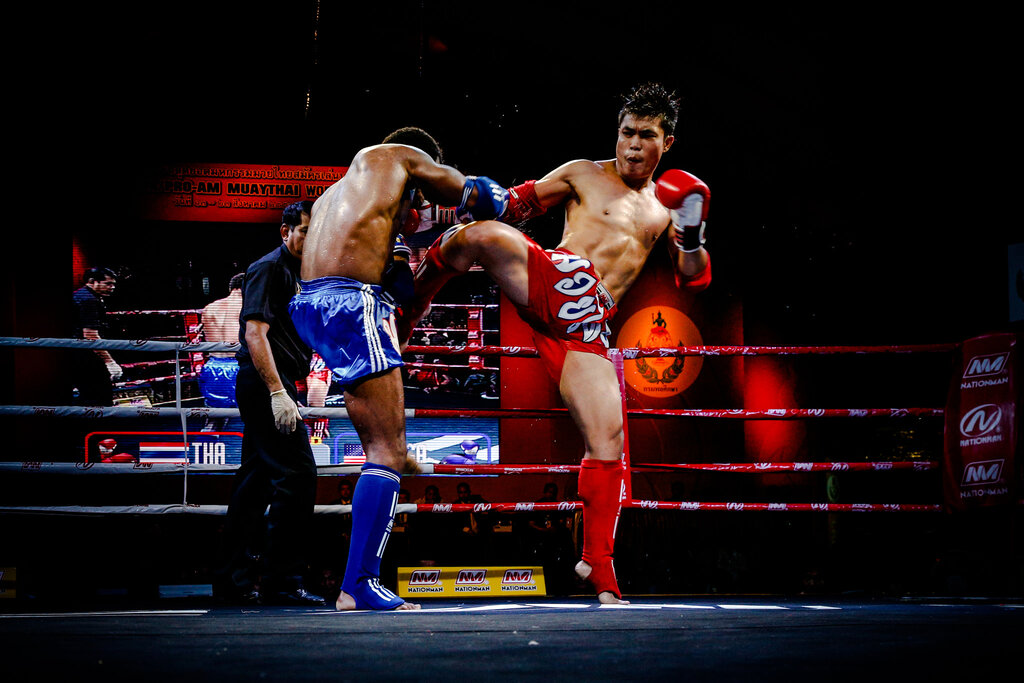
Our data indicates that the typical Karate and Taekwondo snap-like kick is based heavily on rapid knee extension, while Muay Thai uses a technique that places greater emphasise on COM movements to develop high impact forces.
Controlling the Clinch
The biggest tactical divergence between these arts appears at close range. In boxing, a clinch is a brief, defensive entanglement, quickly broken up by the referee. It's a reset button. In Muay Thai, the clinch is a sophisticated system of its own. Fighters vie for a dominant position, typically by securing their arms over their opponent's, controlling the head and neck. From this position, they can land powerful knees to the body and head, unbalance their opponent for a sweep, or create space for a short-range elbow.
This control changes everything. A boxer caught in a Thai clinch is often lost, unable to generate power with their punches and vulnerable to a barrage of knees. Conversely, a Muay Thai fighter must be wary of a boxer's superior hands when closing the distance to initiate that clinch. It's a constant battle of ranges, with each artist trying to force the fight into their preferred zone.
The Ninth Limb
If Muay Thai is the Art of Eight Limbs, then Myanmar's Lethwei is the Art of Nine. The ninth limb? The head. Lethwei permits headbutts, fundamentally altering close-range combat. It's a bare-knuckle art, fought with only hand wraps, which also changes the nature of striking. Fighters must be more selective with their punches to avoid breaking their hands, and the smaller striking surface can create cuts more easily.
The ruleset is also unique. In many traditional promotions, a fight can only be won by knockout. If both fighters are still standing at the end of the final round, the match is declared a draw. This encourages a relentlessly aggressive and decisive style of fighting, as winning on points is not an option.
Hybrid Systems
Naturally, fighters began blending these approaches. This led to the rise of kickboxing, particularly the K-1 style popularised in Japan and the developed in the Netherlands. Dutch kickboxing is a powerful hybrid. It integrates the high-volume punching combinations and head movement of Western boxing with the devastating low kicks of Muay Thai.
The strategy is simple but brutally effective: punish the legs. A few solid low kicks can compromise an opponent's mobility, draining their power and making them a stationary target for further attacks. This style removes some of Muay Thai's more esoteric elements, like elbows and extensive clinch work, to create a fast-paced, spectator-friendly sport focused on powerful combinations.
Time to see how these concepts fit together.
What is the primary tactical purpose of the clinch in Western boxing?
A fighter consistently attacks their opponent's legs to hinder their movement, setting up powerful punching combinations to the head. This strategy is most characteristic of which style?
Each striking system offers a unique set of tools and strategies. Understanding their respective strengths, weaknesses, and biomechanical principles is key to appreciating the complex art of combat.