Mastery of Martial Arts Systems
Combat Biomechanics
The Body as a Whip
Power in martial arts doesn't come from your arms or legs alone. True force is generated from the ground up, travelling through your body in a sequence. This concept is known as the , and it's the secret behind a truly devastating strike. Think of it like cracking a whip. The handle moves first, transferring energy along the length until the tip explodes forward at incredible speed.
When you throw a punch, the movement starts with your feet pushing against the floor. This force travels up through your ankles, knees, and into your hips. The hips and torso then rotate, accelerating the energy into your shoulder, down your arm, and finally into your fist. Each segment adds its own velocity to the one before it, creating a sum total of force far greater than any single body part could generate in isolation.
Efficient striking isn't about pushing. It's about a seamless, full-body rotation that channels ground force into a single point of impact.
Twisting for Power
The rotational movement of your hips and torso is the engine of your power. This twisting motion creates torque, or rotational force. A punch thrown with only the arm is a shove; a punch powered by core rotation is a knockout blow. The speed of this rotation is just as important as the mass behind it.
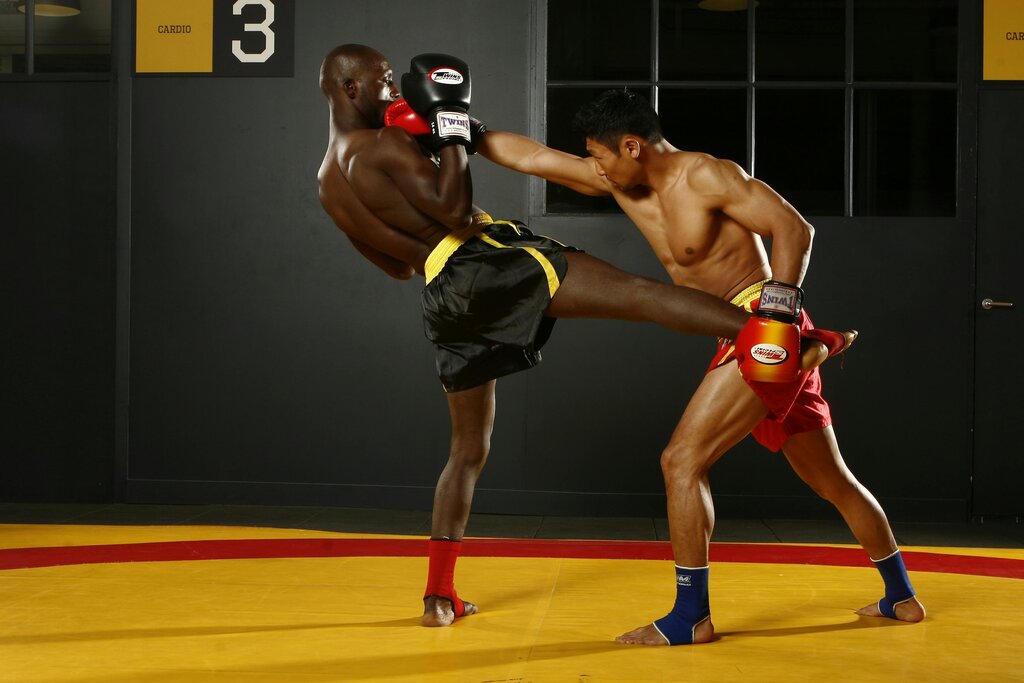
Consider a roundhouse kick. The power doesn't come from just swinging your leg. It begins with the pivot of your supporting foot, which allows your hips to rotate fully towards the target. This rotation whips your kicking leg around, multiplying the force far beyond what the leg muscles alone could achieve. This principle applies to all strikes, from hooks and uppercuts to spinning backfists.
Finding Your Centre
All this movement is useless without balance. Your ability to control your determines your stability. This is the single point where your entire body weight is concentrated. In a typical fighting stance, your center of mass is lowered and kept between your feet, creating a stable base. From this base, you can generate force without falling over.
Balance recovery is just as crucial. When you throw a hard strike, you temporarily shift your center of mass. The efficiency of your technique is measured by how quickly you can return to a stable position, ready to attack again or defend. This is why martial artists practice forms and drills relentlessly, training their bodies to move powerfully while maintaining perfect equilibrium.
Absorbing the Impact
Combat isn't just about dishing out force; it's also about receiving it. Your musculoskeletal system is designed to absorb and dissipate impact. When you take a hit, your body shouldn't be rigid. A stiff target takes the full brunt of the force. Instead, you learn to "roll with the punches."
This involves moving with the strike, increasing the time over which the force is applied and thus reducing its peak impact. Muscles tense at the moment of impact to protect bones and organs, while joints flex slightly to act as shock absorbers. This is why conditioning is so important. Strong core and neck muscles help dissipate the force of a blow before it can rattle the brain. Efficient movement means using your entire body as a suspension system.
Grappling techniques, including takedowns, submissions, and ground control, heavily rely on biomechanical principles.
Understanding these principles of movement allows a martial artist to be more efficient, generating maximum power with minimum effort. It turns movement from a simple action into a scientific application of force.
What is the concept of the 'kinetic chain' in martial arts?
Why is the rotation of the hips and torso crucial for a powerful strike?