Mastery of Kinetic Wielding and Implement Control
Kinetic Energy Mastery
The Body as a Whip
Powerful, efficient movement isn't about brute strength in your arms. It's about turning your entire body into a finely tuned system for transferring energy. This system is called the kinetic chain. Think of it as the process of cracking a whip: the motion starts with a large, slow movement at the handle and accelerates into a lightning-fast snap at the tip. Your body works the same way.
Energy begins with your connection to the ground. You push off, generating force that travels up through your legs, into your hips and torso, then out through your shoulder, arm, and finally to the tool in your hand. Each segment adds to and multiplies the force from the previous one. This is the principle of sequential acceleration.
The optimal flow of energy follows a proximal-to-distal pattern: the legs initiate, the hips rotate explosively, the core transfers this energy upwards, the shoulder follows, the elbow drives forward, and finally, the wrist snaps, accelerating the disc at the endpoint of the chain.
The goal is to create a seamless transfer of energy. A breakdown in any link of the chain—a weak core, stiff hips, or poor timing—causes a massive loss of power. The energy dissipates before it can reach the target. Mastering this sequence is the key to generating maximum force with minimum effort.
This visualization shows how each part of the body contributes in sequence, building momentum that culminates in the final, powerful action of the implement.
Torque and The Snap
The engine of the kinetic chain is rotational force, or torque. It's generated when your hips and torso twist explosively. This is not a slow, grinding motion; it's a dynamic unwinding that transfers massive energy into your upper body. Think of a discus thrower spinning to build momentum before the release. The same principle applies, even on a smaller scale.
While torque provides the raw power, 'the snap' provides the incredible speed. This happens at the very end of the kinetic chain and relies on elasticity. As you rotate your torso, your shoulder and chest muscles stretch like a rubber band. At the peak of this stretch, they contract and release this stored elastic energy, whipping the arm forward. The final link is the wrist, which adds a final, sharp snap to accelerate the tool to its maximum velocity right at the point of impact or release.
Biomechanics
noun
The study of the mechanical laws relating to the movement or structure of living organisms.
Practicing this involves breaking the motion down. Start with slow, deliberate hip rotation, feeling the stretch across your core. Gradually integrate the torso, then the arm, and finally the wrist. The goal is to make the sequence smooth and automatic, so each segment fires at the perfect moment without conscious thought. It's the difference between pushing an object and flicking it.
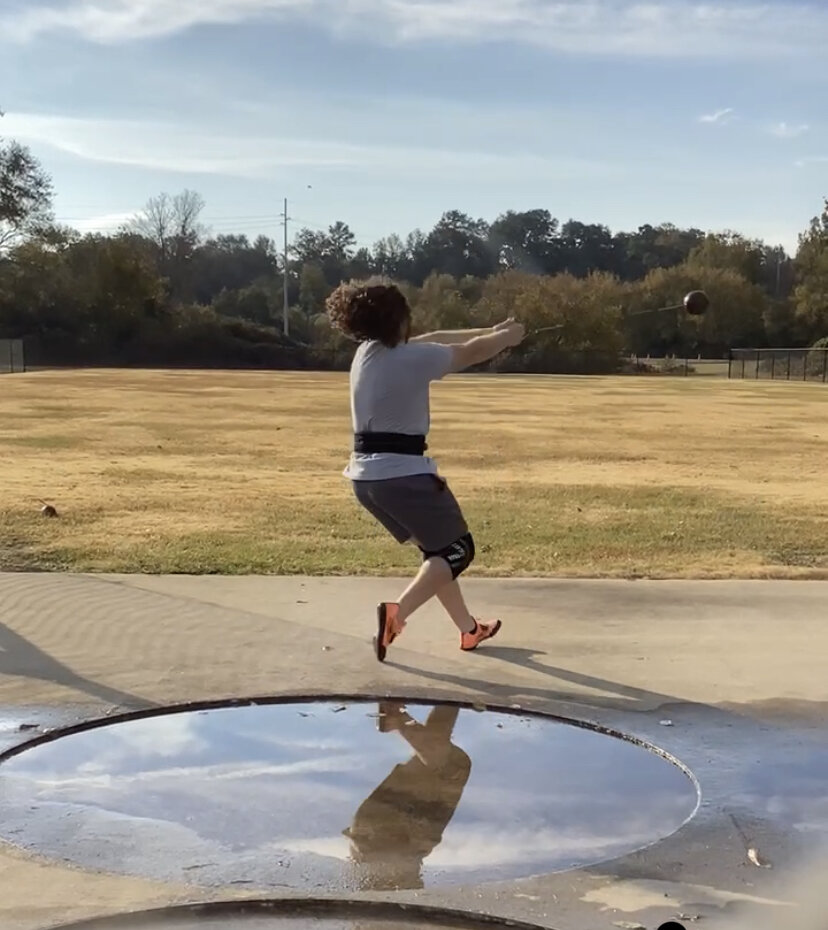
Notice how the athlete's entire body is engaged in the throw. The power doesn't come from just his arms; it's a product of a perfectly timed sequence of movements that channels energy from the ground up.
Time to check your understanding of these dynamic principles.
What is the primary purpose of the kinetic chain in human movement?
According to the principles described, where does the energy for a powerful throw or hit originate?
By focusing on the kinetic chain, you move beyond simple form and begin to understand the physics of power. This allows you to generate force efficiently, increasing both the effectiveness of your actions and your endurance.