Mastering Your Inner Clock
Circadian Rhythm Basics
Your Body's Inner Clock
Have you ever wondered why you naturally feel sleepy around the same time each night and wake up around the same time each morning, even without an alarm? This is the work of your circadian rhythm, a 24-hour internal clock running in the background of your brain.
Your circadian rhythm is your body’s internal clock—a complex system synchronized primarily by light exposure, regulating nearly every biological function on a 24-hour cycle.
This biological pacemaker doesn't just manage your sleep-wake cycle. It also coordinates other essential functions like hormone release, eating habits, digestion, and body temperature. Think of it as your body's master conductor, ensuring all the different instruments in the orchestra play in harmony and on time.
circadian
adjective
Relating to a biological process that recurs naturally on a twenty-four-hour cycle.
The term comes from the Latin phrase circa diem, meaning "around a day." Nearly all living things, from tiny microbes and fungi to plants and animals, have these internal clocks.
The Master Clock
So where is this master clock located? It's a tiny region in your brain's hypothalamus called the suprachiasmatic nucleus, or SCN for short. The SCN is made up of about 20,000 nerve cells and acts as the central hub for your body's timekeeping.
The suprachiasmatic nucleus (SCN) is a very small region of our brain located in the hypothalamus.
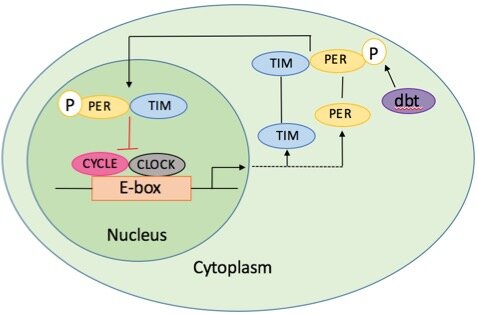
The SCN keeps time through a complex feedback loop involving genes and proteins. Certain "clock genes" produce proteins that build up in the cell nucleus throughout the day. Once they reach a certain level, they switch off their own production. Over the night, these protein levels fall, and by morning, they are low enough that the genes switch back on, starting the cycle all over again. This elegant molecular dance takes about 24 hours to complete.
Setting the Time
While your internal clock can keep time on its own, it isn't perfectly precise. It needs external cues to stay synchronized with the outside world. Without them, your body clock would drift slightly, running on a cycle that's a little longer or shorter than 24 hours.
The most powerful external cue is light. When light enters your eyes, special cells in your retina send signals directly to the SCN. This input helps reset the clock each day, keeping your body in sync with the cycle of day and night. This is why getting sunlight in the morning is so important—it's like winding up your internal clock.
Light is the primary signal that synchronizes your internal body clock to the Earth's 24-hour cycle.
Other factors, known as zeitgebers (German for "time givers"), also help. These include things like your meal times, physical activity, social interactions, and even temperature. For example, your body temperature naturally dips slightly at night to promote sleep and rises in the morning to help you wake up. Consistent daily routines reinforce these signals, helping to keep your circadian rhythm stable and robust.
Now, let's test your understanding of these core concepts.
What is the primary and most powerful external cue that synchronizes the human circadian rhythm to the 24-hour day?
The central 'master clock' of the body, a cluster of about 20,000 nerve cells, is located in which part of the brain?