Mastering Wireless Audio Antennas
Antenna Characteristics
Antenna Gain and Direction
An antenna's primary job is not to create radio frequency (RF) energy, but to direct it. Think of it like the reflector in a flashlight. A bare bulb radiates light in all directions, but adding a curved reflector focuses that light into a useful beam. Antenna gain is the measure of this focusing ability.
Gain is measured in decibels (dB), but you'll see it specified in one of two ways: dBi or dBd.
- dBi: This compares the antenna's power to an isotropic radiator, a theoretical, perfect point source that radiates energy equally in all directions, like an expanding sphere. It's a useful engineering benchmark.
- dBd: This compares the antenna's power to a standard dipole antenna, a real-world reference. A basic dipole antenna has a gain of 2.15 dBi.
So, an antenna with a gain of 3 dBd would have a gain of 5.15 dBi (3 + 2.15). Always check which reference is being used when comparing antennas.
Beamwidth and Polarization
The graphic above also illustrates beamwidth. This is the angle over which an antenna's power is concentrated. It's measured at the points where the power drops to half of its maximum (-3 dB). Gain and beamwidth have an inverse relationship: the higher the gain, the narrower the beamwidth. A high-gain antenna focuses energy tightly in one direction, while a low-gain antenna covers a much wider area.
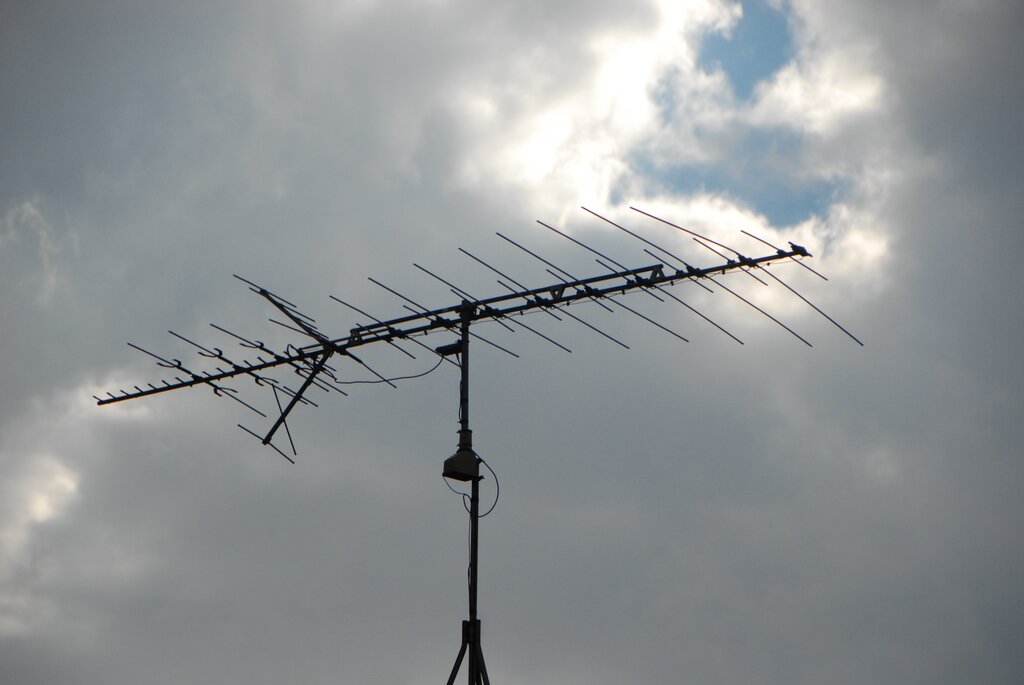
Polarization describes the orientation of the electric field in the radio wave. For wireless microphone systems, the most common types are linear and circular.
- Linear Polarization: The electric field oscillates along a single plane, either vertical or horizontal. For best reception, both the transmitting and receiving antennas must be oriented in the same plane. A mismatch (e.g., one vertical, one horizontal) can cause a significant signal loss of over 20 dB.
- : The electric field rotates in a corkscrew pattern as it travels. This can be right-hand (RHCP) or left-hand (LHCP). The main advantage is that it doesn't matter how the receiving antenna is oriented relative to the transmitter, as long as both use the same circular direction (e.g., both RHCP). This makes it highly effective at rejecting multipath interference, where signals bounce off surfaces.
Matching and Efficiency
For maximum power transfer, the components in an RF system—the transmitter, the cable, and the antenna—must have matching impedance. Impedance is the total opposition to alternating current, measured in Ohms (). In the world of professional wireless audio and video, there is a nearly universal for all equipment.
A perfect impedance match allows all the transmitter's power to be radiated by the antenna. A mismatch, however, causes some of the power to be reflected back toward the transmitter. This creates standing waves in the cable and is measured by the Voltage Standing Wave Ratio (VSWR).
A perfect match has a VSWR of 1:1. This means no power is reflected. A VSWR of 2:1 is generally considered the maximum acceptable limit for professional wireless systems, representing about 11% reflected power.
Finally, an antenna's bandwidth is the range of frequencies over which it can operate effectively, maintaining an acceptable VSWR. A wideband antenna can be used with wireless systems across a broad frequency spectrum, whereas a narrowband antenna is tuned for optimal performance over a smaller, specific range of frequencies.
Time to check your understanding of these core antenna concepts.
What is the primary function of an antenna?
An antenna has a specified gain of 8.15 dBi. What is its gain in dBd?
Understanding these characteristics—gain, beamwidth, polarization, impedance, VSWR, and bandwidth—is key to selecting the right antenna and deploying it effectively for reliable wireless performance.