Mastering Waves for Class 11 Physics
Wave Motion Mechanics
From Oscillation to Propagation
You already know how a single object can oscillate back and forth in simple harmonic motion. Think of a weight on a spring or a pendulum swinging. It's a repeating dance in time, centered around an equilibrium point. But what happens when you connect a whole series of these oscillating objects? You get a wave.
A wave is simply a disturbance that travels, or propagates, through space and time. It's the difference between one person standing up and sitting down, and an entire stadium doing "the wave." The first is a local oscillation; the second is a pattern that moves. Each person just moves up and down (like simple harmonic motion), but the wave itself travels all the way around the stadium.
Wave motion is the transfer of a local oscillation from one part of a medium to another.
Energy, Not Matter
Here’s the most crucial concept about waves: they transfer energy without transferring matter. In the stadium wave, the people (the matter) end up right back in their seats. What traveled was the coordinated motion, the energy of the disturbance. A boat bobbing on the ocean is another great example. The water molecules themselves are mostly just moving in a small circular or up-and-down path. It's the energy from a distant wind or disturbance that moves across the water's surface as a wave, lifting the boat as it passes.
This is true for all mechanical waves, which are waves that require a substance to travel through. That substance is called the medium.
Medium
noun
The substance or material that carries a mechanical wave. It can be a solid, liquid, or gas. The properties of the medium determine the speed of the wave.

Not all waves need a medium. Electromagnetic waves, like light and radio waves, are non-mechanical and can travel through the vacuum of space. But for now, we'll focus on the mechanical waves that rely on a physical medium to get from point A to point B.
How a Medium Carries a Wave
So how does a medium do this? Two key properties are at play: elasticity and inertia.
Elasticity is the property that causes a displaced particle to be pulled back towards its original equilibrium position. It's the "restoring force." In a rope, it's tension. In a solid, it's the bonds between atoms.
Inertia is the property that causes the particle to overshoot its equilibrium point as it returns. An object in motion tends to stay in motion.
This combination creates a chain reaction. One particle is disturbed. Elasticity pulls it back, but inertia makes it overshoot. As it moves, it pulls or pushes on its neighbor, transferring energy and starting its neighbor's oscillation. This process repeats down the line, and the wave propagates. Each particle simply oscillates around its own fixed position, but the wave pattern moves forward.
Pulses, Periods, and Wavefronts
Not all waves look like the repeating sine waves you might imagine. We can classify them based on their duration.
A pulse is a single, isolated disturbance. Think of flicking a rope once. A single hump travels down the rope and is gone.
A periodic wave is a repeating, continuous disturbance. This happens when the source of the disturbance oscillates continuously, like a motor shaking the end of the rope up and down in simple harmonic motion. This creates a train of identical pulses following one another.
To visualize how these waves travel, especially in two or three dimensions, we use the concept of a wavefronts. A wavefront is a line or surface connecting all the points on a wave that are in the same phase of oscillation. For a pebble dropped in a pond, the wavefronts are expanding circles. For a distant light source, the wavefronts are nearly parallel planes.
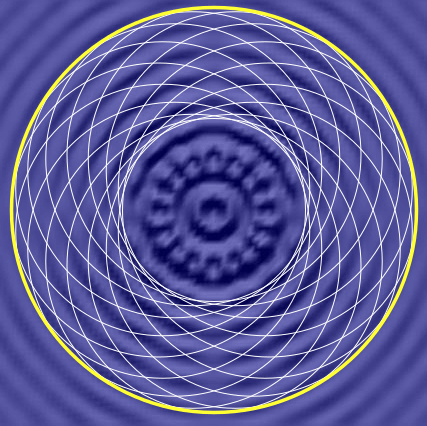
Understanding wavefronts helps us see the shape and direction of a wave's energy propagation. It's a simple but powerful tool for mapping how a disturbance moves through its medium.
What is the most fundamental characteristic of a mechanical wave's propagation?
A mechanical wave travels through a medium due to the interplay of two of its key properties. What are they?