Mastering Vision-Language Model Training
Introduction to Vision-Language Models
Beyond Words and Pictures
The world isn't just text. It isn't just images. It's a rich mix of both. We read a street sign and see the street. We look at a photo and describe it to a friend. Humans naturally connect vision and language. For a long time, artificial intelligence struggled with this. An AI could either be an expert at understanding text or an expert at recognizing images, but rarely both.
Vision-Language Models (VLMs) change that. A VLM is a type of AI designed to understand and process information from both images and text simultaneously. It learns the relationship between visual data and the words we use to describe it. This allows it to perform tasks that require a deep, combined understanding of seeing and reading.
Think of it like learning a picture book. A child sees a picture of a cat and hears the word "cat." Over time, they build a strong connection between the image and the sound, eventually learning to read the word itself. VLMs do something similar, but on a massive scale with millions of images and text descriptions.
What Can VLMs Do?
By bridging the gap between sight and language, VLMs unlock powerful capabilities. Their applications are already transforming how we interact with technology.
One of the most common applications is image captioning. You give the VLM a photograph, and it generates a descriptive sentence. For a picture of a person on a beach at dusk, it might write, "A silhouette of a person standing on the sand during a colorful sunset."
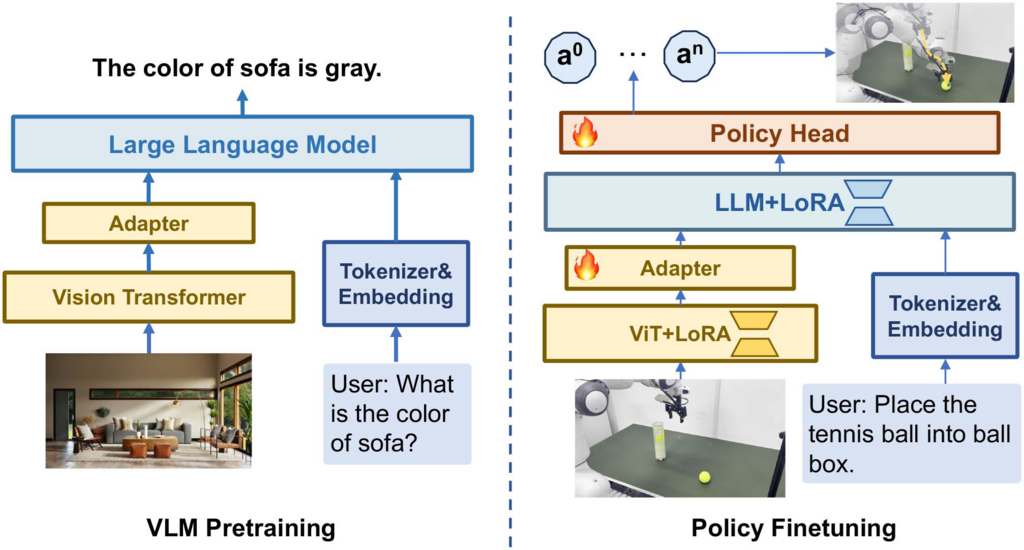
Another is Visual Question Answering (VQA). You can show the VLM that same image and ask, "What time of day is it?" It can analyze the visual cues—the long shadows, the orange sky—and answer, "It is sunset." This goes beyond simple object recognition; it requires reasoning about the contents of the image.
VLMs also power text-based image search and retrieval. Instead of searching for images using simple tags, you can search with a full sentence like, "Show me photos of a brown dog catching a red ball in a grassy field." The model understands the objects, their attributes, and their relationships to find the right images.
They're also fundamental to text-to-image generation. When you type a creative prompt and an AI generates a unique image, it's a VLM working in reverse. It takes your words and translates them into a visual representation.
A Quick History
The idea of combining vision and language isn't new, but early attempts were often clunky. They typically involved separate models—one for vision, one for language—that would pass information back and forth. The real breakthrough came with new architectures that could process both types of data within a single, unified system.
Two landmark models helped pave the way for modern VLMs.
VisualBERT was one of the first to take a successful language model, BERT, and adapt it to see. It works by converting parts of an image into representations that are similar to how it represents words. It then processes the actual words of a sentence and these "image words" together, allowing it to learn direct connections between them.
Then came CLIP (Contrastive Language-Image Pre-training). Instead of trying to fuse text and image data from the start, CLIP was trained on a massive dataset of 400 million image-caption pairs from the internet. Its goal was simple: given a batch of images and a batch of captions, figure out which caption goes with which image. By learning this matching game at an enormous scale, CLIP developed a powerful, flexible understanding of how language describes the visual world. This approach proved incredibly effective for a wide range of tasks, including highly accurate zero-shot image classification.
These models demonstrated the power of training on vast amounts of data and integrating vision and language more deeply than ever before. They set the stage for the powerful and versatile VLMs we see today.
What is the primary function of a Vision-Language Model (VLM)?
If you provide an AI with a picture of a cat sleeping on a red sofa and ask, "What color is the sofa?", what specific VLM task is being performed?