Mastering Vibration Spectrum Analysis
Spectrum Fundamentals and Parameters
Setting the Stage for a Clear Spectrum
A time waveform is a rich source of data, but the frequency spectrum is where specific machinery faults reveal themselves. To get a useful spectrum, you can't just press a button. You need to tell your analyzer what to look for by setting two key parameters: the maximum frequency, or Fmax, and the Lines of Resolution, or LOR.
Fmax defines the upper limit of your measurement window. If you're hunting for a gear mesh problem that you expect to see around 120,000 CPM (2,000 Hz), setting an Fmax of 60,000 CPM (1,000 Hz) means you'll miss it completely. A good rule of thumb is to set your Fmax to at least 3.25 times the running speed for general-purpose monitoring, and higher for specific high-frequency fault types.
Lines of Resolution determine the level of detail within that frequency window. Think of it like pixels in a photograph. A spectrum with 400 lines divides your Fmax into 400 discrete “bins.” A spectrum with 3200 lines divides the same Fmax into 3200 bins, giving you a much sharper, more detailed view. This detail is crucial for separating frequencies that are very close together.
Each of these “bins” represents a specific frequency range. If your Fmax is 1,000 Hz and you use 400 lines of resolution, each bin is 2.5 Hz wide (). Any vibration occurring between 0 Hz and 2.5 Hz will show up in the first bin, anything between 2.5 Hz and 5.0 Hz in the second, and so on. If two distinct fault frequencies fall into the same bin, they'll appear as a single peak.
The Resolution Trade-off
Increasing the Lines of Resolution seems like an obvious choice for getting a better picture, but it comes at a cost: time. To achieve higher resolution, the analyzer must collect data for a longer period.
The math is straightforward. The total time required for a measurement, called the time block (), is the inverse of the frequency resolution (). So, to improve your resolution (making smaller), you must increase the measurement time ().
Let's apply this to a common diagnostic challenge: separating the running speed of an induction motor from its pole pass frequency. An 1800 RPM motor (30 Hz) might have a pole pass frequency just slightly lower, say at 1785 RPM (29.75 Hz). The difference is only 0.25 Hz.
To see two distinct peaks, our frequency resolution () must be less than 0.25 Hz. Let's say we need a resolution of 0.125 Hz to be safe. If our Fmax is 1000 Hz, how many LOR do we need?
lines.
This would require a time block of seconds. If we only used 1600 lines, our resolution would be . This is too coarse, and the two frequencies would merge into a single, smeared peak, hiding the underlying issue.
Refining the Signal
Setting Fmax and LOR gets you most of the way there, but two other processes are vital for a clean, accurate spectrum: windowing and averaging.
The math behind the (FFT) assumes the measured time block contains a signal that repeats perfectly from end to end. In reality, this is never true. Your 8-second measurement is just a snapshot of a continuous vibration. This mismatch between the start and end of the sample causes an error called spectral leakage, which smears the energy of a sharp peak across adjacent frequency bins, distorting its true amplitude and shape.
To fix this, we apply a windowing function. A window is a mathematical function that gently tapers the signal at the beginning and end of the time block down to zero. This forces the sample to meet the FFT's requirement of being periodic, drastically reducing spectral leakage. The is the most common choice for general machinery vibration analysis, offering a good balance between frequency resolution and amplitude accuracy.
Averaging is another technique to improve data quality, especially on machines with fluctuating loads or noisy signals. Instead of relying on a single 8-second measurement, the analyzer can take multiple measurements and average them together. This process reinforces the steady, periodic signals related to machine health while random, noisy signals tend to cancel themselves out, resulting in a much cleaner spectrum.
Avoiding Phantom Frequencies
One of the most dangerous pitfalls in digital signal processing is It's a phenomenon where high-frequency signals masquerade as lower frequencies if the signal is not sampled fast enough. The rule to prevent this is called the Nyquist criterion: the sampling rate () must be at least twice the highest frequency present in the signal.
Your vibration analyzer handles this automatically. The sampling rate is directly tied to your chosen Fmax. Typically, the analyzer will sample at 2.56 times the Fmax. For an Fmax of 1000 Hz, the sampling rate would be 2560 samples per second.
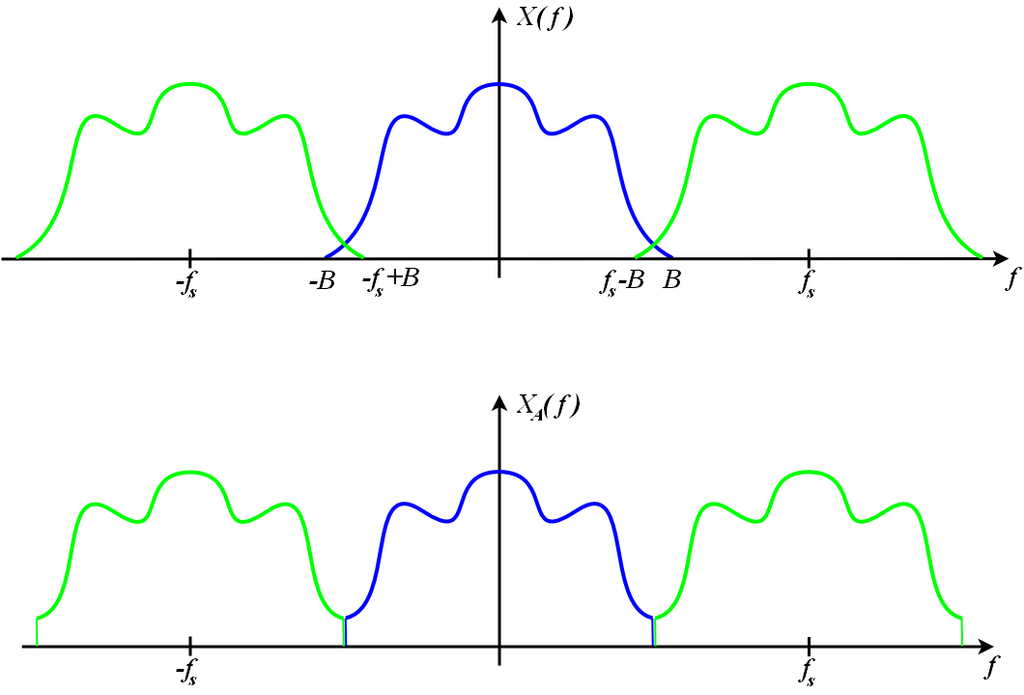
But what if there's an unexpected vibration happening above your Fmax? For example, you set Fmax to 1000 Hz, but a hidden gear problem is generating a signal at 1600 Hz. The sampling rate of 2560 Hz is not high enough to properly capture the 1600 Hz signal ( would be needed).
This 1600 Hz signal will be aliased and show up as a phantom peak in your spectrum at Hz. You would then waste time trying to diagnose a non-existent 960 Hz problem.
To prevent this, analyzers are equipped with anti-aliasing filters. These are sharp, low-pass hardware filters that aggressively cut off any signal content above your Fmax before the signal is ever sampled. This ensures that the only data being digitized is within the frequency range you intended to analyze, protecting your data from corruption by aliasing.
By correctly setting Fmax, Lines of Resolution, and understanding the roles of windowing, averaging, and anti-aliasing filters, you can ensure your spectrum is a true and accurate representation of your machine's health.
You are monitoring a machine with a running speed of 1800 CPM. Using the general rule of thumb to set your Fmax to at least 3.25 times the running speed, what is the minimum recommended Fmax for general-purpose monitoring?
What is the primary trade-off when you increase the Lines of Resolution (LOR) for a vibration spectrum measurement?