Mastering Vehicle Mechanics and Operation
System Interdependence
The Connected Car
A modern vehicle is more than just an engine, wheels, and a steering wheel. It's a complex, interconnected system where the performance of one component directly impacts another. The engine, transmission, and cooling system form a critical trio that must work in harmony to maintain equilibrium. Think of it less like a collection of separate parts and more like a delicate dance of mechanical force and thermal energy.
At the center of this dance is the Engine Control Unit (ECU), the vehicle's onboard computer. The ECU acts as a central command, constantly receiving data, making decisions, and sending instructions to ensure everything runs smoothly. It relies on a network of sensors to get a real-time picture of what's happening.
ECU Feedback Loops
Two of the most important sensors feeding the ECU information are the Mass Air Flow (MAF) sensor and the Oxygen (O2) sensor. The MAF sensor measures the amount of air entering the engine, while the O2 sensor measures the amount of unburned oxygen in the exhaust. The ECU uses this data to make continuous adjustments to the fuel injection system.
The goal is to maintain the ideal air-fuel mixture, known as the This ratio is approximately 14.7 parts air to 1 part fuel by mass. When this ratio is maintained, the engine achieves nearly complete combustion, maximizing power while minimizing harmful emissions. The ECU constantly adjusts what are known as 'fuel trims'—tiny, precise changes to the amount of fuel injected—to chase this perfect balance. A fault in either sensor can throw the whole system off, leading to poor fuel economy, increased emissions, and even engine damage.
The ECU manages a continuous feedback loop: sensors provide data, the ECU processes it, and actuators (like fuel injectors) carry out commands. This loop happens hundreds of times per second.
Thermal Management
An internal combustion engine is essentially a heat engine; it converts the thermal energy from burning fuel into mechanical work. However, only about 20-30% of that energy actually moves the car. The rest is lost, primarily as heat. Managing this waste heat is the job of the cooling system.
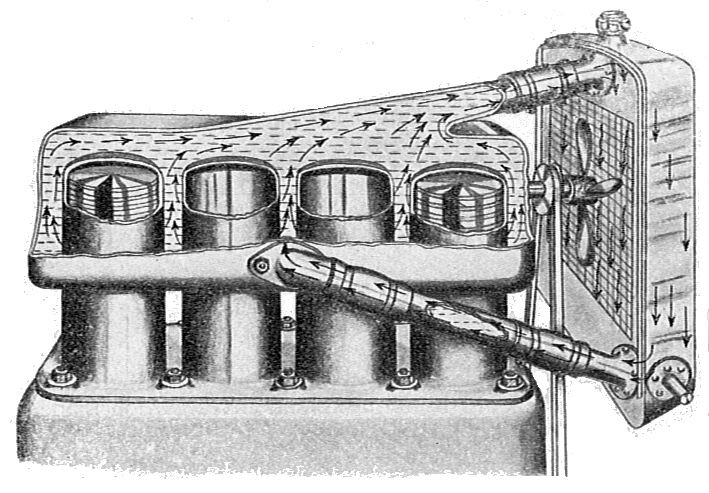
The cooling system doesn't just prevent overheating; it maintains the engine's ideal operating temperature, typically between 195-220°F (90-104°C). An engine that runs too cool is inefficient and produces more emissions. The key component in this regulation is the thermostat, a simple valve that opens and closes based on coolant temperature. When the engine is cold, the thermostat stays closed, allowing the coolant in the engine block to warm up quickly. Once it reaches the target temperature, the thermostat opens, letting coolant flow to the radiator to dissipate excess heat.
Drivetrain and Cooling Synergy
The engine isn't the only component that generates significant heat. The transmission, especially in automatic vehicles, also gets very hot. The primary source of this heat is the , a fluid coupling that connects the engine to the transmission. The fluid shear and turbulence inside the converter create a massive amount of heat, especially under heavy load or when the vehicle is stopped in gear.
To manage this, transmission fluid must also be cooled. In most passenger cars, the transmission cooler is integrated into the engine's radiator. Hot transmission fluid is pumped into a separate chamber or set of tubes inside one of the radiator's end tanks. It transfers its heat to the engine coolant, which then gets dissipated to the air passing through the radiator fins.
This is a direct link: a failure in the engine's cooling system can quickly become a failure in the transmission. A simple coolant leak can cause the engine to run hot, which reduces the radiator's ability to cool the transmission fluid. Overheated transmission fluid breaks down rapidly, leading to poor shifting, internal damage, and eventual transmission failure.
This interdependence means a problem's root cause can be deceptive. For example, a failing O2 sensor causes the ECU to miscalculate the air-fuel ratio, leading to a rich condition. This unburned fuel can ignite in the exhaust manifold, raising engine temperatures. This puts extra stress on the cooling system, which in turn elevates transmission fluid temperatures. What starts as a simple sensor fault can cascade into a major drivetrain problem. Understanding these connections is key to diagnosing issues correctly.
Time to test your knowledge on how these systems work together.
What is the primary role of the Engine Control Unit (ECU) in a modern vehicle?
The ideal air-fuel mixture for complete combustion, approximately 14.7 parts air to 1 part fuel, is known as the _______ ratio.
By viewing the vehicle as a unified system, you can better appreciate the intricate balance required for it to operate reliably and efficiently.