Mastering Variable Length Coding
Introduction to Variable-Length Coding
Smarter Codes, Smaller Files
Think about how we text. We don't always type out "laughing out loud". We use "lol". It's shorter and everyone knows what it means. We do this naturally to save time and effort. Computers can do something similar to save space, and the technique is called variable-length coding.
At its heart, data compression is about saying the same thing with fewer bits. One of the most common ways to represent characters in a computer is with a fixed-length code. For example, the ASCII system uses a set number of bits, typically eight, for every single character, whether it's an 'e' or a 'z'.
Fixed-length coding is like giving every word in a dictionary its own seven-digit phone number. It's organised, but not very efficient for the words we use all the time.
Let's look at the word "banana". It has six letters, but only three unique characters: 'b', 'a', and 'n'. With a simple fixed-length code, we need at least two bits per character to distinguish between them.
| Character | Fixed-Length Code |
|---|---|
| b | 00 |
| a | 01 |
| n | 10 |
Using this scheme, "banana" becomes "000110011001". That's a total of 12 bits. It works, but we can do better. Notice that 'a' appears three times, 'n' twice, and 'b' only once. What if we gave the most common character, 'a', a shorter code?
The Efficiency of Frequency
This is the core idea of variable-length coding: assign shorter codes to frequent symbols and longer codes to infrequent ones. It's a simple concept with a powerful impact. Let's create a new set of codes for our characters in "banana".
| Character | Frequency | Variable-Length Code |
|---|---|---|
| a | 3 | 0 |
| n | 2 | 10 |
| b | 1 | 110 |
Now, let's encode "banana" again: "1100100100". This version is only 10 bits long. We've saved two bits, which is a 17% reduction in size. On a small word, the savings are modest. But scale this up to a book, an image, or a video file, and the savings become enormous. This is how file compression formats like ZIP work their magic.
Information and Surprise
Why does this work so well? It taps into a fundamental concept from information theory called entropy. In simple terms, entropy is a measure of surprise or uncertainty. An event that is very likely, like the sun rising tomorrow, contains very little surprise and therefore very little new information. An unlikely event, like seeing a pig fly, is a huge surprise and carries a lot of information.
In our "banana" example, seeing the letter 'a' is not very surprising because it's so common. Seeing a 'b' is more surprising. Variable-length coding schemes are designed to use fewer bits for the unsurprising, low-information symbols and more bits for the surprising, high-information ones. This aligns the length of the code with the amount of information each symbol actually carries, squeezing out redundancy.
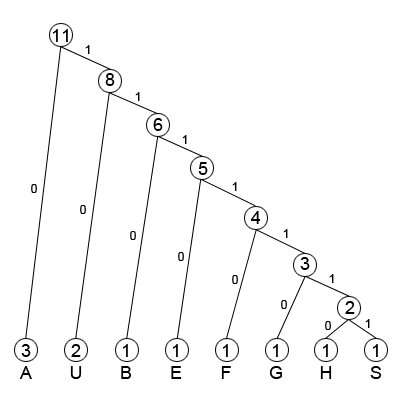
This principle is the foundation for many compression algorithms. It allows us to send emails, stream videos, and store vast libraries of data more efficiently. By encoding information more intelligently, we make better use of our digital storage and bandwidth. In later sections, we'll explore specific algorithms like Huffman coding that put these powerful ideas into practice.
Time to check your understanding.
What is the core principle of variable-length coding?
In the word "MISSISSIPPI", which letter would be assigned the shortest code using an efficient variable-length coding scheme?
Variable-length coding is a simple but powerful tool for making data smaller by getting rid of statistical redundancy.