Mastering Unstructured Data
Introduction to Unstructured Data
What Is Unstructured Data?
Most of the world's data is a bit of a mess. Think about the text in an email, a photo on your phone, or a song you stream. This is all unstructured data. It's information that doesn't have a predefined model or organization. It doesn't fit neatly into rows and columns like a spreadsheet.
Unstructured data is all around us. Common examples include:
- Text: Emails, social media posts, reports, and articles.
- Images: JPEGs, GIFs, and PNGs from photos or medical scans.
- Audio: MP3s, WAVs, and other sound files like podcasts or phone calls.
- Video: Recordings from security cameras, movies, or online meetings.
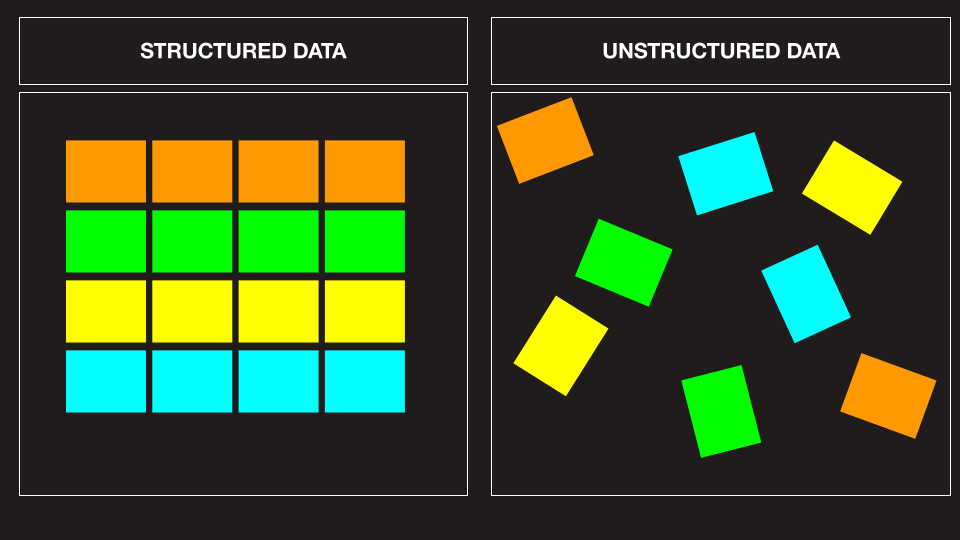
Structured vs. Unstructured
The easiest way to understand unstructured data is to compare it to its opposite: structured data. Imagine a well-organized filing cabinet where every folder is labeled and every document is in its proper place. That's structured data. It's highly organized and easy to search. A customer database with names, addresses, and phone numbers in separate columns is a classic example.
Unstructured data is like a giant, messy pile of papers, photos, and tapes in the middle of a room. The information is all there, but it's not organized in a predictable way. You have to sort through it to find what you need.
| Feature | Structured Data | Unstructured Data |
|---|---|---|
| Organization | Predefined model (rows, columns) | No predefined model |
| Format | Typically text-based, numerical | Text, images, audio, video |
| Examples | Excel sheets, SQL databases | Emails, social media, PDFs |
| Searchability | Easy to search and query | Difficult to search |
| Amount | About 20% of enterprise data | About 80% of enterprise data |
Unstructured data doesn’t fit neatly into the traditional row and column structure of relational databases, and represent the vast majority of data available in the actual world.
The Challenge of Unstructured Data
Working with unstructured data is tricky. Because it lacks a uniform format, it's difficult for computers to process and analyze. A machine can easily read a column of dates, but it's much harder for it to understand the sentiment of an email, identify a person in a photo, or transcribe a conversation from an audio file.
The sheer volume and variety make it a complex puzzle. Before you can get any insights from it, the data needs to be sorted, categorized, and given some form of structure. This process is the fundamental challenge that fields like data science and artificial intelligence work to solve.
Now, let's check your understanding of these core concepts.
Which of the following is an example of structured data?
What is the main reason computers find it difficult to process unstructured data?
Understanding the difference between structured and unstructured data is the first step in learning how we can make sense of the vast amounts of information in our world.