Mastering University Math from Foundations
Arithmetic Fundamentals
The Building Blocks of Numbers
Arithmetic is the foundation of math. It starts with whole numbers and the four basic operations: addition, subtraction, multiplication, and division. These are the tools we use to combine, separate, and scale quantities in the world around us. Think of adding groceries to your cart, subtracting expenses from your budget, or multiplying ingredients for a recipe.
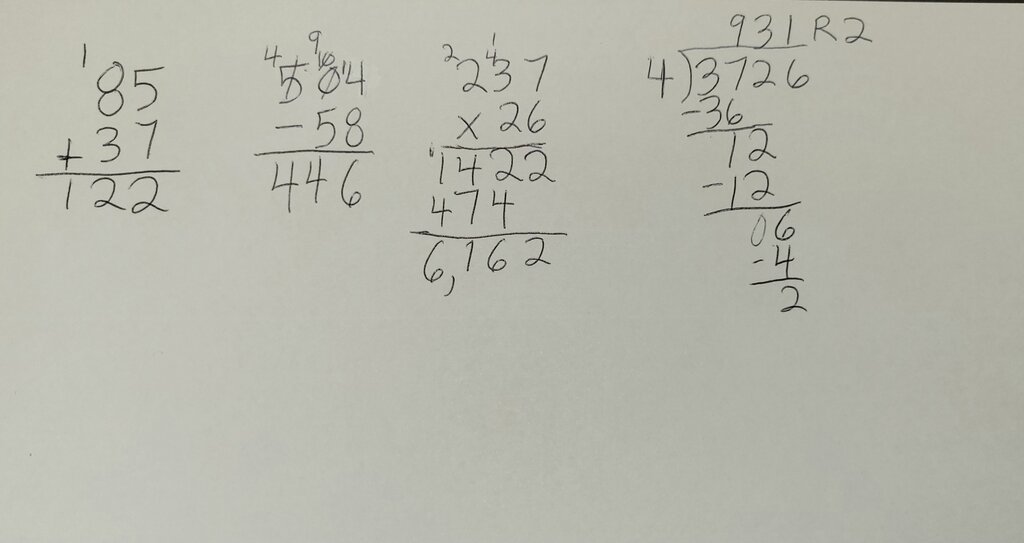
Beyond just doing the calculations, it helps to understand a few basic rules, or properties, that numbers follow. These properties make calculations easier and more flexible.
Commutative Property
adjective
The order of numbers doesn't change the result. This applies to addition and multiplication.
This property is like putting on your socks. It doesn't matter if you put the left or right one on first; the result is the same.
Associative Property
adjective
How you group numbers in a longer calculation doesn't change the result. This also applies to addition and multiplication.
Imagine you're adding up the cost of three items. You can add the first two and then the third, or add the second and third and then the first. You'll get the same total either way.
Distributive Property
adjective
This property links multiplication and addition. It lets you 'distribute' a multiplier to each number in a sum.
Working With Parts
Not everything in life is a whole number. We often deal with parts of things, which is where fractions come in. A fraction represents a part of a whole, like a slice of pizza or half of an hour.
To add or subtract fractions, they must have the same denominator. The denominator is the bottom number, and it tells you how many equal parts the whole is divided into. If the denominators are different, you need to find a common denominator before you can do the math.
Multiplication and division are more direct. To multiply fractions, you just multiply the numerators (top numbers) together and the denominators together.
To divide by a fraction, you flip the second fraction over (find its reciprocal) and multiply.
This makes sense: how many quarters are in a half? The answer is two.
The Point of Decimals
Decimals are another way to write fractions, specifically fractions with denominators of 10, 100, 1000, and so on. They are often easier to work with, especially when using a calculator. The key to decimal arithmetic is the decimal point.
When adding or subtracting decimals, always line up the decimal points. This ensures you're adding tenths to tenths, hundredths to hundredths, and so on.
  2.45
+ 1.80
------
  4.25
When you multiply decimals, you can ignore the decimal points at first. Multiply the numbers as if they were whole numbers. Then, count the total number of decimal places in the original numbers and put that many places in your answer.
For example, to multiply , you'd first calculate . Since has one decimal place and has one, the answer must have two decimal places: .
Percentages in Real Life
Percentages are a special kind of fraction where the denominator is always 100. The word "percent" literally means "per hundred." We use them everywhere, from store discounts to bank interest rates. Since they are just fractions and decimals in disguise, you can easily convert between them.
| Fraction | Decimal | Percent |
|---|---|---|
| 1/2 | 0.5 | 50% |
| 3/4 | 0.75 | 75% |
| 1/5 | 0.20 | 20% |
| 1/100 | 0.01 | 1% |
Calculating a percentage of a number is a common task. To find a percentage, you convert it to a decimal or fraction and then multiply.
Let's say you want to find 25% of 80. You can convert 25% to the decimal 0.25.
So, a 25% discount on an 💲80 item would save you 💲20.
Now let's review these core concepts.
Ready to test your knowledge?
Which of the following lists the four basic operations of arithmetic?
What is the first step you must take when adding fractions with different denominators, such as ?
Mastering these operations is the first step toward confidence in math. They are the tools you'll use again and again in more complex problems.