Mastering Units and Measurements for NEET Physics
Fundamental Units
The Language of Measurement
Physics describes the universe, from the tiniest particles to the largest galaxies. To do this accurately, scientists need a shared, consistent language. This isn't a language of words, but of measurements. Every physical quantity, whether it's the speed of a car or the temperature of a star, needs to be described with a number and a unit.
Without a standard unit, a number is meaningless. Saying a distance is "10" tells us nothing. Is it 10 feet, 10 miles, or 10 millimeters? The unit provides the context.
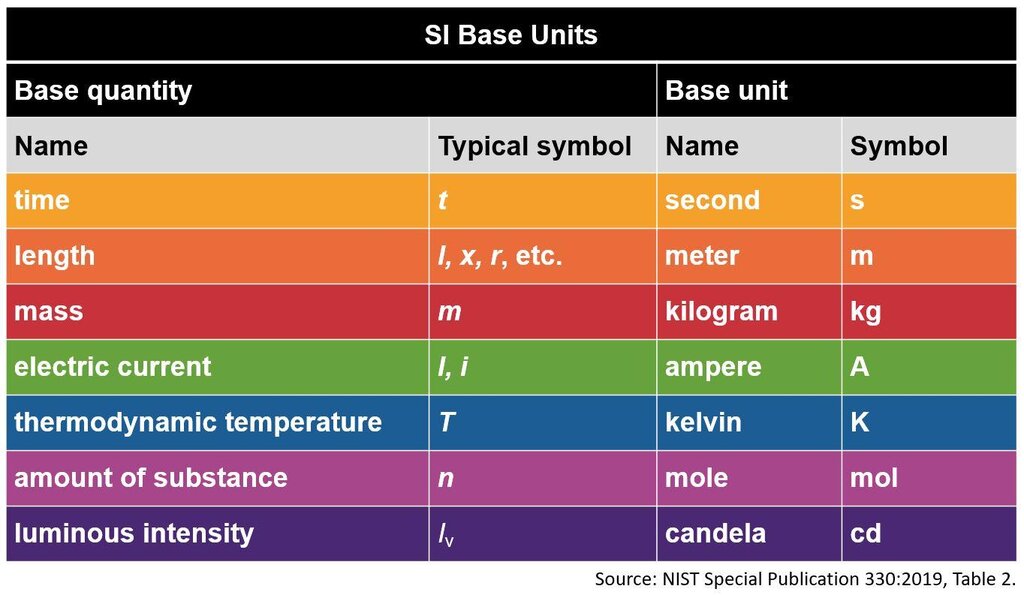
To solve this problem, scientists around the world agreed on a single system of measurement: the International System of Units, or SI for short (from the French Système International). This system is the foundation for all scientific and technical measurement. It's built upon seven fundamental units, known as base units. Every other unit we use in physics can be derived from these seven.
The Seven Base Units
Think of these seven units as the primary colors of measurement. By mixing them in different ways, we can describe any physical phenomenon. Each base unit corresponds to a fundamental physical quantity.
| Base Quantity | Unit Name | Symbol |
|---|---|---|
| Length | meter | m |
| Mass | kilogram | kg |
| Time | second | s |
| Electric Current | ampere | A |
| Temperature | kelvin | K |
| Amount of Substance | mole | mol |
| Luminous Intensity | candela | cd |
Each of these units has a very precise, formal definition based on fundamental constants of nature. For example, the second is defined based on the frequency of a specific transition in a cesium-133 atom. This ensures that a second measured in a lab in Japan is exactly the same as a second measured in a lab in the United States.
Building with Base Units
While the seven base units are fundamental, we often need to measure quantities that are combinations of them. These are called derived units. They are created by multiplying or dividing the base units.
For instance, speed is the distance traveled over a certain time. In SI units, this is measured in meters per second. We derive the unit for speed by dividing the base unit for length (meter) by the base unit for time (second).
Let's look at the notation. Meters per second is written as m/s or . The unit for area would be square meters (), and the unit for volume would be cubic meters (). Another common derived unit is the newton (N), the unit of force. It's defined as the force needed to accelerate a 1-kilogram mass at 1 meter per second squared. Its composition from base units is .
This system of building complex units from a simple, standardized base is what makes the SI system so powerful and universally understood. It ensures that when scientists share their results, they are all speaking the same language.
What is the primary purpose of the International System of Units (SI)?
Which of the following is a derived unit, not a base unit?