Mastering U-Substitution in Calculus
Introduction to Integration
The Opposite of a Derivative
In calculus, differentiation lets us find the rate of change of a function. For example, if a function describes a car's position over time, its derivative gives us the car's velocity at any moment. Integration does the exact opposite. If you have the velocity, integration helps you find the original position.
Because it reverses differentiation, integration is also called antidifferentiation. The goal is to find the original function when you only know its derivative. Imagine you know the derivative of some function is . What was the original function? You might guess . And you'd be right, because the derivative of is indeed . But what about ? Its derivative is also . The same goes for .
This puzzle leads us to an important part of integration: the constant of integration.
Indefinite and Definite Integrals
There are two main types of integrals. The first, the indefinite integral, is the one that deals with the puzzle we just saw. It gives us the general family of functions that could be the antiderivative. When we integrate , the answer isn't just , but . The '' stands for any constant. It’s our way of saying that any constant could have been part of the original function before it disappeared during differentiation.
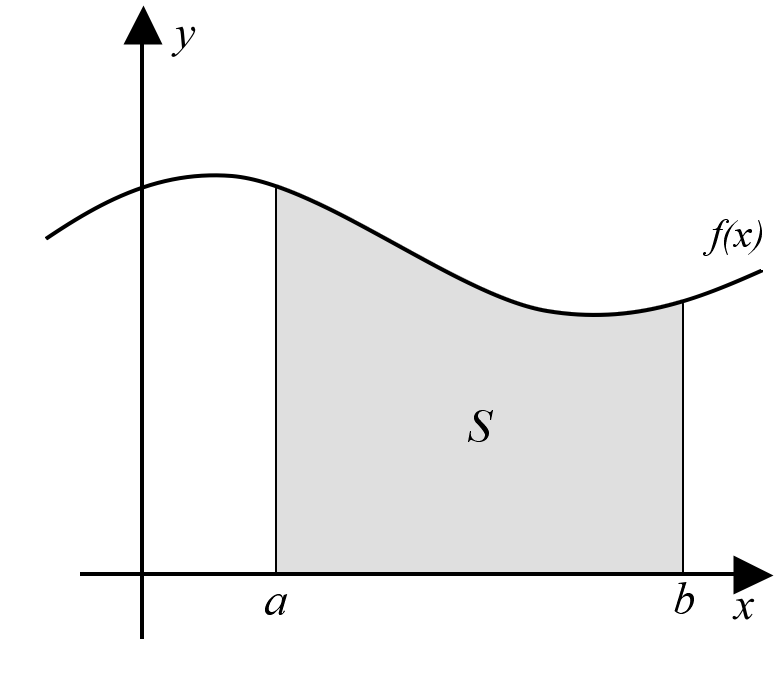
The second type is the definite integral. This is where integration gets really powerful. Instead of finding a general function, a definite integral calculates a specific number. That number represents the cumulative total of a function's values between two points, which visually corresponds to the area under the function's curve.
An indefinite integral gives you a function (), while a definite integral gives you a number (like the area).
The notation for an indefinite integral is . The symbol is the integral sign, is the function we're integrating (the integrand), and indicates that we are integrating with respect to the variable .
A definite integral adds 'limits of integration'. It looks like this: . Here, 'a' is the lower limit and 'b' is the upper limit. This tells us to find the net area under the curve of from to .
Basic Integration Rules
Just like with derivatives, there are rules to make integration easier. The most fundamental one is the reverse of the power rule for derivatives.
To integrate a variable raised to a power, you increase the exponent by one and then divide by the new exponent.
Let's try it. To find :
- Add 1 to the exponent: .
- Divide by the new exponent: .
- Add the constant of integration: .
You can always check your work by taking the derivative. The derivative of is . It works!
Another simple rule involves constants. If you're integrating a constant, you just multiply it by .
Why Integration Matters
Integration isn't just for finding areas under curves. It's about accumulation. It helps us sum up infinitely small pieces to find a whole.
In physics, if you know an object's acceleration, you can integrate to find its velocity, and then integrate again to find its position. In finance, if a company knows its marginal revenue (the revenue from selling one more item), it can integrate to find the total revenue from selling a certain number of items. Engineers use it to calculate the volume of objects or the pressure exerted by a fluid.
Integrals are essentially about accumulation, and they are used to calculate areas, volumes, and other quantities that add up infinitesimally small elements.
Understanding this concept of accumulation is the key to seeing where integration applies in the world around us. Let's test your knowledge of these core ideas.
Integration is often called by another name that highlights its relationship with differentiation. What is that name?
Why must the constant of integration, 'C', be added to the result of an indefinite integral?
Now that you've got the basics down, you're ready to explore the specific techniques that make solving more complex integrals possible.