Mastering Trigonometric Principles
Unit Circle Connections
Beyond Right Triangles
You're likely familiar with sine, cosine, and tangent from right-angled triangles. That's a great start, but it limits us to angles between 0 and 90 degrees. To work with any angle, we need a more powerful tool: the unit circle.
Unit Circle
noun
A circle on the Cartesian coordinate plane with a radius of exactly 1, centered at the origin (0,0). Its equation is .
Imagine drawing a line from the origin to any point on the edge of this circle. This line is the radius, so its length is 1. It forms an angle, , with the positive x-axis. This setup creates a right-angled triangle inside the circle.
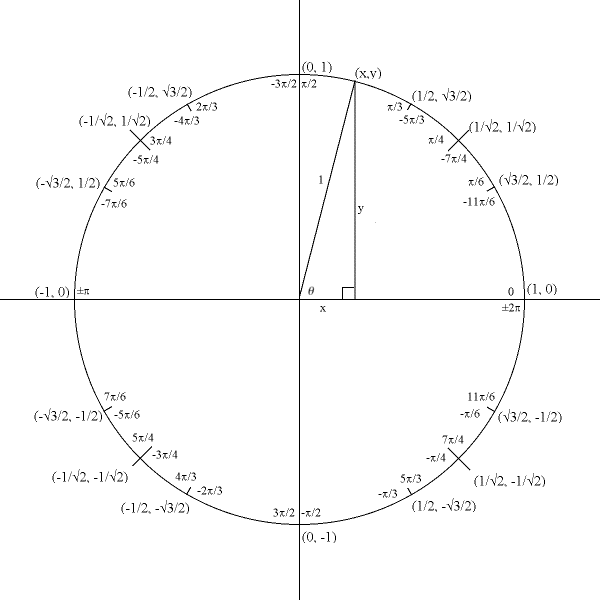
Using our basic trigonometric ratios, we know that is the adjacent side over the hypotenuse, and is the opposite side over the hypotenuse. In our unit circle, the adjacent side is the x-coordinate, the opposite side is the y-coordinate, and the hypotenuse is the radius, which is 1.
This simple but powerful connection is the foundation for extending trigonometry to all angles. By tracking the coordinates as we move around the circle, we can find the sine and cosine for any angle, even those greater than 90° or less than 0°.
A Better Way to Measure Angles
Degrees are useful, but in physics and engineering, a more natural unit for angles is the radian measure. A radian is defined by the arc length it cuts out on a circle. Specifically, one radian is the angle created when the arc length is equal to the circle's radius.
Since the circumference of a circle is , a full rotation of corresponds to an arc length of times the radius. This gives us a direct conversion.
Values in Every Quadrant
The coordinate plane is divided into four quadrants. As our angle moves from one quadrant to another, the signs of the x and y coordinates change. Since and , the signs of our trigonometric functions also change.
| Quadrant | Angle (Degrees) | Angle (Radians) | x = cos(θ) | y = sin(θ) |
|---|---|---|---|---|
| I | 0° to 90° | 0 to π/2 | Positive | Positive |
| II | 90° to 180° | π/2 to π | Negative | Positive |
| III | 180° to 270° | π to 3π/2 | Negative | Negative |
| IV | 270° to 360° | 3π/2 to 2π | Positive | Negative |
To find the trigonometric values for an angle greater than 90°, we use a concept called the (). This is the smallest acute angle that the terminal side of our angle makes with the horizontal x-axis. The value of the trig function for will be the same as for , but the sign will depend on the quadrant.
For example, the reference angle for 150° is 30° (since 180° - 150° = 30°). So, and , because in Quadrant II, sine (y) is positive and cosine (x) is negative.
Special Angles
For certain common angles like 30° (), 45° (), and 60° (), we can find the exact coordinates on the unit circle using geometry, based on the properties of special right triangles (30-60-90 and 45-45-90 triangles) where the hypotenuse is 1.
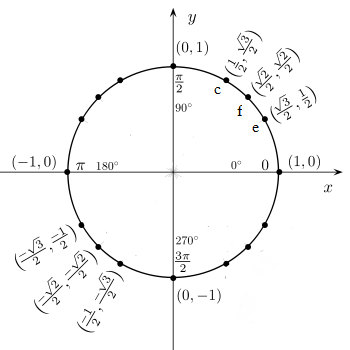
These values are fundamental in trigonometry and appear frequently in various scientific fields. Memorising them, or at least understanding how to derive them quickly, is incredibly useful.
| Degrees | Radians | (x, y) = (cos θ, sin θ) |
|---|---|---|
| 30° | ||
| 45° | ||
| 60° |
Using these special angles and our knowledge of reference angles, we can now find the exact trigonometric values for many more angles around the entire circle.
Now let's test your understanding.
On the unit circle, what is the relationship between the coordinates of a point (x, y) and the angle θ it forms with the positive x-axis?
In which quadrant are both sine and tangent negative?