Mastering Transistor Circuit Design
BJT Operational Mechanics
The Transistor as a Valve
A Bipolar Junction Transistor, or BJT, acts like a tiny, electrically controlled valve. Unlike a simple switch that's just on or off, a BJT can precisely regulate the flow of a large current using a very small one. This ability to amplify current is what makes transistors the foundation of modern electronics.
To open this valve, we need to forward bias the base-emitter junction. Since you're familiar with diodes, this should sound familiar. The base-emitter junction is essentially a P-N junction. Just like a silicon diode, it requires a voltage of about 0.6V to 0.7V to turn on and allow current to flow from the base to the emitter.
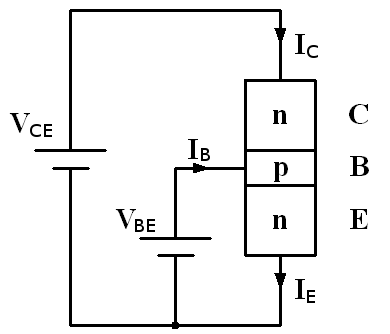
Once this base-emitter voltage () is applied, the valve is open. A small base current () begins to flow. This small current is the control signal that enables a much larger current, the collector current (), to flow from the collector to the emitter. The relationship between these currents is the transistor's defining characteristic.
Current Gain and Beta
The magic of the BJT lies in its ability to amplify. The collector current isn't just enabled by the base current; it's directly proportional to it. This proportional relationship is defined by a parameter called Beta, or hFE (Hybrid parameter Forward current gain, common-Emitter configuration).
Beta is a unitless ratio that tells you how much the transistor amplifies the base current. A typical BJT might have a value between 50 and 200. This means for every 1 milliamp of current flowing into the base, 50 to 200 milliamps can flow through the collector.
Since charge can't be created or destroyed, the current flowing out of the emitter () is simply the sum of the currents flowing in.
Charge Carrier Mobility
BJTs come in two flavors: NPN and PNP. The difference lies in their internal sandwich of P-type and N-type semiconductor material and, crucially, in what carries the charge.
In an NPN transistor, the majority of the current is carried by electrons flowing from the emitter to the collector. In a PNP transistor, the current is carried by the movement of "holes" (the absence of electrons). Electrons are significantly more mobile than holes—they can move through the silicon lattice about twice as fast. This higher means NPN transistors can switch on and off much faster than their PNP counterparts. For this reason, NPN transistors are far more common in high-frequency and fast-switching applications, like in computer processors and radio circuits.
While PNP transistors are slower, they are essential for complementary circuit designs, like push-pull amplifiers, where they work in tandem with NPN transistors.
A Real-World Complication
Our model so far () assumes the transistor is a perfect current source. In reality, it's not quite that simple. The collector current is also slightly affected by the voltage between the collector and emitter (). As increases, the collector current also increases slightly, even if the base current is held constant.
This phenomenon is known as the , named after its discoverer, James M. Early. It's caused by the widening of the depletion region at the reverse-biased collector-base junction as goes up. This effectively shortens the active base region, which allows a little more current to flow. For most basic analyses, you can ignore this, but in high-precision circuits like current sources or high-gain amplifiers, it becomes an important factor to model. It gives the transistor a finite output resistance rather than an infinite one.
Here, we resort to the geometrical structure imposed on BJTs behavior by the Early effect and voltage as a means to derive a simple, intuitive and more complete respective model that, though excluding cut-off and saturation regimes, can simplify the design and characterization of BJTs and respective circuits, including integrated devices.
With this understanding of how a BJT operates, you can begin to see how it functions as the building block for amplifiers and digital logic circuits.
What is the primary function of a Bipolar Junction Transistor (BJT) in an electronic circuit?
For a typical silicon BJT to be 'turned on', what condition must be met at the base-emitter junction?