Mastering Tower Speaker Performance
Advanced Cabinet Engineering
The Silent Partner in Sound
A speaker driver creates sound by moving back and forth, pushing air. But the sound waves coming from the back of the driver are just as powerful as those from the front. A speaker cabinet, or enclosure, isn't just a box to hold the components. Its primary job is to manage those rearward sound waves to prevent them from cancelling out the forward waves and to shape the overall sound.
The two most common approaches to this challenge are sealed and ported designs, each with a distinct philosophy on how to handle the air pressure inside the box.
Sealed vs Ported Enclosures
A sealed enclosure, also known as an acoustic suspension design, is exactly what it sounds like: an airtight box. The air trapped inside acts like a spring, compressing as the woofer moves in and creating a vacuum as it moves out. This spring-like action provides tight control over the driver's movement, resulting in a very accurate and articulate bass. The trade-off is that this design is less efficient and the bass begins to roll off at a higher frequency compared to ported designs.
A ported or bass reflex design takes a different approach. It features a vent, or port, that allows air to move in and out of the cabinet. This port is tuned to a specific frequency, acting like a Helmholtz resonator. When the woofer produces frequencies near this tuning, the port radiates sound that is in phase with the woofer, reinforcing the low-end output. This makes the speaker more efficient and allows for deeper bass extension from a given cabinet size. However, this can come at the cost of transient response, sometimes leading to a less precise or "boomy" sound if not engineered carefully.
| Feature | Sealed (Acoustic Suspension) | Ported (Bass Reflex) |
|---|---|---|
| Transient Response | Excellent (tight, fast bass) | Good (can be less precise) |
| Low-Frequency Roll-Off | Gradual (12 dB/octave) | Steep (24 dB/octave) |
| Bass Extension | Less deep for its size | Deeper for its size |
| Efficiency | Lower | Higher |
| Potential Issues | Limited deep bass output | Port noise ("chuffing"), group delay |
For designers seeking a middle ground, there's another option that combines attributes of both.
Passive Radiators and Cabinet Resonance
Enter the passive radiator. A passive radiator looks like a regular speaker driver but has no magnet or voice coil; it's just a cone in a frame. It's used in place of a port. As the active woofer moves, it changes the air pressure inside the cabinet, which in turn moves the passive radiator. It functions similarly to a port, extending bass response, but without the potential for air turbulence or "chuffing" noises at high volumes. This design can achieve low-frequency extension comparable to a ported box but in a smaller enclosure and often with better control.
Beyond controlling air pressure, a high-fidelity cabinet must control itself. The cabinet panels can vibrate in sympathy with the music, a phenomenon called cabinet resonance . When this happens, the box itself becomes a sound source, adding unwanted distortion and "colouration" to the audio. This is where material science and structural engineering come into play.
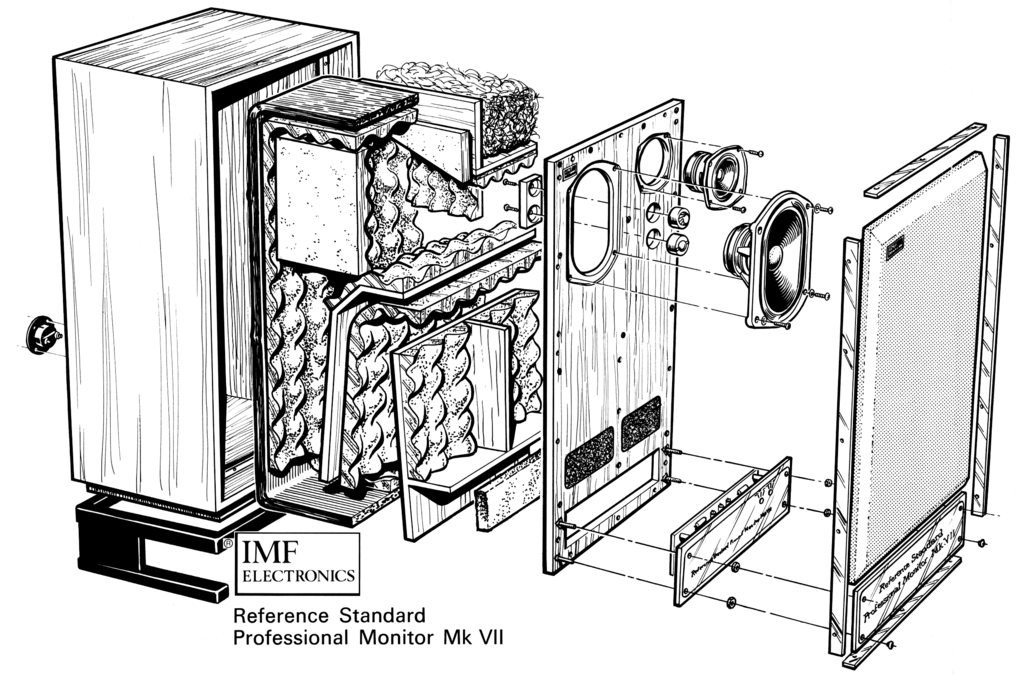
The most common material for speaker cabinets is high-density fibreboard (MDF) because it's dense, acoustically dead, and relatively inexpensive. More exotic designs might use aluminium, phenolic composites, or layered materials to achieve even greater rigidity. The goal is always to make the cabinet as inert as possible.
Internal bracing is crucial. By adding struts and panels inside the cabinet, engineers connect opposing walls, making them much stiffer. This doesn't eliminate resonance, but it pushes the resonant frequency higher, moving it out of the critical midrange where our ears are most sensitive. Damping materials like acoustic foam, wool, or bitumen pads are also used to line the interior walls, absorbing stray sound waves and converting vibrational energy into tiny amounts of heat.
Shaping Sound at the Edges
The final piece of the puzzle is the front face of the speaker, known as the baffle. When sound waves from a driver (especially a tweeter) travel across the baffle and hit its sharp edges, they tend to diffract, or bend, around the corner. This baffle diffraction creates a secondary, slightly delayed sound source that can interfere with the direct sound, causing dips and peaks in the frequency response and blurring the stereo image.
Engineers combat baffle diffraction by rounding the cabinet edges, recessing the drivers so they are flush with the baffle, or using absorbent materials like felt around the tweeters to absorb the sound waves before they reach the edge.
Ultimately, advanced cabinet engineering is a balancing act. It's a game of trade-offs between bass extension, accuracy, efficiency, and the physical constraints of the box itself. Every element, from the choice of materials to the radius of an edge, plays a role in the quest for pure, uncoloured sound.
What is the primary acoustic purpose of a speaker cabinet?
In a sealed enclosure, what provides the tight, accurate control over the woofer's movement?