Mastering TILT Framework Architecture
Deconstructing Purpose
The “Why” Behind the Work
Every assignment is a system designed to produce learning. The 'Purpose' statement is its foundational specification. It’s the mission statement that answers the most important question a student has: “Why am I doing this?” Without a clear answer, motivation suffers. When the 'why' is explicit, students can connect the work in front of them to their larger goals.
Learning outcomes give learners a sense of purpose for their learning, answering the frequently asked question, “Why am I learning this?”
A well-crafted Purpose statement isn't just a single sentence. It’s a clear deconstruction of the assignment's value, broken into two distinct parts: the skills students will practice and the knowledge they will gain. This separation is crucial. It moves beyond a vague goal like "Write a paper about the Civil War" and into a precise articulation of what a student will be able to do and what they will know by the end of the task.
Skills vs. Knowledge
Think of skills as the verbs and knowledge as the nouns of learning. Skills are transferable actions. Knowledge is the context, the theories, and the facts that give those actions meaning.
- Skills Practiced: This is about the how. It defines the cognitive and practical abilities the student is developing. Are they analyzing data, constructing an argument, synthesizing sources, or designing a solution? These are the durable competencies that will serve them long after the specific facts of the course have faded.
- Knowledge Gained: This is about the what. It specifies the core concepts, terminology, and information the student will command. What key theories will they be able to explain? What historical events will they be able to describe? What formulas will they be able to recall?
Separating them forces clarity. It ensures an assignment is not just a test of memory but a deliberate exercise in building valuable, real-world abilities. It also helps expose the by making the instructor's pedagogical goals transparent.
| Vague Purpose | Deconstructed Purpose |
|---|---|
| Write a research paper on renewable energy. | Skills Practiced: Formulate a research question, evaluate the credibility of scientific sources, synthesize information from multiple texts, and construct a persuasive, evidence-based argument. |
| Knowledge Gained: Define and compare different forms of renewable energy (solar, wind, geothermal), explain the economic and environmental trade-offs of each, and identify key policy initiatives shaping the industry. |
Using Measurable Verbs
To make skill and knowledge objectives truly effective, they must be measurable. This is where becomes an essential tool. It provides a hierarchy of cognitive skills, each with a corresponding set of action verbs. Vague goals like "understand" or "learn about" are replaced with precise actions like "classify," "critique," "design," or "predict."
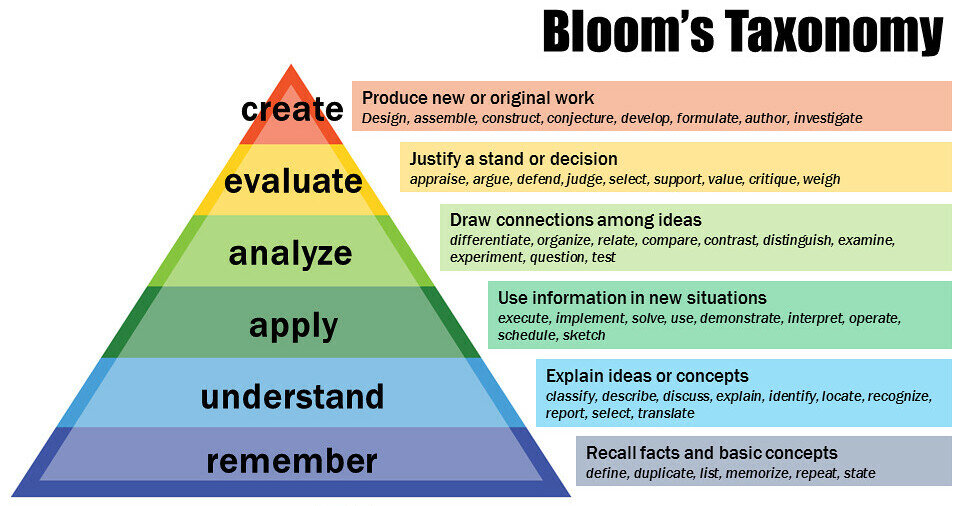
Using these verbs makes success concrete. A student knows exactly what is expected of them, and an instructor knows exactly what to look for when assessing the work. This clarity is a form of equity; it ensures that all students are working from the same set of explicit expectations.
Instead of asking students to know the parts of a cell, ask them to diagram the process of mitosis and predict the outcome if a specific organelle failed. The verb changes everything.
Connecting to the Real World
The final, crucial element of a strong Purpose statement is the bridge to life beyond the classroom. Why does this particular skill or piece of knowledge matter in a professional context? How will it be used in their future career, civic life, or further education? This is the ultimate motivator.
For example, explaining that a lab report's strict formatting isn't arbitrary but mirrors the process for submitting federal grant proposals or peer-reviewed journal articles reframes the entire task. The assignment is no longer just an academic hurdle; it’s professional training. This connection increases student persistence because the work is now imbued with authentic, long-term value.
A transparent Purpose, deconstructed into skills and knowledge and articulated with measurable verbs, turns an assignment from a directive into a shared mission. It tells students not just what to do, but why it's worth doing well.
What is the primary question a well-crafted 'Purpose' statement answers for a student?
An assignment objective is stated as: 'Students will understand the key themes in Shakespeare's Hamlet.' Why is this considered a weak objective according to the principles of a strong Purpose statement?