Mastering the World of Luxury Horology
Mechanical Complications Engineering
Beyond Telling Time
At the heart of high-end horology lies a fascination with mechanical marvels that do more than just track hours and minutes. These features, known as complications, are tiny, spring-powered computers. They solve complex astronomical and logistical problems using nothing but gears, levers, and cams. We're not talking about simple date windows, but intricate systems engineered to solve problems that span years, or even centuries.
A watch complication is any function that goes beyond simply telling the time.
These mechanisms represent the peak of mechanical engineering, condensed to fit on a wrist. Let's look under the dial at the specific engineering challenges these complications solve.
A Calendar with a Memory
A perpetual calendar knows the length of every month, including the irregular 28 days of February and the addition of a 29th day in a leap year. It achieves this not with silicon chips, but through a mechanical memory system. The core of this system is a complex that translates the steady rotation of the watch's gear train into the irregular, multi-year cycle of the Gregorian calendar.
Typically, the central component is a wheel that completes one revolution every four years (or 48 months). This wheel has a complex surface profile of varying heights and notches, effectively a mechanical hard drive storing the length of each of the 48 months in the leap-year cycle. A lever, called a feeler or finger, rests on this wheel. At the end of each month, the feeler drops into the notch corresponding to that month. The depth of the notch determines how far the date-change mechanism advances, instantly jumping from the 28th, 29th, 30th, or 31st to the 1st.
The engineering challenge is immense. The forces involved are tiny, and the tolerances are microscopic. The entire system must function flawlessly for years without intervention, all while being jostled on a person's wrist.
Engineering the Sound of Time
A minute repeater is a complication that chimes the time on demand, usually down to the minute. It's a mechanical marvel of acoustic engineering. When a slide on the case is activated, a separate spring is wound and released, powering a series of racks and cams that read the current time from the watch's hands. These racks then trigger tiny, hardened steel hammers to strike tuned gongs.
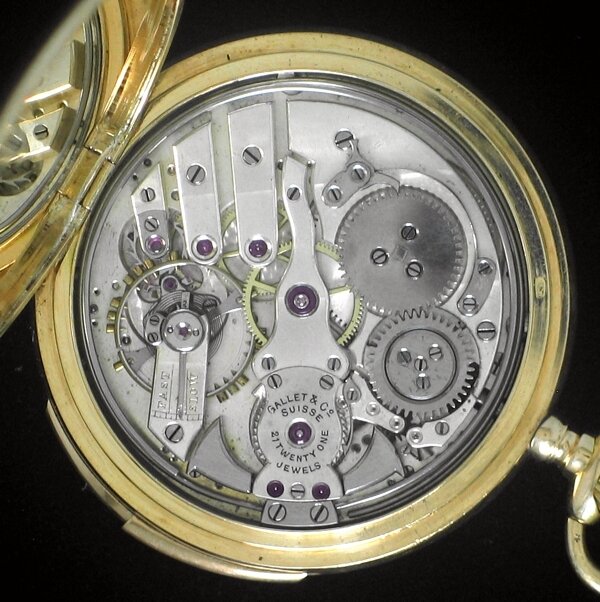
The true art lies in the gongs. They are not bells, but long, hardened steel wires that curve around the inside of the watch case. One gong produces a low note for the hours, while a second produces a high note for the minutes. For the quarter-hours, they are struck in quick succession (ding-dong). The gongs must be tuned perfectly, and their shape and material are critical. Watchmakers like are legendary for their sound quality, a result of decades of acoustic research into metal alloys and case construction. The watch case itself acts as a resonance chamber, amplifying the delicate chime so it can be clearly heard.
The goal is to produce a loud, clear chime with a long, pleasant decay, all from a space no bigger than a coin.
Defying Gravity and Taming Chaos
The was invented to counteract the effect of gravity on a watch's regulating organs. It places the escapement and balance wheel inside a rotating cage that turns, typically once per minute. This averages out the positional errors that gravity induces when a watch is held in different positions, theoretically improving accuracy.
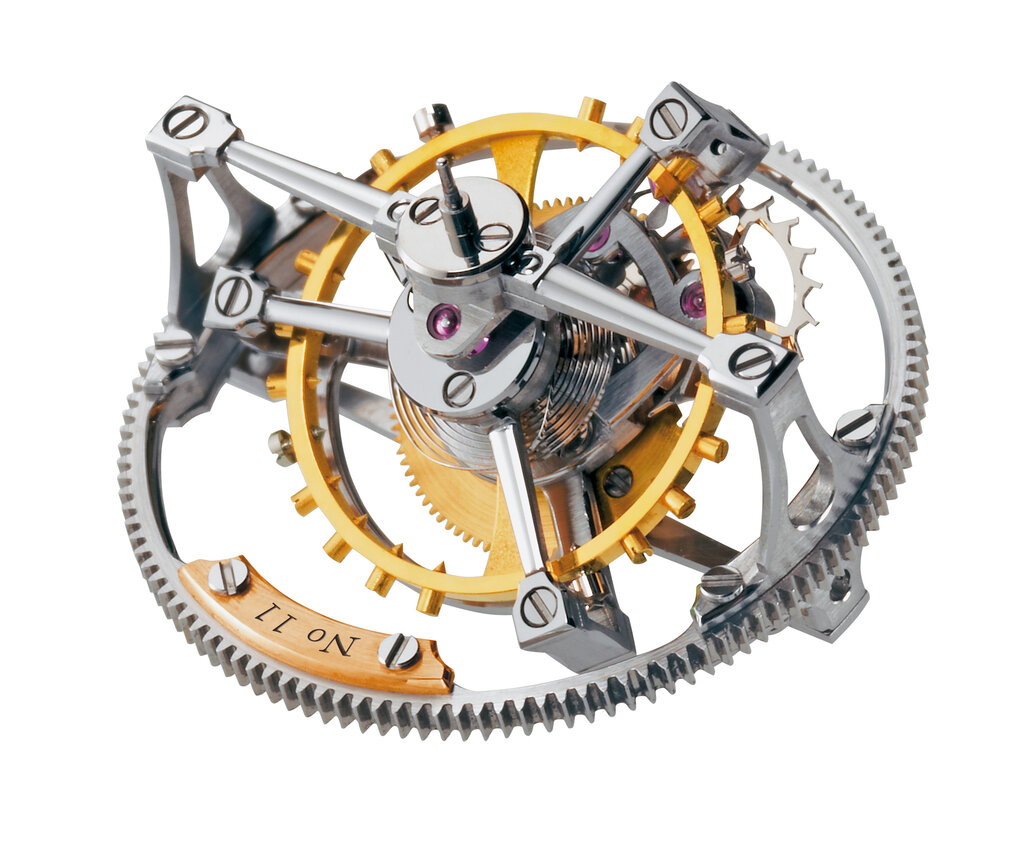
Modern horology has pushed this concept to its limits. A multi-axis tourbillon features a cage rotating on one axis inside another cage rotating on a different axis. This creates a much more complex, three-dimensional rotation designed to compensate for the more dynamic movements of a wristwatch. A Greubel Forsey, for example, might have an inner cage inclined at 30 degrees that completes a rotation in one minute, housed within an outer cage that rotates every four minutes.
A flying tourbillon is a variation supported only from below, without an upper bridge. This makes it appear to float unsupported, offering a clearer view of the mechanism but posing a significant engineering challenge in terms of stability and shock resistance.
Clutch Performance
A chronograph is essentially a stopwatch integrated into a watch movement. A key engineering challenge is how to smoothly engage and disengage the chronograph mechanism from the main timekeeping gear train without disrupting the watch's accuracy. This is the job of the clutch.
The traditional design is the horizontal clutch. It uses a lever to physically push a gear into mesh with the continuously running seconds wheel of the watch. While effective, this can cause the chronograph seconds hand to jump slightly upon starting, as the gear teeth mesh. It is, however, visually appealing and easier to service.
The modern solution is the vertical clutch. It works like the clutch in a car, using two discs that sit on top of each other. The lower disc is always turning with the timekeeping train. When the chronograph is started, the upper disc is lowered onto the spinning lower one. The friction between them provides a smooth, instantaneous start with no hand-jump. This design is technically superior for performance but is often hidden within the movement and is more complex to manufacture.
Time to see if you can connect these complex concepts.
What is the primary component in a perpetual calendar that stores the length of each month in the leap-year cycle?
The primary purpose of a tourbillon is to counteract the effects of gravity on the watch's accuracy.
The engineering behind these complications is a testament to human ingenuity. Each one solves a complex problem with an elegant, purely mechanical solution, turning a simple time-telling device into a piece of kinetic art.