Mastering the World of Fractions
Understanding Fractions
Parts of a Whole
Imagine you have a chocolate bar and you want to share it equally among four friends. You'd break it into four pieces, and each friend would get one piece. That single piece is a part of the whole chocolate bar. Fractions are simply a way to talk about these kinds of parts.
They show up everywhere. When you follow a recipe that calls for a half-cup of sugar, you're using a fraction. When you say it's a quarter past the hour, that's a fraction too. Fractions help us describe amounts that are less than one whole thing.
Fractions represent equal parts of a whole.
Every fraction has two numbers, stacked on top of each other and separated by a line. For example, the fraction one-half is written as . Each number has a specific job.
denominator
noun
The bottom number in a fraction. It shows how many equal parts the whole is divided into.
numerator
noun
The top number in a fraction. It shows how many of the equal parts you have.
Let's think about that chocolate bar again. If you broke it into four equal pieces, the denominator would be 4. If you ate one of those pieces, the numerator would be 1. So you ate of the chocolate bar.
Seeing Fractions
Visualizing fractions can make them much easier to understand. If someone tells you they have three-eighths of a pizza left, you can picture what that looks like.
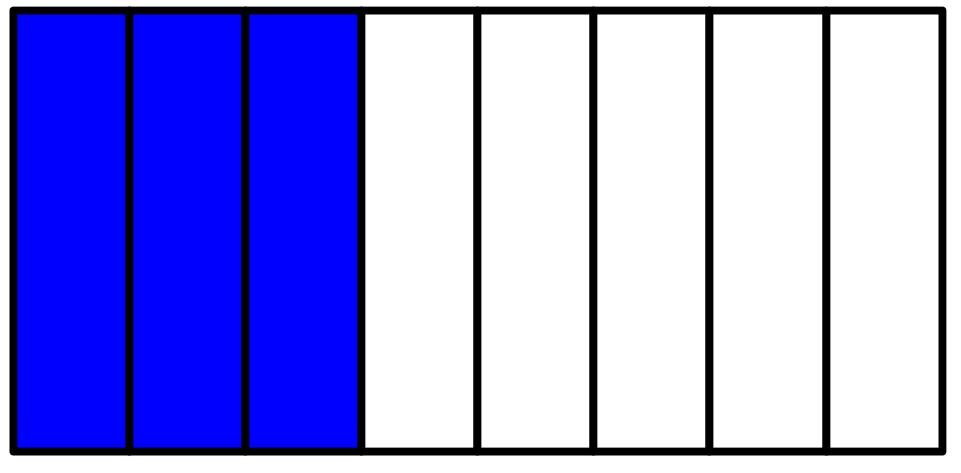
In the image above, the whole rectangle is divided into 8 equal sections. This means our denominator is 8.
Three of those sections are colored blue. This means our numerator is 3. So, the shaded portion represents the fraction .
Thinking about fractions this way helps connect the numbers to a real amount. The denominator tells you the size of the slices, and the numerator tells you how many slices you have.
The next time you cut a sandwich in half or see a pie with a few slices missing, you're looking at fractions in action. It’s a fundamental math concept for dividing and sharing things fairly.