Mastering the Tsukahara Vault
Pre-flight Entry Mechanics
The Tsukahara Entry
The Tsukahara vault family is defined by its entry. Unlike a forward-facing handspring vault, a Tsukahara begins with a round-off onto the vaulting table, redirecting the gymnast's forward momentum into a backward-rotating flip. This transition from a linear run to a complex, multi-axis rotation happens in a fraction of a second. Mastering it requires precise timing and control over three key phases: the pre-table turn, the hand placement, and the block.
The Quarter Turn
The core of the Tsukahara entry is the 1/4 to 1/2 turn that happens before your hands make contact with the vaulting table. This is not a last-second twist. The rotation should begin as you leave the springboard, initiated from your core and hips. Think of it as starting to unscrew a tight lid; the force comes from your entire body, not just your wrist.
As you hurdle towards the table, your shoulders and hips begin to turn in the direction of your round-off. If you round-off to the left, your right hip and shoulder will lead the rotation. This pre-turn aligns your body for the asymmetrical hand placement that follows, ensuring you don't lose momentum by having to correct your path mid-air. The goal is to land on the table already turned sideways, ready to snap your legs over and block.
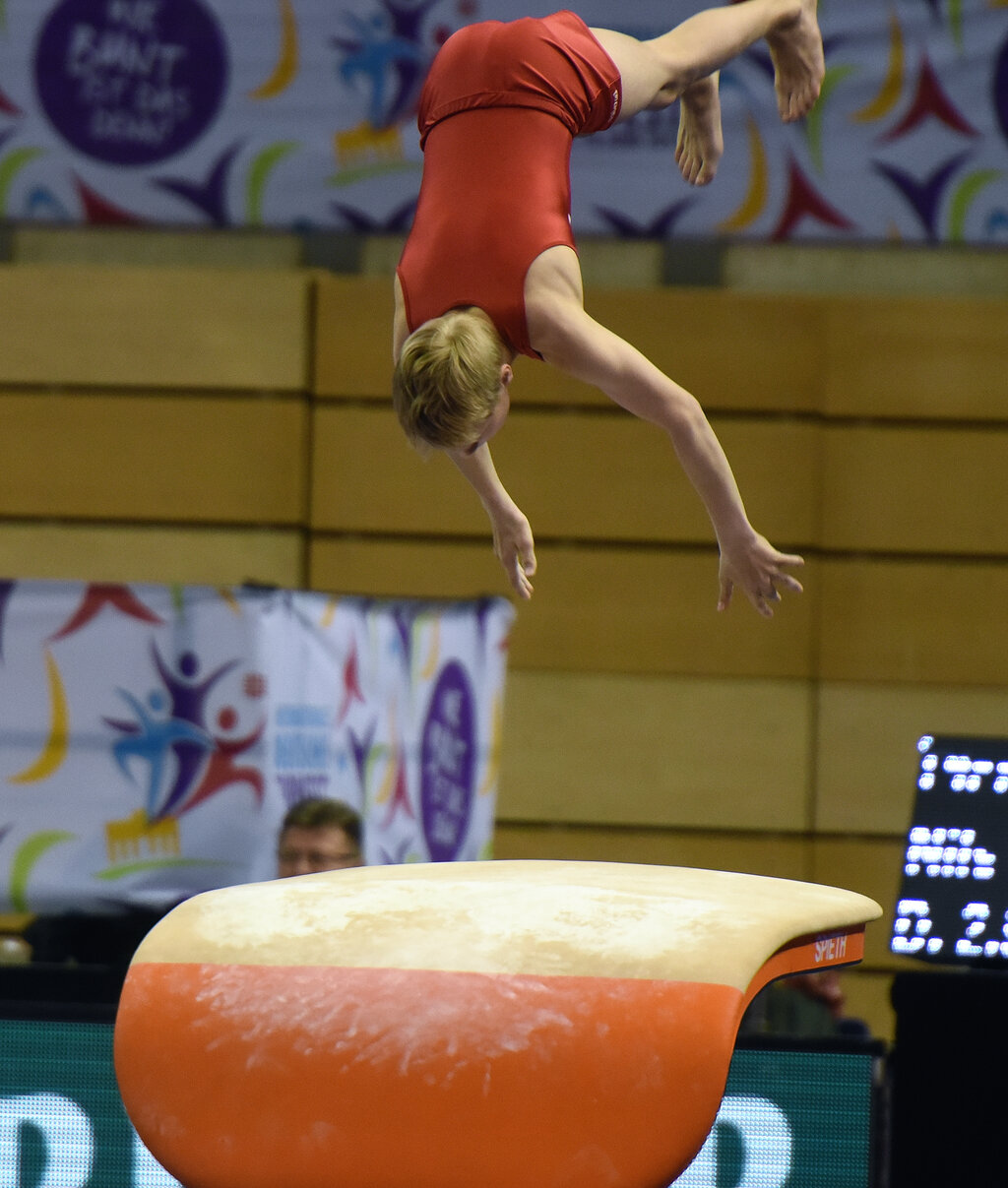
Hand Placement and Blocking
A standard round-off involves placing both hands down at once. For a entry, the placement is asymmetrical. The hand on the side you are turning toward lands first, followed microseconds later by the second hand. For a gymnast turning left, the left hand contacts the table first, pointing slightly inward (around 10 o'clock), followed by the right hand (at 12 o'clock). This staggered placement facilitates the continued rotation of the body over the table.
Once your hands are on the table, the next action is the a powerful, explosive push originating from the shoulders. This is not just pushing off; it's a dynamic repulsion that converts your horizontal speed into the vertical lift and rotation needed for the post-flight saltos. A weak block results in a low, slow vault, while a strong, well-timed block sends you high into the air with ample time to complete your skills.
From Speed to Height
The entire entry sequence is about efficiently transferring energy. Your horizontal velocity from the run-up is the fuel for the vault. The round-off and block are the engine that converts that fuel into height and rotation.
If you can improve your run-up speed, more power will follow in the rest of the vault.
The angle of entry is critical. You want to contact the table with your body in a tight, slightly hollow position, driving your heels over your head rapidly. Your shoulders should remain open and aligned over your hands during the block. If your shoulders close or pike down, you'll absorb the force instead of redirecting it, killing your momentum. The objective is to hit the table and get off it as quickly and powerfully as possible, like a stone skipping across water.
Now, let's test your understanding of these crucial entry mechanics.
What is the defining characteristic of a Tsukahara vault's entry that distinguishes it from a forward-facing handspring vault?
According to the text, when should the gymnast initiate the 1/4 to 1/2 turn for the Tsukahara entry?
With these fundamentals in place, you can build a powerful and consistent Tsukahara vault.