Mastering the Three Trot Variations
Trot Mechanics and Rhythm
The Diagonal Dance
The trot is a two-beat gait with a distinct diagonal footfall pattern. Unlike the four-beat walk, the horse's legs move in diagonal pairs. The right front leg and the left hind leg lift and land together, followed by the left front leg and the right hind leg. Think of it as the horse marching, but with opposite corners of its body moving in sync.
This synchronized movement creates a moment of suspension between each beat. For a split second, all four of the horse's feet are off the ground. This suspension is what gives the trot its characteristic bounce and energy. It's also the reason why learning to sit the trot smoothly is a fundamental skill for any rider. The key is to absorb that upward thrust, not fight against it.
Feeling the Rhythm
From the saddle, the trot feels like a steady 1-2, 1-2 rhythm. This comes from the horse's back, which lifts and falls with each diagonal step. The challenge for the rider is to synchronize their body with this movement. A stiff rider will be bounced out of the saddle, while a relaxed, engaged rider can move in harmony with the horse.
To properly follow the motion, especially when posting, you need to identify which diagonal pair of legs is moving forward. The easiest way to do this is to watch the horse's shoulders. Look down at the outside shoulder (the one closer to the arena wall). When that shoulder moves forward, its corresponding diagonal leg pair (outside foreleg and inside hindleg) is in the air. This visual cue is your guide for rising and sitting at the correct moment. This understanding of animal movement was famously advanced by the photographer in the 19th century.
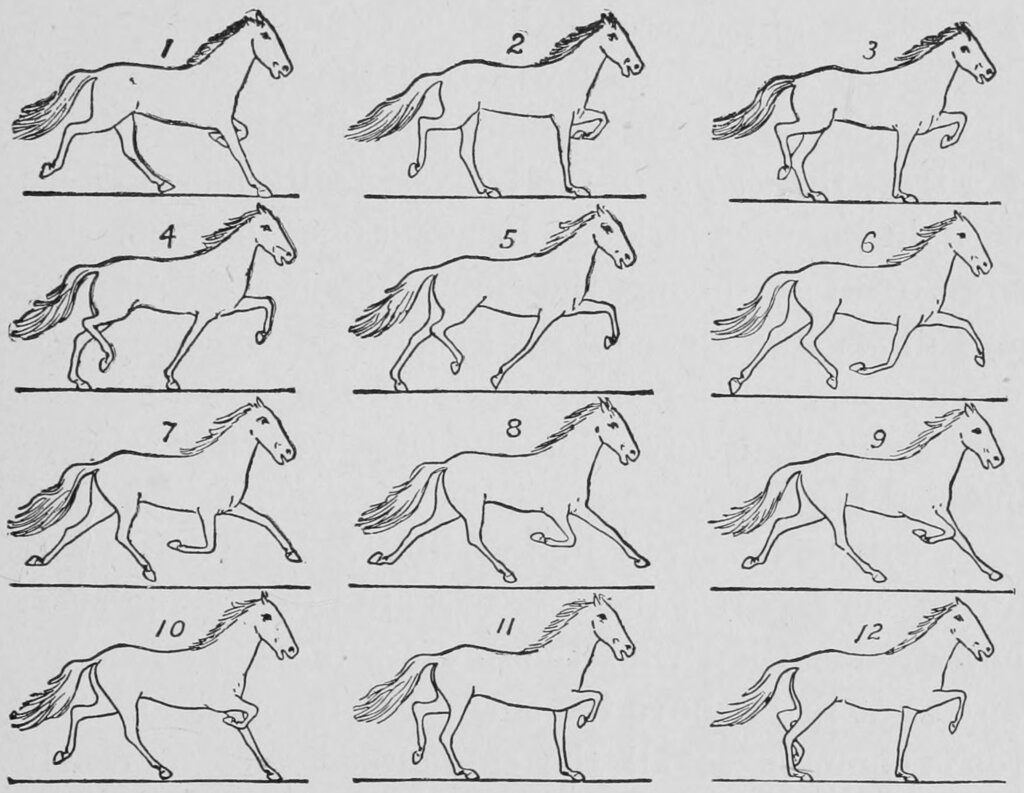
Synchronizing with this movement isn't just about timing; it's about physics. As the horse pushes off from a diagonal pair of legs, it generates an upward thrust that travels through its back and into the saddle. Your job is to manage this force. Engaging your core muscles provides stability, allowing your hips and lower back to absorb the motion like a shock absorber. Rhythmic breathing helps keep your upper body relaxed and prevents you from tensing up against the horse's movement.
A strong core and fluid hips are the keys to a balanced trot. They allow you to absorb the horse's upward thrust without losing your seat.
The Physics of the Bounce
The feeling of being 'bounced' in the trot is a direct result of the vertical displacement of the horse's centre of mass. During each stride, the horse's body lowers slightly as it loads weight onto a diagonal pair of legs and then vaults upward and forward into the suspension phase. The peak of this arc occurs mid-suspension, and the lowest point occurs at mid-stance when a diagonal pair is bearing the most weight.
As a rider, you are positioned directly over this moving centre of mass. The upward acceleration phase is what pushes you out of the saddle. By learning to anticipate this 1-2 rhythm, you can use your core and leg muscles to either absorb the force (for a sitting trot) or flow with it (for a rising trot). The goal is to make your own centre of mass move in harmony with the horse's, creating a picture of seamless unity.
Ready to check your understanding of the trot's mechanics?
What is the defining characteristic of the trot's footfall pattern?
During the trot, there is a moment in every stride where all four of the horse's feet are off the ground.
By breaking down the trot into its mechanical parts, you can better understand how to work with your horse, not against it. Recognizing the diagonal footfalls, feeling the suspension, and managing the upward thrust are the first steps to a truly balanced and effective ride.