Mastering the Thalamus and its Neural Circuitry
Thalamic Nuclear Organization
The Thalamus's Inner Map
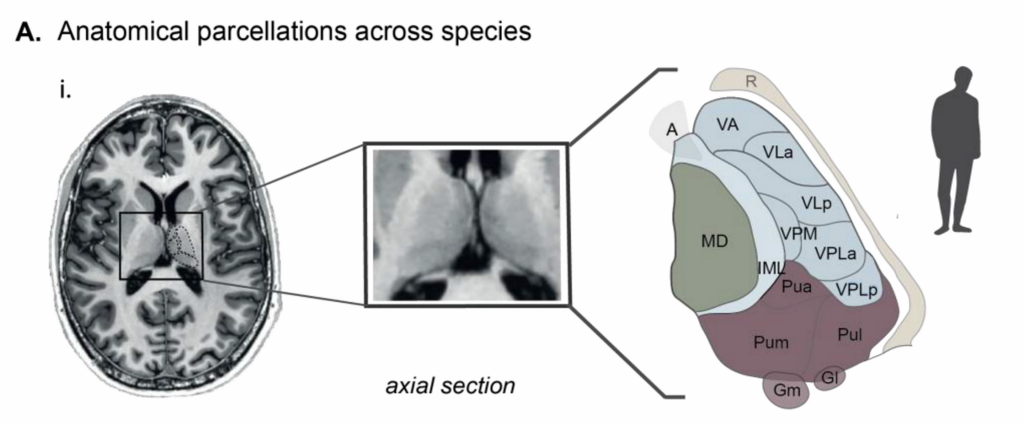
The thalamus isn't a single, uniform structure. It's more like a busy office building with different departments, each handling specific tasks. A Y-shaped sheet of white matter, known as the internal medullary lamina, acts as the building's floor plan. It divides the main part of the thalamus into three large nuclear groups: anterior, medial, and lateral.
Key Nuclear Groups
Each nuclear group has a distinct role, defined by its connections to other parts of the brain.
Anterior Nuclear Group
This group sits at the front of the thalamus. It's a key player in the Papez circuit, a neural loop that is fundamental for memory formation and emotional expression. It receives major input from the mammillary bodies of the hypothalamus and projects primarily to the cingulate gyrus. Think of it as a critical hub linking memory storage with emotional context.
Medial Nuclear Group
This group is dominated by the large mediodorsal nucleus (MD). It has strong, reciprocal connections with the prefrontal cortex, the brain's executive control centre. These connections are vital for higher-order cognitive functions like planning, attention, and judgment. Damage to this area can profoundly affect personality and foresight.
The Diverse Lateral Group
The lateral group is the largest of the three and is further subdivided into tiers, each containing nuclei with specific relay functions. We'll focus on the most prominent ones.
The ventral tier processes sensory and motor information:
- Ventroposterolateral (VPL) nucleus: This is the main relay station for sensory information from the body, including touch, pressure, pain, and temperature. It receives signals via the spinothalamic tracts and medial lemniscus and sends them on to the somatosensory cortex.
- Ventroposteromedial (VPM) nucleus: The VPM does the same job as the VPL, but for the face. It receives sensory information from the trigeminal nerve.
Two other crucial nuclei in the lateral group are responsible for our special senses:
- Lateral Geniculate Nucleus (LGN): This is the primary relay centre for visual information. It receives input directly from the retina via the optic tract and projects to the primary visual cortex in the occipital lobe.
- Medial Geniculate Nucleus (MGN): This is the auditory relay centre. It receives information from the inferior colliculus in the brainstem and sends it to the primary auditory cortex in the temporal lobe.
Essentially, almost all sensory data you perceive—what you see, hear, and feel—must first pass through a specific nucleus in the lateral thalamus before reaching your conscious awareness in the cerebral cortex.
Integrators and Regulators
Not all thalamic nuclei are simple relays. Some have more widespread, regulatory roles.
Intralaminar Nuclei
Embedded within the internal medullary lamina itself are the intralaminar nuclei. They don't relay specific sensory information. Instead, they receive input from various parts of the brainstem's reticular activating system and project diffusely across the entire cerebral cortex. Their main job is to maintain consciousness and alertness. They help
The intralaminar nuclei act like a dimmer switch for the cortex, dialing up arousal and focus when needed.
Midline Nuclei
These are a thin collection of nuclei adjacent to the third ventricle. Like the intralaminar nuclei, they have widespread connections, particularly with the limbic system. They are thought to be involved in memory and arousal.
This intricate organisation allows the thalamus to do much more than just pass signals along. It actively filters, integrates, and modulates the flow of information that ultimately shapes our perception, thoughts, and actions.
A patient experiences a specific loss of touch, pressure, and pain sensation in their face. Damage to which thalamic nucleus is the most likely cause?
Which thalamic nuclear group has strong reciprocal connections with the prefrontal cortex and is vital for executive functions like planning and judgment?