Mastering the Taylor-Couette Reactor Thesis Section
Introduction to Taylor-Couette Reactors
The Taylor-Couette Reactor
Imagine a simple setup: one cylinder spinning inside another, with a fluid trapped in the gap between them. This device, known as a Taylor-Couette reactor, is a powerful tool for controlling how fluids mix and react. The space between the two cylinders is called the annular gap or annulus.
The magic happens when the inner cylinder starts to spin. At low speeds, the fluid flows in smooth, concentric layers—a state known as laminar flow. But as the speed increases, the flow undergoes a dramatic transformation.
The Birth of Taylor Vortices
As the inner cylinder spins faster, centrifugal force pushes the fluid near it outwards. Meanwhile, the fluid near the stationary outer cylinder is slower. When the rotational speed crosses a certain threshold, this difference in forces causes the smooth flow to become unstable. The fluid reorganizes itself into a stunning and highly ordered pattern: a stack of doughnut-shaped, counter-rotating vortices.
vortex
noun
A mass of whirling fluid or air, especially a whirlpool or whirlwind.
These are called Taylor vortices, named after the physicist G.I. Taylor, who first predicted and observed them. Each vortex is a self-contained mixing zone, with fluid moving in a spiral path up or down the annulus before crossing over to the next vortex. This creates a series of distinct, stacked toroidal rings along the length of the cylinder.
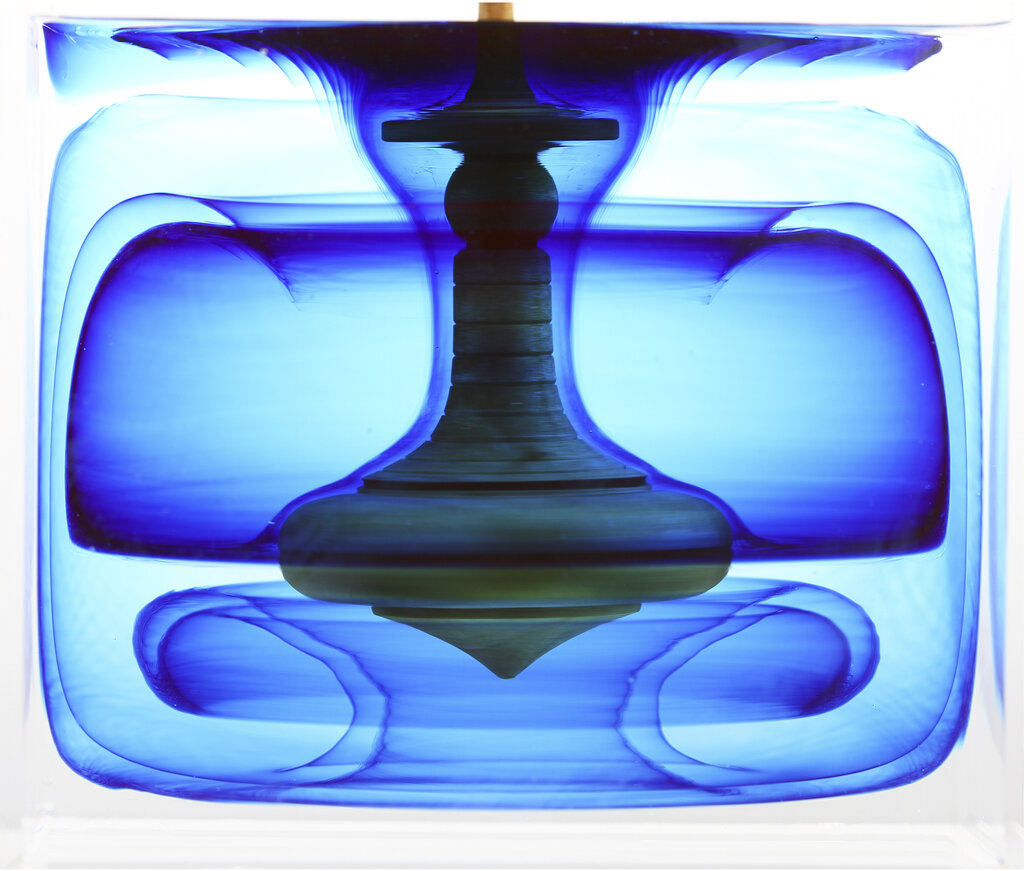
The formation of Taylor vortices marks the transition from simple shear flow to a more complex, three-dimensional flow that is incredibly effective at mixing.
Why This Matters
The structured chaos of Taylor vortices is extremely useful. In a standard stirred tank, mixing can be uneven, with some areas well-mixed while others remain stagnant. Taylor-Couette flow, however, creates uniform and intense mixing throughout the entire volume of the reactor.
This enhanced mixing significantly improves mass and heat transfer. For chemical reactions, it means reactants are brought together more efficiently, leading to faster reaction rates and more consistent products. In biological systems, it ensures cells get uniform access to nutrients and oxygen, improving the yield of bioreactors.
| Application | Benefit of Taylor Vortices |
|---|---|
| Chemical Synthesis | Faster reaction rates, higher yields |
| Bioreactors | Uniform nutrient distribution for cells |
| Crystallization | Control over crystal size and shape |
| Filtration | Reduced fouling of membranes |
Because of these advantages, Taylor-Couette reactors are used in a variety of fields, from manufacturing fine chemicals and pharmaceuticals to studying the fundamentals of fluid dynamics. They provide a controlled environment to study complex flows and their impact on physical and chemical processes.
Ready to check your understanding?
What is the name of the space between the inner and outer cylinders in a Taylor-Couette reactor?
What is the primary force that causes the stable, laminar flow to break down and form Taylor vortices?
By controlling the rotation of two simple cylinders, we can generate complex, predictable, and incredibly useful flow patterns.