Mastering the Sounds of Traditional Japan
Historical Soundscapes
The Roots of Japanese Music
When we talk about traditional Japanese music, we're referring to a rich history of sound known as Hogaku. This isn't just one style of music; it's a vast collection of genres and traditions that have evolved over more than a thousand years.
Hogaku
noun
The collective term for traditional Japanese music, as opposed to Western classical music or modern popular music.
The story of Hogaku begins long ago. During Japan's Nara period (710–794), the country was heavily influenced by its powerful neighbors. Music and instruments from China and Korea traveled across the sea, brought by monks, diplomats, and traders. This imported music laid the foundation for Japan's first great musical tradition.
Music for the Court
By the Heian period (794–1185), these imported styles had been adapted into something uniquely Japanese. This new form of music, called Gagaku, became the official sound of the Imperial Court in Kyoto. It was a refined and highly structured music, performed by elite musicians for aristocrats and important ceremonies. For centuries, Gagaku was the dominant form of music, a symbol of power and high culture, rarely heard by anyone outside the court.
Gagaku
noun
Literally meaning "elegant music," it is the ancient orchestral music of the Japanese Imperial Court. It is the oldest continuously performed orchestral music in the world.
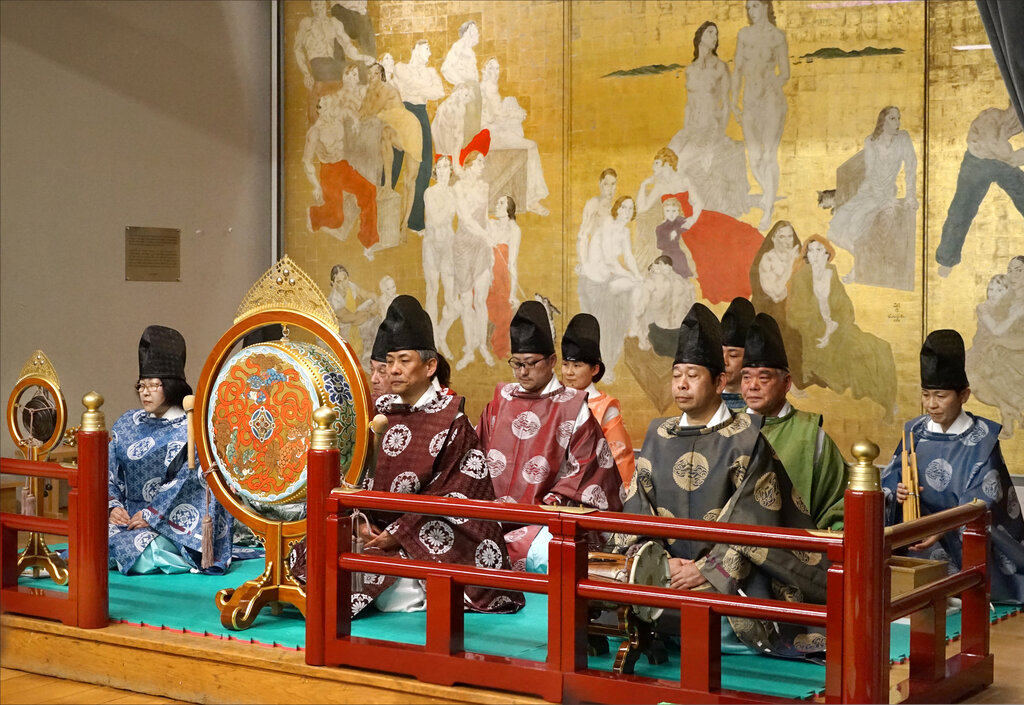
Gagaku is characterized by its slow rhythms, long tones, and precise orchestration. It was designed to create a sense of timelessness and grandeur, fitting for its role in imperial life. The music was passed down meticulously from generation to generation, preserving its ancient form.
Music for the People
Japan changed dramatically during the long and peaceful Edo period (1603–1868). Major cities like Edo (modern-day Tokyo) grew, and a new, wealthy merchant class emerged. These commoners had money to spend on entertainment, and they wanted music that reflected their own lives—stories of love, drama, and daily struggles. Gagaku felt distant and old-fashioned.
This demand fueled a musical boom. New theaters for Kabuki (a stylized dance-drama) and Bunraku (puppet theater) opened, and they needed soundtracks. This new wave of music for the masses was called Zokugaku.
Zokugaku
noun
A category of Japanese traditional music that developed for and was popular among the common people, particularly during the Edo period. It stands in contrast to the aristocratic Gagaku.
Unlike the stately Gagaku, Zokugaku was lively, emotional, and diverse. It included narrative songs, theatrical music, and instrumental pieces. Instruments like the three-stringed shamisen and the long zither called the koto became incredibly popular, defining the sound of the era.
So, while Gagaku was the music of the elite, preserved in the palace, Zokugaku was the music of the streets and theaters, constantly evolving with popular tastes.
Sound and Spirit
Religion also played a key role in shaping Hogaku. Japan's native religion, Shinto, has its own musical traditions called kagura, performed to entertain the gods (kami). This music is often cyclical and hypnotic.
At the same time, Buddhist chanting, known as shomyo, influenced many vocal styles. The meditative and disciplined nature of Buddhist practice can be heard in the controlled breathing and sustained notes found in some Japanese music, particularly for the bamboo flute, the shakuhachi.
From its ancient courtly origins to its flourishing in the bustling cities of the Edo period, Japanese traditional music tells the story of the country itself. The journey from the exclusive Gagaku to the popular Zokugaku reflects a shift from a society ruled by aristocrats to one driven by its common people. Today, these historical soundscapes are preserved as a vital part of Japan's cultural heritage.
What is the overarching term for traditional Japanese music?
The development of Zokugaku during the Edo period was primarily driven by: