Mastering the Sheet Competitive Curling Rules and Strategy
Elite Delivery Mechanics
The Elite Delivery
You already know how to get out of the hack and slide. Now, let's refine that motion into something precise and repeatable. An elite delivery isn't about raw strength; it's about perfecting three interconnected principles: momentum, balance, and release. Mastering these elements transforms a simple slide into a powerful, accurate weapon.
Think of the delivery as a single, flowing movement, not a series of separate steps. Each part should seamlessly transition into the next.
Momentum and the Slide Window
Consistent momentum starts with an efficient weight shift. As you leave the hack, your weight should drive forward, not upward. This creates a stable, gliding platform for the rest of your delivery. Your goal is to establish a clear —an imaginary line running from your hack foot, through the stone, and straight to the skip's broom. Every part of your body should align with this line.
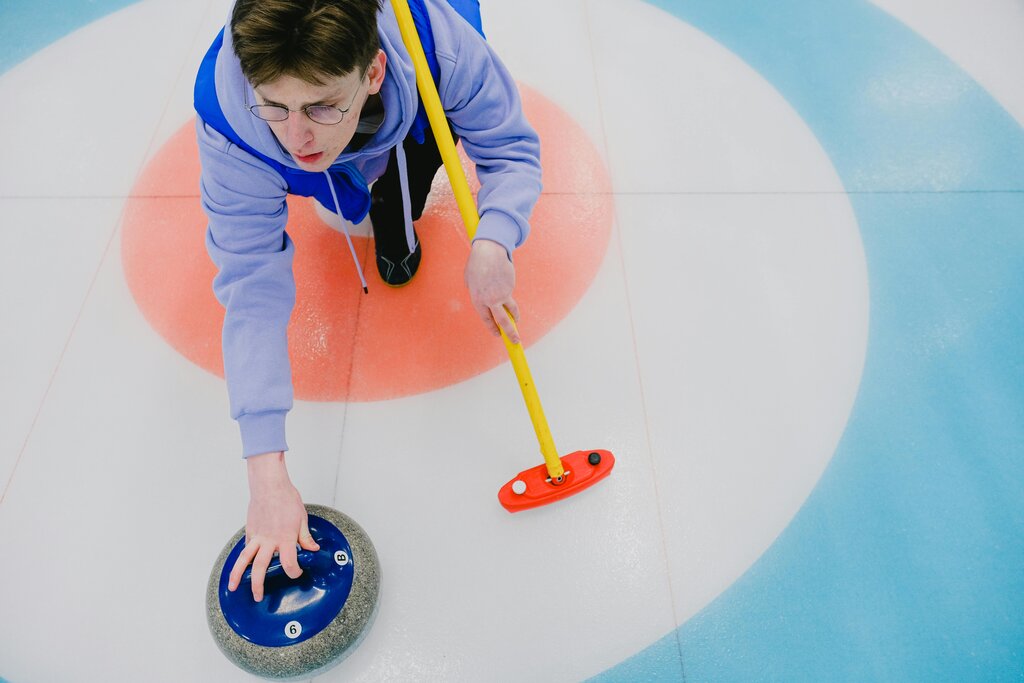
The secret to maximizing this forward momentum is a slight delay in your sliding foot. Instead of pushing your slide foot forward immediately, keep it back for a fraction of a second as your hips and chest drop into position. This delay allows your center of gravity to fall forward, creating a more powerful and controlled slide without needing an aggressive leg drive. You essentially 'fall' into the slide, letting gravity do much of the work. This creates a 'slide window'—the optimal period during your slide where you have maximum stability for a clean release.
Balance and the Release
Perfect lateral balance is non-negotiable. As you slide, your hips and shoulders must remain square to the skip's broom. Any twisting or leaning will pull the stone off its intended path. Your core should be engaged to keep your upper body stable and quiet. A still upper body leads to a consistent release point.
The release itself should feel soft and effortless. You're not throwing the stone; you're simply letting it go. The key is the rotation, applied from your fingers at the 10 o'clock (for an in-turn) or 2 o'clock (for an out-turn) position and gently turning towards 12 o'clock upon release. A professional standard is between 3 and 4.5 full rotations from the hog line to the house. This rotation is what allows the stone to 'curl' or bend its path predictably across the ice. It's this spin that manages the stone's —the spot where it begins to curve most sharply.
Common Faults to Avoid
Two common faults derail even talented curlers: 'dumping' and 'starting' the turn.
Dumping happens when your shoulders or hips open up during the release, causing you to pull the stone across your body. Instead of traveling down the line of delivery, the stone is pushed outward, resulting in a wide miss. This often stems from poor balance or trying to generate power from your upper body instead of your legs.
Starting the turn is the opposite error. It occurs when a player initiates the rotation too early, often by pushing the stone with their thumb or turning their wrist before the release. This causes the stone to wobble or travel straight instead of taking the intended curl. A proper release is generated by the fingers with no wrist or arm involvement. Remember, the release is a quiet, simple extension toward the target.
According to elite curling principles, what are the three interconnected elements that transform a slide into a powerful, accurate delivery?
To create a more powerful and controlled slide, a curler should slightly delay their sliding foot as they leave the hack. What is the main benefit of this technique?
Focusing on these refined mechanics—a delayed slide for momentum, squared alignment for balance, and a soft, precise rotation for the release—is what separates good curlers from great ones.