Mastering the Science of Heart Healthy Gourmet Cooking
Advanced Knife Mechanics
Beyond the Basics
You've mastered the claw grip and know your way around a basic dice. Now, it's time to refine your technique. Advanced knife work isn't about speed or flash; it's about precision. Creating uniform pieces is the key to controlling how food cooks. When every piece has the same size and shape, they all react to heat in the same way, resulting in a perfectly cooked, consistent dish.
Two fundamental precision cuts are the batonnet and the chiffonade. Each serves a different purpose, but both are designed to maximize control over the final texture and flavor of your ingredients.
The Batonnet Cut
The batonnet is the foundation for many other cuts, including the small dice. It refers to cutting vegetables into small sticks, precisely 1/4 inch by 1/4 inch by about 2 inches long. This cut is ideal for firm vegetables like carrots, potatoes, and celery.
Why this shape? The large, flat surface area of the batonnet is perfect for sautéing. It allows for quick, even browning with minimal oil, developing flavor without overcooking the vegetable's interior.
To execute the cut, focus on a smooth gliding motion rather than a forceful chop. Use the tip of your knife as a fulcrum and rock the blade through the vegetable. This 'glide' stroke uses the full length of the blade, resulting in a cleaner cut that preserves the vegetable's cellular structure.
The Chiffonade Cut
For delicate leafy greens and herbs like basil, spinach, or mint, the chiffonade is the technique of choice. The goal is to create fine, consistent ribbons of green.
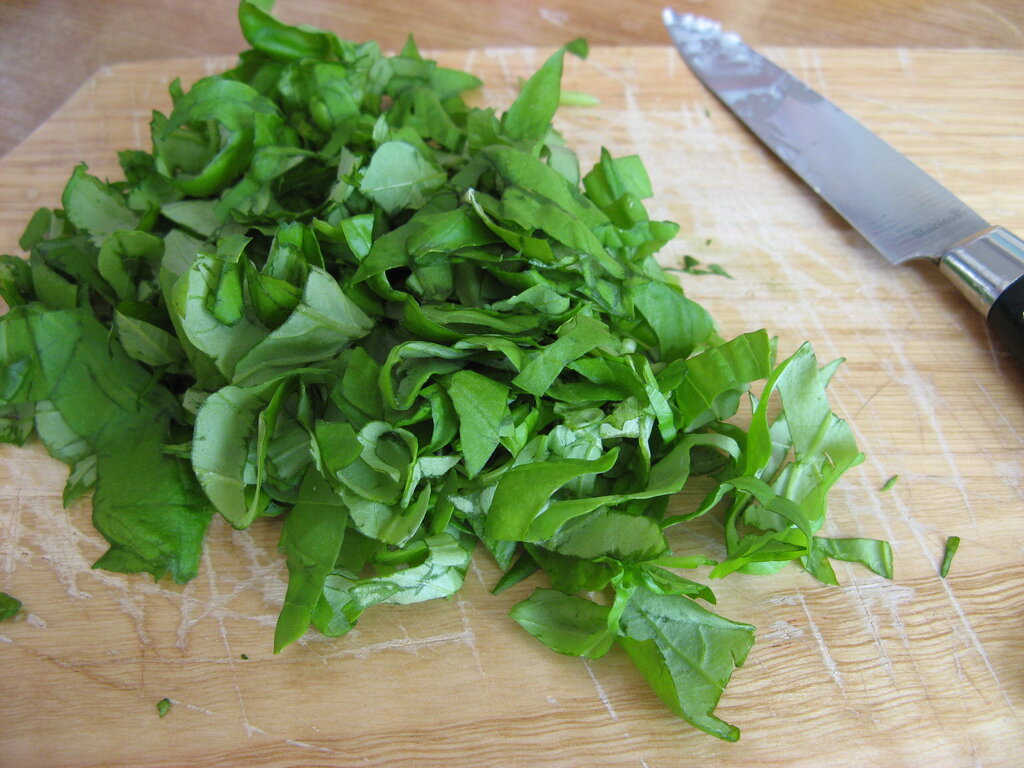
To perform a chiffonade, stack several leaves on top of one another. Roll them tightly into a small cigar-like tube. Then, using the same gliding stroke, slice across the roll to produce thin ribbons. A very sharp knife is crucial here. A dull blade will crush and bruise the delicate leaves, causing them to oxidize and turn brown or black much faster.
A clean cut from a sharp blade severs cell walls neatly, minimizing damage. This preserves not only the appearance and flavor of the herb but also its nutritional content.
Science of the Cut
Why all this fuss about uniformity? It comes down to physics, specifically the surface area to volume ratio. Small, uniform pieces like batonnets have a much higher surface area compared to their volume than large, irregular chunks. This increased surface area allows heat to penetrate quickly and evenly from all sides.
For cooking methods like sautéing, this is a huge advantage. You can cook vegetables rapidly over high heat, achieving a tender-crisp texture without absorbing excess fat. This makes precision cuts a key technique for preparing heart-healthy meals. The food cooks faster, retaining more of its color, texture, and water-soluble vitamins.
Proper blade maintenance is inseparable from advanced technique. A sharp, well-honed knife is not just a tool for safety; it's a tool for preserving the integrity of your ingredients. Clean cuts reduce oxidation, prevent bruising, and are the first step in creating a dish that is as nutritious as it is beautiful.
What is the primary reason for cutting vegetables into uniform pieces?
Which knife cut is most suitable for turning delicate, leafy herbs like basil into fine, consistent ribbons?
Mastering these cuts takes practice, but understanding the mechanics behind them will make you a more precise, efficient, and thoughtful cook.