Mastering the Rider-Waite Tarot for Beginners
Introduction to Tarot
Your First Tarot Deck
If you're new to tarot, the Rider-Waite deck is the perfect place to start. Created over a century ago, it remains one of the most popular and influential decks in the world. Its rich, detailed imagery tells a story, making it easier for beginners to connect with the cards and understand their messages intuitively.
This is a good deck to start with because there are pictures on every card which helps when you are learning.
Many modern decks are based on its structure and symbolism. By learning the Rider-Waite system, you build a strong foundation that will help you read almost any other tarot deck you encounter.
A Deck with a Story
The deck was first published in 1909. The vision behind it came from Arthur Edward Waite, a prominent member of a spiritualist group called the Hermetic Order of the Golden Dawn. Waite wanted to create a tarot deck that was less about fortune-telling and more a tool for spiritual development.
While Waite provided the concepts, the deck's iconic art was created by Pamela Colman Smith, an artist and fellow member of the Order. Her contribution was groundbreaking. Before the Rider-Waite deck, only the Major Arcana cards and court cards were fully illustrated. The numbered suit cards, or “pips,” were often simple arrangements of the suit symbol, much like modern playing cards.
Smith created detailed, narrative scenes for all 78 cards. This innovation made the tarot more accessible, allowing readers to interpret the cards by studying the pictures, not just by memorizing abstract meanings.
The Deck's Two Halves
A standard tarot deck contains 78 cards, split into two main sections: the Major Arcana and the Minor Arcana.
arcana
noun
Secrets or mysteries. From the Latin word arcanum.
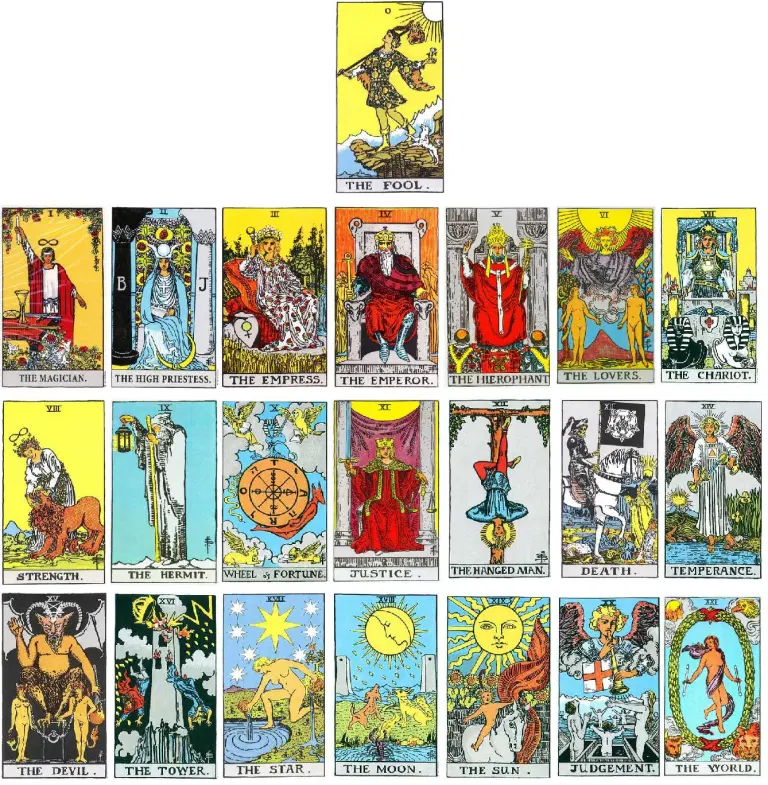
The Major Arcana consists of 22 cards that represent significant life events, spiritual lessons, and major archetypal themes. Think of these as the headline moments in life’s journey, like The Fool starting a new path or The World marking a cycle's completion.
The Minor Arcana contains the other 56 cards. These cards reflect the day-to-day situations, challenges, and joys that make up our lives. They offer guidance on more immediate and practical matters.
| Arcana | Number of Cards | Focus |
|---|---|---|
| Major Arcana | 22 | Major life events & spiritual lessons |
| Minor Arcana | 56 | Everyday situations & practical matters |
The Four Suits
The Minor Arcana is further divided into four suits, each containing 14 cards: ten numbered cards (Ace through 10) and four court cards (Page, Knight, Queen, and King). Each suit is connected to an element and governs a different area of life.
| Suit | Element | Represents |
|---|---|---|
| Wands | Fire | Action, passion, creativity, and ambition |
| Cups | Water | Emotions, relationships, and intuition |
| Swords | Air | Thoughts, challenges, and communication |
| Pentacles | Earth | Material world, finances, work, and health |
Understanding this basic structure is the first step in learning to read tarot. It provides a framework for interpreting the story the cards tell.
Now, let's test your knowledge of the deck's structure.
Who created the iconic illustrations for the Rider-Waite tarot deck?
What was a major innovation that the Rider-Waite deck introduced?