Mastering the Random Walk Problem
Introduction to Random Walks
A Random Stroll
Imagine a person standing on a long line. They flip a coin. Heads, they take one step forward. Tails, one step back. They flip the coin again and take another step. Where will they be after 100 flips? 1,000? It's impossible to say for sure. This simple process is the essence of a random walk.
Random Walk
noun
A mathematical object that describes a path consisting of a succession of random steps on some space.
A random walk is a path traced by a point that moves in a series of discrete, random steps. The direction of each step is determined by chance, like the flip of a coin or the roll of a die. While we can't predict the exact final position, we can use probability to understand the likely outcomes.
A Mosquito Problem
The formal study of random walks began with a practical question. In 1905, the famous biologist and statistician Karl Pearson wrote a letter to the journal Nature. He posed a problem about a mosquito in a field. If the mosquito starts in the center and flies a certain distance in a random direction, then another distance in a new random direction, and so on, how far is it likely to be from its starting point after many flights?
Pearson was trying to model the spread of mosquitoes to combat malaria. He needed a way to figure out how far they could travel from their breeding grounds. This simple question about a mosquito's journey gave birth to a powerful mathematical tool for describing unpredictable processes.
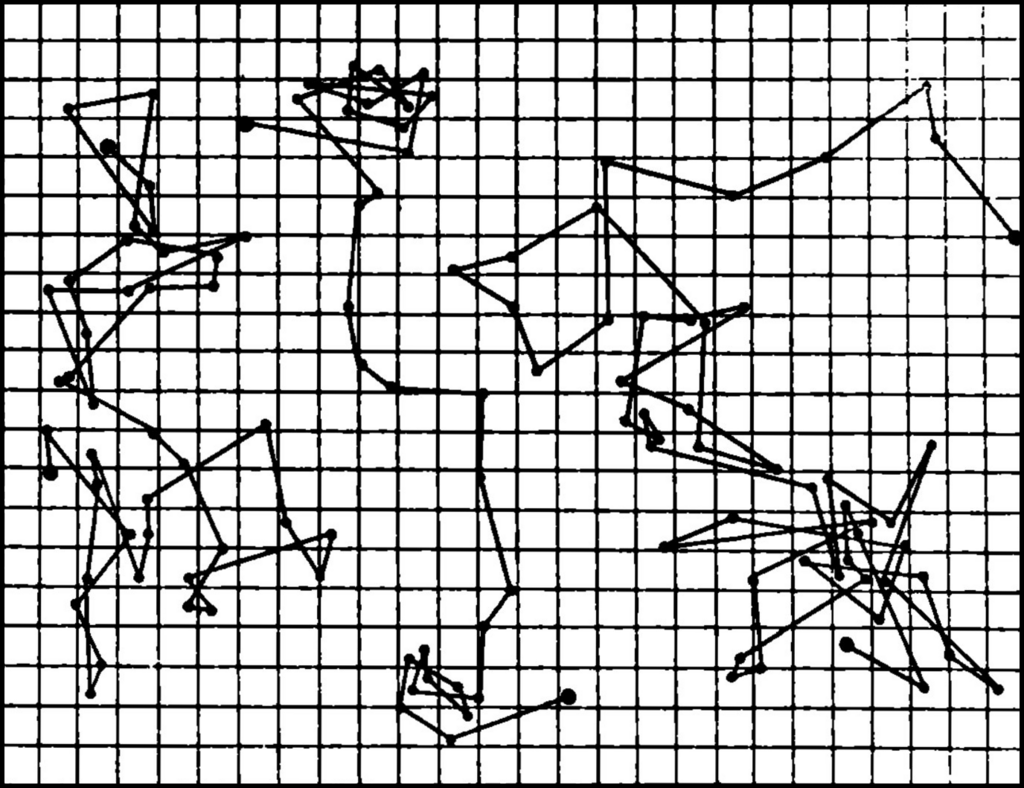
The key insight is that even though each individual step is random, the collective behavior of many steps can be analyzed statistically. We might not know where one specific mosquito will end up, but we can make strong predictions about the general dispersion of a whole population of them.
From Molecules to Markets
Once the idea was formalized, scientists and mathematicians began seeing random walks everywhere. The concept provides a surprisingly effective model for a vast range of phenomena across different fields.
In physics, the jittery, random motion of a pollen grain suspended in water—known as Brownian motion—is a classic example of a random walk. The grain is being constantly bombarded by unseen water molecules, each tiny push acting as a random step.
In biology, the path an animal takes while foraging for food can often be modeled as a random walk, especially when resources are scarce and spread out. In computer science, random walks are used in algorithms to sample large networks like the internet.
Perhaps the most famous application is in finance. The "random walk hypothesis" suggests that stock market price changes are random and cannot be predicted from past movements. In this view, the path of a stock price on a chart is essentially a random walk, making it impossible to consistently outperform the market through technical analysis alone.
The power of the random walk lies in its simplicity. It's a foundational stochastic process, a process driven by randomness. By understanding this basic building block, we can begin to model and make sense of the complex, unpredictable systems that shape our world.