Mastering the Pythagorean Theorem
Algebraic and Geometric Proofs
Beyond the Formula
You've likely memorised the Pythagorean theorem: . But a formula is just a statement. True understanding comes from seeing why it works. The relationship between the sides of a right triangle isn't magic; it's a logical consequence of how squares and triangles fit together. We'll explore two classic proofs that demonstrate this, one using algebra and another relying on pure geometry.
Proof by Rearrangement
One of the most elegant proofs is an algebraic one often attributed to the 12th-century Indian mathematician . It starts not with a triangle, but with a square. Imagine four identical right-angled triangles, each with sides labelled , , and hypotenuse . We can arrange them in two different ways inside a larger square that has sides of length .
In the first arrangement, the four triangles leave a tilted square in the middle. The side of this inner square is the hypotenuse, , so its area is . The total area of the large square is the area of the four triangles plus the area of this inner square.
In the second arrangement, we rearrange the same four triangles. This time, they leave two smaller squares. One square has sides of length (area ), and the other has sides of length (area ). The total area is now the sum of the four triangles and these two squares.
Since both arrangements are inside the exact same large square, their total areas must be equal. This lets us set the two expressions for the area equal to each other.
If we subtract $2ab$ from both sides, we are left with the theorem itself. The geometry of the squares directly proves the algebraic relationship.
Euclid's Geometric Proof
Over a thousand years before Bhaskara, the Greek mathematician laid out a different kind of proof in his foundational work, Elements. His method is purely geometric, relying on the areas of shapes without the algebraic shortcuts we just used. It's a masterclass in logical deduction.
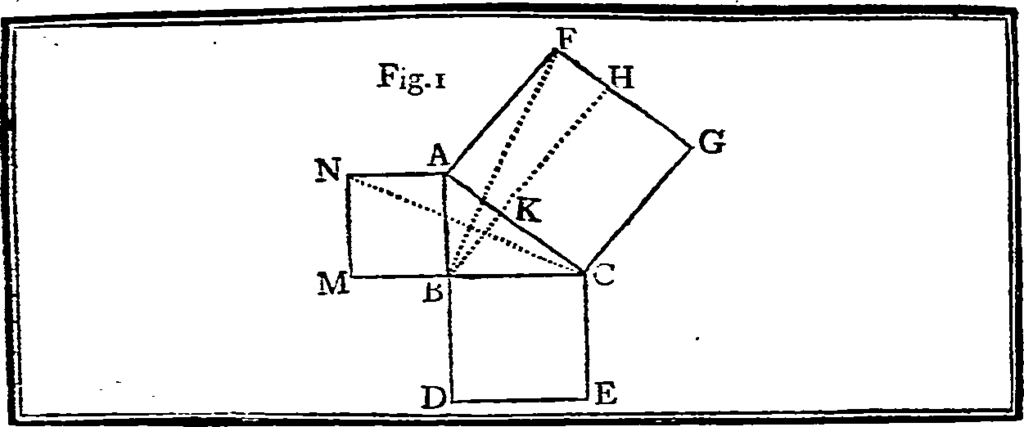
Euclid’s proof starts with a right triangle (let's call it ABC, with the right angle at A). He then constructs squares on each of the three sides. The goal is to show that the area of the large square on the hypotenuse (BC) is equal to the sum of the areas of the two smaller squares on the other sides (AB and AC).
He does this in a few brilliant steps:
-
He draws a line from the right-angle vertex (A) straight down, perpendicular to the hypotenuse. This line divides the large square on the hypotenuse into two separate rectangles.
-
He then shows, through a series of logical steps involving congruent triangles, that the area of the smaller square on side AB is exactly equal to the area of the rectangle on the left.
-
Similarly, he proves that the area of the other small square (on side AC) is equal to the area of the rectangle on the right.
By proving these two equivalences, he demonstrates that the sum of the areas of the two smaller squares must equal the sum of the areas of the two rectangles. And since those two rectangles together make up the large square on the hypotenuse, the theorem is proven.
The Converse
The theorem also works in reverse. This is called the . It states that if you have a triangle with side lengths , , and , and if those side lengths satisfy the equation , then the triangle must be a right-angled triangle. The angle opposite the longest side, , must be a right angle.
This is incredibly useful for construction and navigation. If you need to ensure a corner is perfectly square, you can measure out a triangle with sides in a 3-4-5 ratio. Since , you know the angle opposite the 5-unit side is exactly 90 degrees.
Ready to test your understanding of these proofs?
Bhaskara's algebraic proof relies on arranging four identical right-angled triangles within a larger square. What is the fundamental principle used to prove the theorem?
In Euclid's geometric proof, a line is drawn from the right-angle vertex perpendicular to the hypotenuse. What is the purpose of this line?
Understanding these proofs elevates the Pythagorean theorem from a simple formula to a profound statement about the nature of space and shape. It’s a foundational piece of logic that underpins much of geometry and beyond.