Mastering the Pull-Up
Understanding Pull-Up Mechanics
The Pull-Up Blueprint
A pull-up looks simple: hang from a bar, pull yourself up. But beneath that straightforward motion lies a complex interplay of muscles, leverage, and technique. It’s one of the best tests of upper body strength precisely because it’s not just an arm exercise. It's a full-on collaboration between your back, shoulders, and arms.
The pull-up requires lifting one’s entire body weight against gravity, primarily targeting the large muscles of the back, especially the latissimus dorsi.
Understanding what’s happening in your body is the first step to mastering the movement. It transforms the exercise from a brute-force struggle into a skillful lift. Let’s break down the key players and how they work together.
Your Back's Superstars
The primary engine for a pull-up isn't your biceps; it's your back. The main muscle doing the heavy lifting is the latissimus dorsi, often called the "lats." These are the large, fan-shaped muscles that run down the sides of your back. Think of them as the wings that pull your arms down and in toward your body. When you initiate a pull-up, you should feel your lats engage first.

Working alongside the lats are the trapezius (traps) and rhomboids. These muscles are located in your upper and mid-back, and their main job here is to pull your shoulder blades (scapulae) together and down. This stabilizes your shoulders and creates a strong platform for the pull.
Of course, your arms are essential. The biceps brachii and the underlying brachialis are responsible for flexing the elbow, which is a major part of the movement. Your forearms also work overtime, providing the grip strength needed to simply hang on.
It's All in the Grip
How you grab the bar significantly changes which muscles do the most work. There are three primary grips, each with its own focus.
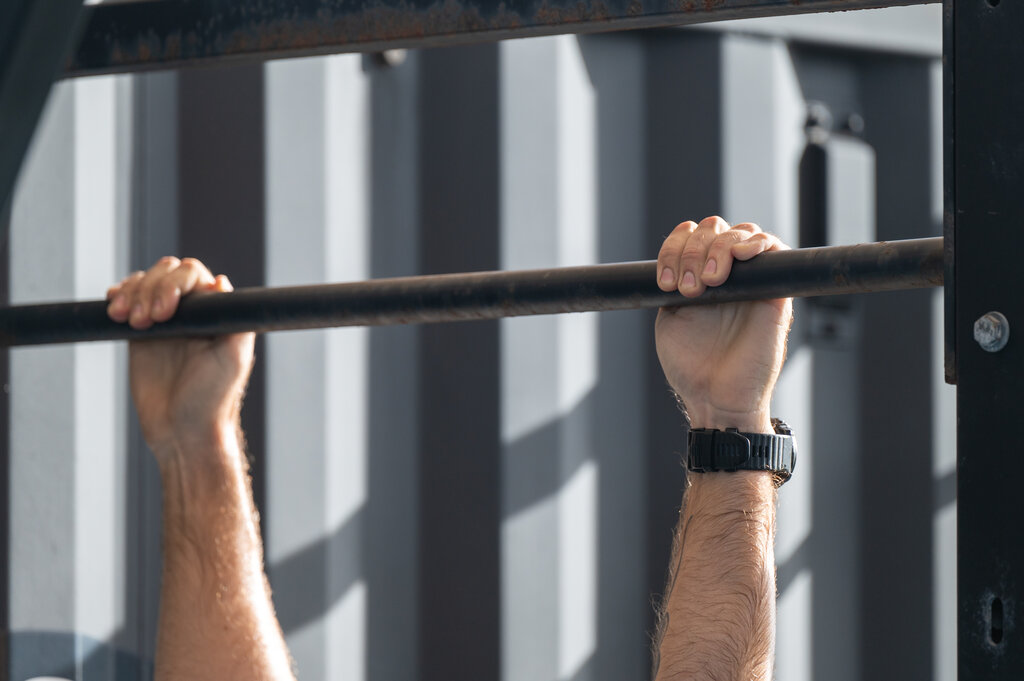
Overhand (Pronated) Grip: This is the classic pull-up. Your palms face away from you, and your hands are typically placed slightly wider than your shoulders. This grip maximizes the engagement of your lats.
Underhand (Supinated) Grip: Often called a chin-up, this is where your palms face toward you. This position recruits your biceps much more heavily, making it a bit easier for many beginners. The lats are still working hard, but the biceps share more of the load.
Neutral Grip: Your palms face each other, as if you were about to applaud. This grip is a happy medium, putting your shoulders in a very stable and natural position. It balances the work between your lats and biceps effectively.
The Movement Deconstructed
A pull-up isn't just one movement, but a sequence. Breaking it down helps clarify the mechanics.
1. The Dead Hang: The starting point. You're hanging from the bar with your arms fully extended and your shoulders relaxed but engaged. Your body should be in a straight line, with your core tight to prevent swinging. This is an active hang, not a passive one.
2. Scapular Retraction: This is the most crucial and often-missed first step. Before you bend your arms, pull your shoulder blades down and back. Your body will rise slightly without you even bending your elbows. This action properly engages your lats and sets your shoulders in a safe, powerful position.
Initiate the pull with your lats instead of your arms.
3. The Pull: Now, drive your elbows down and back towards your ribs, thinking about pulling the bar to your chest. Your biceps will engage to bend your arms, but the primary force should come from your back muscles squeezing together. Continue pulling until your chin clears the bar.
4. The Descent: The work isn't over. Control your movement back down to the starting position. Don't just drop. Lowering your body slowly, known as the eccentric phase, builds significant strength and reinforces good form. Aim for a descent that lasts at least two seconds.
Proper form is non-negotiable. Using momentum, kipping, or not going through the full range of motion might get your chin over the bar, but it cheats you out of the strength-building benefits and increases your risk of injury. Every rep should be clean, controlled, and deliberate.
What is the primary muscle group responsible for the pulling motion in a standard pull-up?
According to proper form, what is the very first movement you should initiate from a dead hang?
By understanding these mechanics, you can approach the pull-up with intention, making every attempt a productive step toward your goal.