Mastering the Psychology of Wealth
Bias Interplay in Markets
The Pull of the Disposition Effect
Investors often act against their own best interests. One of the most common ways this happens is through the disposition effect. It’s the tendency to sell assets that have increased in value while holding onto assets that have dropped in value. Essentially, we lock in our winners too early and let our losers run too long.
Disposition Effect
noun
The tendency for investors to sell assets that have increased in value, while keeping assets that have dropped in value.
Why does this happen? It’s a mix of emotions. When a stock is up, the fear of losing those paper gains becomes powerful. We sell to make the profit 'real' and feel the satisfaction of a win. When a stock is down, hope takes over. We hold on, waiting for it to return to the price we paid, because selling would mean admitting a mistake and making the loss concrete. This behaviour is directly linked to loss aversion, where the pain of a loss feels much stronger than the pleasure of an equivalent gain.
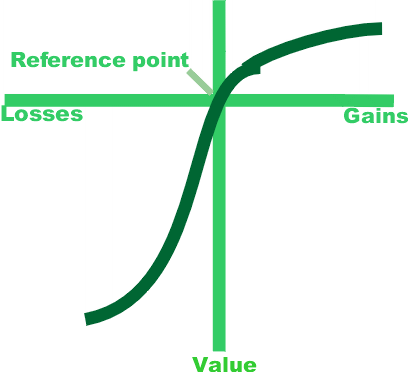
For example, imagine you buy two different stocks for $100 each. Stock A rises to $120, while Stock B falls to $80. The disposition effect predicts you’ll be tempted to sell Stock A to lock in the $20 profit. Meanwhile, you'll likely hold onto Stock B, hoping it will climb back to $100 so you can 'break even', even if its future prospects are poor.
When Biases Collide
Individual biases are powerful, but they become explosive when they interact and spread through a market. This is how speculative bubbles are born. A bubble starts when an asset's price begins to rise, often due to a genuinely promising new technology or economic shift. Early investors make money, and their success stories attract more people.
This is where herd behaviour kicks in. As more investors pile in, they create social proof that buying is the right decision. The rising price itself becomes the justification for buying, regardless of the asset's underlying value. This upward spiral is fueled by overconfidence ('I can't lose') and anchoring, where investors fixate on recent high prices as the new normal.
The dot-com bubble of the late 1990s is a classic example. Many internet companies with no profits, or even revenue, saw their stock prices soar as investors, caught in a wave of collective excitement, abandoned traditional valuation metrics.
When the bubble eventually pops, the same psychological forces work in reverse. Fear replaces greed, and the herd rushes to sell, causing a dramatic crash. The interaction of these biases creates volatility far beyond what economic fundamentals would suggest.
Momentum vs. Mean Reversion
The market is a constant psychological tug-of-war between two opposing beliefs: momentum and mean reversion.
Momentum investing is driven by the idea that trends will continue. Psychologically, it’s powered by herd behaviour and confirmation bias. As a price rises, investors look for information that confirms their decision to buy, ignoring negative signs. The fear of missing out (FOMO) is a powerful accelerant, pushing more and more people to chase the trend.
Mean reversion is the opposite. It’s the belief that asset prices will eventually return to their long-term average or fundamental value. This camp is populated by value investors who see a rising stock not as an opportunity, but as an overvalued asset due to be corrected. They are looking for bargains, buying assets that have fallen below their historical average.
These two forces are always at play. Momentum can dominate for long periods, creating bubbles and strong trends. But over the long term, mean reversion often has the final say, as prices can't disconnect from their underlying value forever.
Limits of Arbitrage
If bubbles and anomalies are so obvious, why don't rational traders, or 'arbitrageurs', simply bet against them and correct the prices? This is where the theory of efficient markets meets the messy reality of human psychology.
Arbitrage is often risky and costly. A rational trader might know an asset is overvalued, but short-selling it is dangerous. The bubble could continue to inflate for a long time, forcing the arbitrageur to cover their position at a huge loss. They face the risk that the market can stay irrational longer than they can stay solvent.
Incorporating investment strategies built around behavioral finance theories like momentum and trend following in a portfolio can materially reduce losses from shifts in investor sentiment, and enhance diversification and risk-adjusted returns.
Furthermore, if a mispricing is driven by a widespread, deeply held belief, there may not be enough rational capital available to fight the trend. This is why anomalies can persist for months or even years. The smart money doesn't always win, at least not right away.
An investor bought two stocks, X and Y, for $50 each. Stock X is now worth $70, and Stock Y is worth $30. According to the disposition effect, what is the investor most likely to do?
Which psychological factor is a primary driver in the formation of speculative bubbles, causing investors to buy an asset simply because its price is rising?
Understanding how these biases interplay is key to navigating the emotional currents of the market.