Mastering the Product Operating Model
Product Model Shift
Beyond the Feature Factory
In a traditional, project-centric world, a Solution Architect's role often starts with a detailed list of requirements. The business has decided what to build, and your job is to figure out how. This model, often called a "feature factory," is great at shipping code. The problem is, shipping code isn't the same as delivering value.
Teams work on fixed-scope projects, get disbanded, and then re-formed for the next initiative. Success is measured by whether the project was delivered on time and on budget. But a critical question often goes unanswered: Did we actually solve the underlying business problem?
The Product Operating Model
A more effective approach is the Product Operating Model, a concept championed by Silicon Valley veteran of the Silicon Valley Product Group. This model reframes the goal entirely. Instead of giving teams a list of features to build, you give them problems to solve.
This approach empowers cross-functional teams, each balancing three critical concerns:
- Value and Viability: Will customers pay for this? Does it work for our business? (Product Manager)
- Usability and Desirability: Can users figure out how to use it? Do they want it? (Product Designer)
- Feasibility: Can we actually build this with the technology, skills, and time we have? (Lead Engineer / Architect)
As an architect, you are the pillar of feasibility. Your role shifts from being a recipient of requirements to a strategic partner in discovery. You're not just asked "can we build this?" but "what are the different ways we could solve this problem, and what are the trade-offs?"
The core shift is from a team that builds features to a team that solves business problems.
Project vs. Product Mindset
This transformation requires a fundamental change in how teams think about their work. It's less about managing a temporary project and more about stewarding a long-lived product.
| Mindset | Project-Centric | Product-Centric |
|---|---|---|
| Focus | Outputs (Features delivered) | Outcomes (Business results) |
| Funding | Upfront for a fixed scope | Continuous, based on value |
| Teams | Temporary, assembled per project | Persistent, dedicated to a problem space |
| Goal | Deliver on time and on budget | Achieve a measurable business objective |
| Risk | Risk of building the wrong thing | Risk of not solving the problem |
| Success | Hitting a launch date | Moving a key metric |
In the product model, your architectural decisions are not just technical implementations; they are business enablers. You are constantly thinking about how the system's design can support future iteration, experimentation, and scalability to achieve the desired outcomes.
Rethinking Roadmaps and Metrics
This new mindset changes how we plan and measure success. Traditional roadmaps are often a list of features plotted on a timeline. The problem with this is that it commits the team to building specific solutions before validating that those solutions actually solve the problem. It prioritizes outputs over outcomes.
shift the focus. Instead of listing features, they articulate the customer or business outcomes the team aims to achieve. For example, instead of "Build a new dashboard," the roadmap item would be "Reduce customer support ticket volume by 25%."
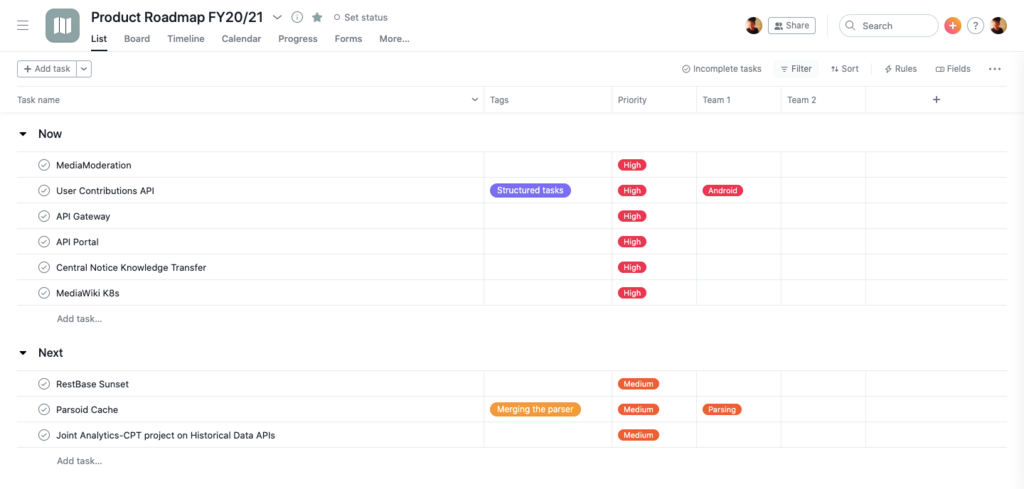
This gives the team—including the architect—the creative freedom to figure out the best way to achieve that goal. Maybe a new dashboard isn't the answer. Perhaps a better search function, improved in-app guidance, or an automated chatbot would be more effective and technically simpler. As the architect, you are now a key player in that discovery process.
Success metrics also evolve. While Key Performance Indicators (KPIs) are still important for monitoring the ongoing health of a system (e.g., uptime, latency), the focus for new initiatives shifts to Objectives and Key Results ().
A KPI tells you if your ship is running smoothly. An OKR tells you if you're sailing toward the right destination.
An Objective is an ambitious, qualitative goal, like "Improve user onboarding satisfaction." The Key Results are the measurable outcomes that prove you achieved it, such as "Increase completion rate of the setup wizard from 60% to 90%" and "Reduce support tickets from new users by 50%."
As a Solution Architect in a product-led organization, you're not just executing a plan. You're a vital partner in shaping the strategy, defining what's possible, and building resilient systems that deliver continuous value.
What is the primary difference between a traditional "feature factory" approach and the Product Operating Model?
In a cross-functional product team, the Solution Architect is primarily responsible for which concern?
This shift in mindset is foundational for modern architects looking to maximize their impact.