Mastering the Piper Archer Landing
Aircraft Familiarization
The Pilot's Office
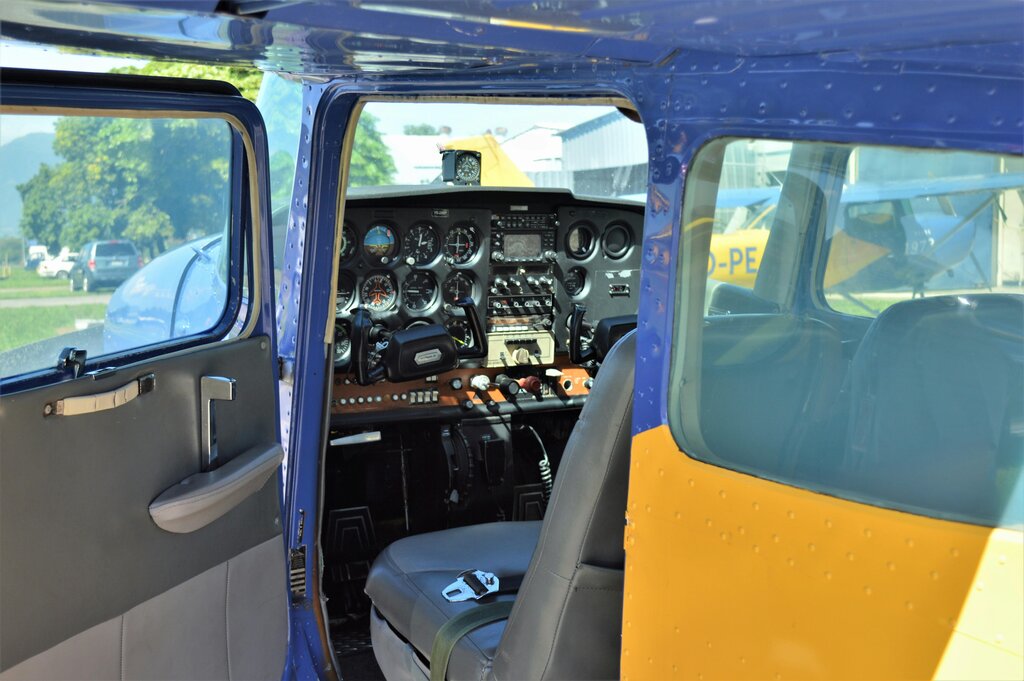
Welcome to the cockpit of the Piper Archer. Think of it as your office in the sky. Everything is placed logically to help you fly safely and efficiently. Directly in front of you is the main instrument panel, which holds all the gauges and screens that tell you what the aircraft is doing. The control yoke, which looks a bit like a steering wheel, is what you'll use to guide the plane through the air.
Between the two front seats, you'll find the throttle quadrant. This is where you control the engine's power. Down at your feet are the rudder pedals, which help you steer on the ground and make coordinated turns in the air. The design philosophy is simple: the most critical information and controls are right in front of you or within easy reach.
Primary Flight Controls
An aircraft moves in three dimensions: pitch, roll, and yaw. You control these movements using the yoke and rudder pedals.
- Pitch: Pulling the yoke back or pushing it forward moves the elevator on the tail. This raises or lowers the nose of the aircraft, controlling its climb or descent.
- Roll: Turning the yoke left or right moves the ailerons on the wings. This causes one wing to lift and the other to drop, banking the aircraft into a turn.
- Yaw: Pushing the left or right rudder pedal moves the rudder on the tail. This swings the nose of the aircraft left or right.
During a landing, you'll use all three controls in concert. You'll pitch the nose up to slow down and flare just before touchdown. You'll use roll to stay aligned with the runway centerline, especially in a crosswind. And you'll use the rudder to keep the plane flying straight and coordinated.
Engine and Systems
Managing the engine is crucial, especially during landing when you need precise control over your speed and descent rate. The primary engine controls are in the throttle quadrant.
- Throttle (Black Knob): Pushing it in increases engine power; pulling it out decreases power. This is your main tool for controlling airspeed and altitude.
- Mixture (Red Knob): This adjusts the fuel-to-air ratio. For landing, it's typically set to 'full rich' (pushed all the way in) to ensure maximum power is available if you need to abort the landing and go around.
On the instrument panel, you'll monitor key engine gauges like the tachometer, which shows engine speed in RPM (revolutions per minute). You'll also keep an eye on oil pressure and temperature to ensure the engine is healthy. During the approach, you will make small, smooth adjustments to the throttle to maintain a stable descent.
Avionics for Approach
The avionics, or aviation electronics, provide the information you need to fly the plane accurately. For a visual landing, the most important instruments are often called the "six pack."
| Instrument | Function During Landing |
|---|---|
| Airspeed Indicator | Shows your speed through the air. Critical for maintaining a safe approach speed. |
| Attitude Indicator | Displays the aircraft's orientation relative to the horizon. Helps you keep the wings level. |
| Altimeter | Shows your altitude above sea level. Used to judge your height in the landing pattern. |
| Turn Coordinator | Indicates the rate and quality of your turn. Helps you make smooth, coordinated turns. |
| Heading Indicator | Shows your magnetic heading. Used to align with the correct runway. |
| Vertical Speed Indicator | Displays your rate of climb or descent. Helps you maintain a stable descent rate. |
Another key system for landing is the flaps. These are surfaces on the trailing edge of the wings that can be extended. Extending the flaps increases both lift and drag. This allows you to fly at a slower speed and make a steeper approach without building up excess speed, giving you a better view of the runway and a shorter landing roll.
With a solid understanding of these controls and instruments, you can manage the aircraft precisely through the critical phases of flight.
To initiate a bank to the left, what is the primary control input you should make?
What is the primary function of extending the flaps during a landing approach?
This familiarity with the cockpit is the foundation of good piloting. Knowing where everything is and what it does allows you to focus on the most important task: flying the plane.