Mastering the Photographic Eye
Gestalt Principles Foundations
Your Brain on Photography
You've learned how to control light with aperture, shutter speed, and ISO. Now, let's talk about controlling something just as important: the viewer's brain.
Our minds are hardwired to find order. When we look at an image, our brain isn't just passively receiving information. It’s actively working, grouping, and organizing visual elements into a coherent whole. This automatic process is the foundation of Gestalt psychology, a theory that explains how we perceive patterns and structure.
Gestalt
noun
A German word meaning “unified whole.” It refers to theories of visual perception that describe how people tend to organize visual elements into groups or unified wholes when certain principles are applied.
By understanding these principles, you can move from simply capturing a subject to intentionally composing an image that guides the viewer's perception. You can create clarity, build connections, and tell a more compelling story.
Creating Groups
The first step is understanding how the brain naturally clusters objects together. Two of the most powerful principles for this are proximity and similarity.
The Law of Proximity states that objects positioned close to one another are perceived as a single group. The individual elements are seen less as individuals and more as one collective unit.
Think of a small group of people standing together at a party, a cluster of boats moored at a dock, or a grove of trees in a field. Even if the individual elements are different, their closeness binds them together visually. You can use this to create relationships between subjects in your frame. Placing two people close together implies a connection, while separating them suggests distance, emotional or physical.
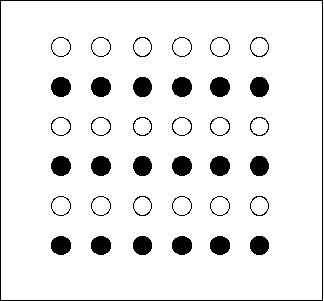
Similarity works in a similar way, but instead of relying on distance, it relies on shared characteristics. The Law of Similarity suggests we group things that share a common color, shape, size, or texture.
A single yellow flower in a field of red ones will stand out, but three yellow flowers will form a visual group, connected by their shared color. This principle allows you to create harmony and rhythm in a photo, or intentionally break that pattern to draw attention to a specific element.
Guiding the Eye
Beyond grouping, you can direct how a person's eye moves through your photograph. The brain wants to follow paths and complete puzzles, and you can use that to your advantage.
Continuance is the principle that the human eye will follow the smoothest path when viewing lines, regardless of how the lines were actually drawn. This can be a literal line, like a road or a fence, or an implied line, like the direction of a subject's gaze.

A winding river guides the eye from the foreground to the background, creating a sense of depth and journey. When photographing a person, the direction they are looking creates a powerful invisible line. Viewers will instinctively look where your subject is looking.
Another powerful tendency is our brain's desire for completion. The Law of Closure explains that our minds will often fill in the gaps to perceive a complete object, even if parts of it are missing or obscured.

This is why we can recognize a face from a simple caricature or see a shape suggested by just a few points of light. In photography, you can use closure by partially obscuring your subject with something in the foreground. This technique adds depth and invites the viewer to mentally complete the image, making them more engaged.
Separating Subject from Scene
Finally, one of the most fundamental acts of perception is separating a subject from its background. This is known as the figure-ground relationship.
The 'figure' is the element that is the focus of our attention, while the 'ground' is the undifferentiated background. A classic example is seeing words on a page; the text is the figure, and the white page is the ground.
In photography, you create a strong figure-ground relationship by making your subject distinct from its surroundings. You can achieve this using contrast in brightness or color. A brightly lit person against a dark background is a clear figure. You can also use depth of field, as a sharp subject against a blurry background instantly separates the figure from the ground.
Mastering this relationship is key to avoiding cluttered, confusing images. When the viewer can't easily tell what the subject is, the photograph loses its impact.
Figure/Ground relationships shape visual perception
By consciously applying these principles—proximity, similarity, continuance, closure, and figure-ground—you can bring a new level of intention and psychological depth to your work.
According to the principle of Proximity, what is the most likely interpretation a viewer will make when seeing two people standing very close together in a photograph?
A photographer captures an image of a flock of white seagulls flying, with a single black crow among them. Which Gestalt principle explains why the seagulls are perceived as one group and the crow as a separate element?